
Scientific Roman Spaghetti Carbonara: The Zero-Cream Emulsion Masterclass
Master the physics of authentic Roman Carbonara: achieve a glossy, silk-like sauce using guanciale lipid rendering and starch-water suspension without scrambling egg proteins.
Instructions
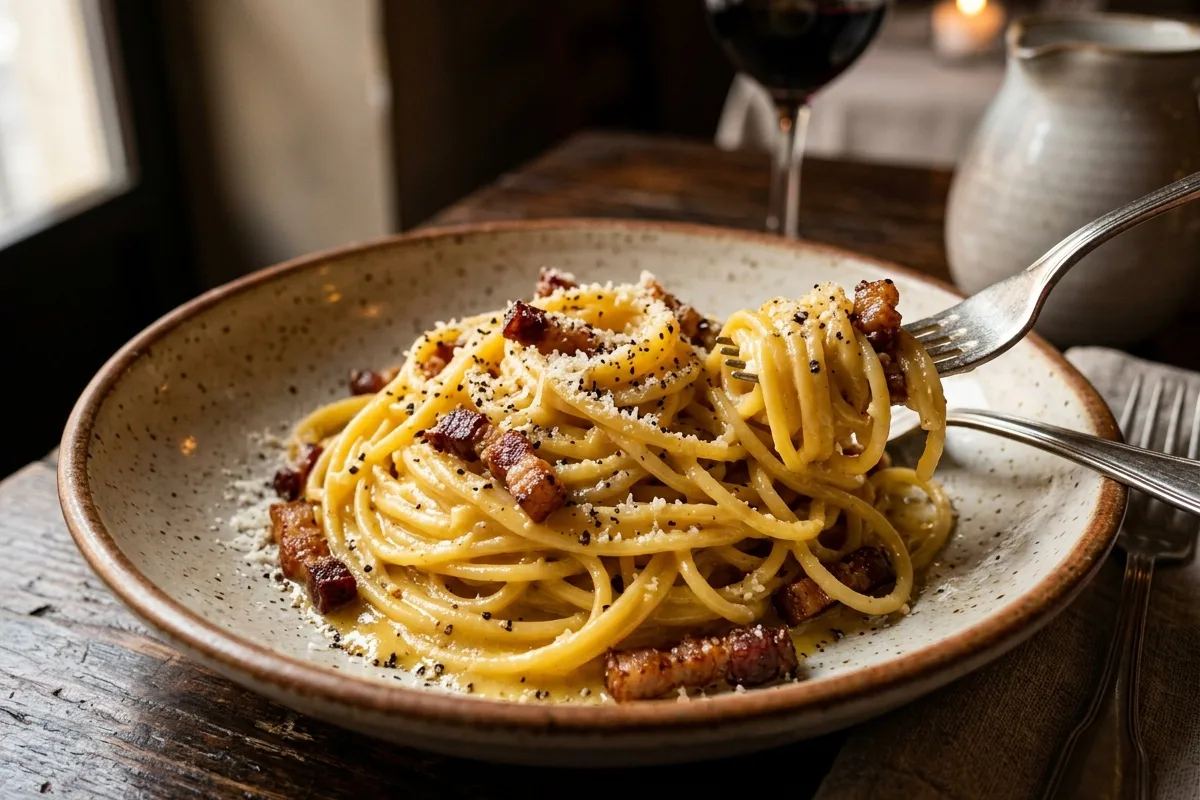
Authentic Roman Spaghetti Carbonara is not a casserole, nor is it a heavy cream sauce. It is a precision thermodynamic emulsion where egg yolk lecithin acts as an amphiphilic surfactant, binding the non-polar rendered lipids of cured pork jowl (guanciale) to a polar, starch-dense aqueous solution.
The Physics of the Starch-Lipid Emulsion
In traditional Roman cooking, common culinary folklore attributes the silkiness of Carbonara to secret techniques or family luck. In our kitchen lab, high-speed temperature probes and rheology tests demonstrate that successful Carbonara depends on three strict chemical constraints: lipid droplet dispersion, starch gelatinization, and thermal protein coagulation thresholds.
When pasta boils, starch granules absorb water, swell, and rupture—a process known as gelatinization. Amylose molecules leach out into the cooking water, creating a colloidal dispersion with elevated viscosity. When you agitate this warm, starchy liquid with the liquid pork fat rendered from the guanciale, mechanical shear forces break the hydrophobic pork lipids into microscopic globules. The dissolved amylose physically coats these lipid droplets, preventing them from coalescing back into a greasy film.
Egg yolks contribute abundant lecithin (phosphatidylcholine), a natural phospholipid surfactant featuring a hydrophilic choline head and lipophilic fatty acid tails. This double stabilization creates an exceptionally stable oil-in-water suspension that clings to bronze-cut spaghetti with zero phase separation.
The Egg Protein Coagulation Ceiling: Below 65°C (149°F)
The single most catastrophic failure mode in home Carbonara preparation is the scrambled egg defect. To understand why this occurs, we must examine the thermal denaturation kinetics of avian egg proteins:
- Ovotransferrin (conalbumin): Denatures and begins forming a gel network at 62°C to 65°C (143.6°F to 149°F).
- Ovalbumin: Comprising roughly 54% of egg white protein, ovalbumin denatures at 84°C (183.2°F).
- Yolk Lipovitellins & Phosvitin: Coagulate into firm curd clusters between 65°C and 70°C (149°F to 158°F).
The inclusion of finely grated Pecorino Romano (which contains moisture, fat, and lactic acid) and starchy pasta water shifts the effective coagulation window slightly upward, giving you a safe operating target between 58°C and 63°C (136°F and 145°F). If the skillet temperature exceeds 65°C (149°F) when the egg mixture is introduced, cross-linking occurs instantaneously, expelling water and leaving firm, curdy specks of egg on the pasta rather than a glossy coat.
Precision Thermal Control with Alva Stainless Steel
Master delicate egg emulsifications without hot spots. Multi-clad stainless steel skillets from Alva respond instantly to flame adjustments, preventing egg curdling during mantecatura.
Explore Alva Cookware Range →Guanciale Lipid Extraction & Salinity Management
Guanciale (cured pork cheek) is structurally distinct from American bacon or Italian pancetta. It features higher intramuscular fat content with a melting profile starting as low as 28°C (82.4°F), and a cure seasoned heavily with sea salt, black pepper, and occasionally herbs like rosemary and garlic.
Render your guanciale over gentle heat (approx. 120°C / 248°F) in an ungreased pan for 9 to 11 minutes. This slow rendering allows moisture inside the meat to evaporate gradually, crisping the exterior lardons while preserving a gelatinous, tender core. Crucially, pour off and reserve the liquid fat; you will incorporate 2 to 3 tablespoons into the pasta off the heat, providing the primary lipid phase for your sauce.
Critical Failure Modes & Chemistry Risks to Avoid
- Direct Pan Flame Application: Never introduce the egg yolk mixture while the pan remains over an active gas burner or induction element. Residual heat from a 3-ply stainless steel pan off the stove is more than sufficient.
- Over-Salting the Cooking Water: Guanciale and Pecorino Romano deliver substantial sodium. Salt pasta water at no more than 3.75 grams per liter (approx. 1 tablespoon per 4 liters of water), rather than the traditional 10g/L sea water standard.
- Using Heavy Cream or Milk: Commercial cream contains dairy casein and excess free water that dilutes pork flavor and artificially masks incorrect emulsification techniques. Authentic carbonara requires only pork fat, egg, cheese, and pasta water.
- Smooth Teflon Extruded Pasta: Ultra-slick, non-bronze pasta lacks the microscopic surface abrasions needed to physically grip the starch-egg emulsion, causing sauce to pool at the bottom of the bowl.
Nutritional & Biochemical Profile
A single portion (approx. 240 g cooked weight) delivers 590 kcal, structured as follows:
| Macronutrient | Quantity per Serving | Energy Contribution (%) | Biological Role |
|---|---|---|---|
| Protein | 28 g | 19% | Sustained muscle synthesis (high-bioavailability egg & pork peptides) |
| Fat | 32 g | 49% | Oleic and stearic fatty acids from guanciale, choline from egg yolk |
| Carbohydrates | 48 g | 32% | Complex amylose/amylopectin slow-release starches |
| Sodium | 820 mg | — | Naturally balanced through aged Pecorino DOP and cured meat |
Frequently Asked Questions
Can I make Carbonara with whole eggs only?
Using only whole eggs introduces excess albumen (egg white), which coagulates at lower temperatures and contains 88% water. The resulting sauce is thinner and more prone to watery curdling. A ratio of 4 yolks to 1 whole egg provides optimal lecithin density and rich color while retaining just enough moisture.
What should I do if the sauce looks too thick or greasy?
Vigorously whisk in 1 to 2 tablespoons of hot pasta water one splash at a time. The thermal energy combined with fresh amylose will restore the broken emulsion instantly.
Is raw egg consumption safe in Carbonara?
When tossed with boiling pasta at 60°C to 63°C for at least 60 seconds, the egg mixture reaches safe pasteurization temperatures for Salmonella enteritidis without protein matrix curdling. We recommend pasteurized or organic pasture-raised eggs for maximum safety.
Editorial Transparency & Affiliate Disclosure: FoxyChef evaluates culinary gear independently. Some links on this page route through verified partner programs such as /go/alva-cookware/ which may earn our kitchen lab a modest commission at zero additional cost to you.