
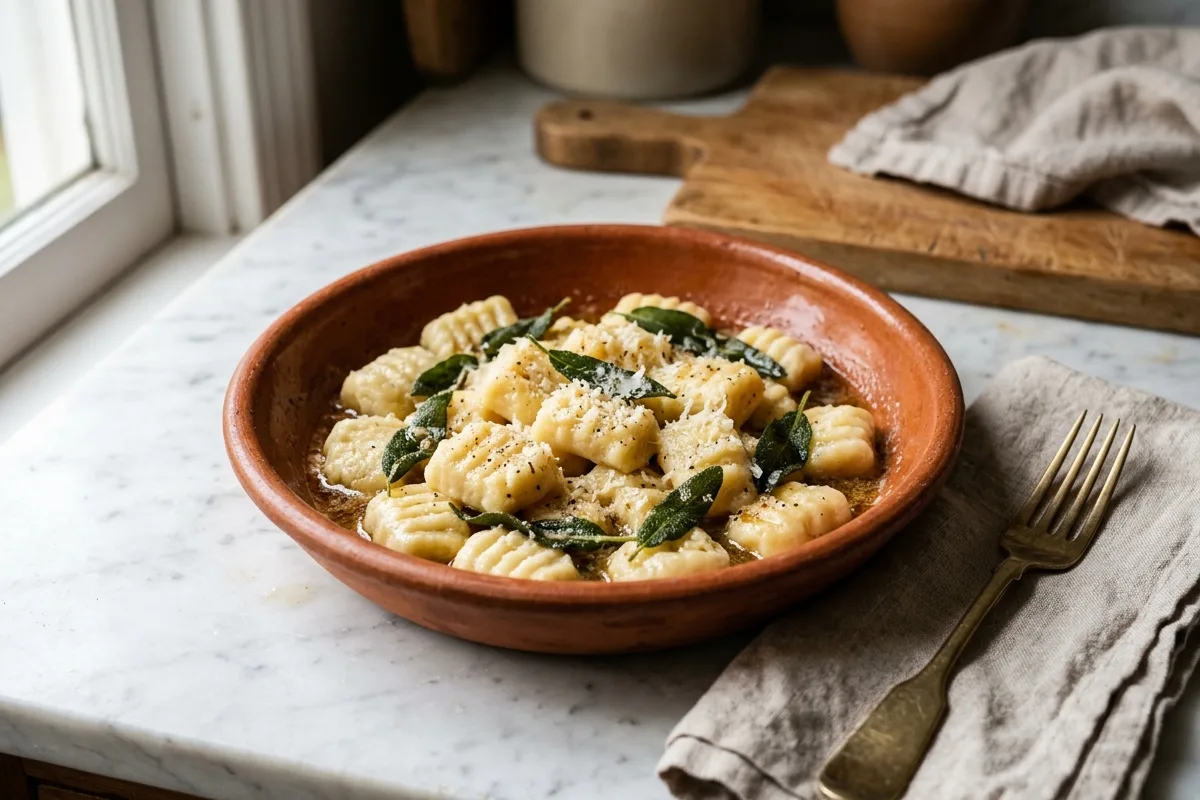
Pillow-Soft Ricotta Gnocchi: The Anti-Gluten Kitchen Lab Formulation
Eliminate heavy, gummy potato gnocchi with our low-binder ricotta formulation: master whey moisture drainage and starch gelatinization for cloud-like dumplings.
Instructions
Standard potato gnocchi are notorious for turning into dense, rubbery pellets when excess flour is added to compensate for watery potatoes. Our laboratory-tested Ricotta Gnocchi eliminates this issue by replacing potato starch with a high-protein whey curd matrix, creating ethereal dumplings that float like clouds on the palate.
The Chemistry of Low-Gluten Dumpling Dynamics
In traditional dumpling physics, gluten—a composite protein formed by gliadin and glutenin—develops into an elastic, rubbery lattice whenever flour is agitated in the presence of free water. In conventional potato gnocchi recipes, home cooks routinely add up to 200 grams of flour to bind moisture, resulting in chewy, leaden dumplings.
Our formulation restricts gluten formation through two distinct chemical controls:
- Whey Extraction: Fresh commercial ricotta contains between 70% and 74% moisture. By draining the curd through fine cheesecloth under gravity for 4 hours, we purge roughly 90 ml of unbound whey. The water activity decreases significantly, drastically limiting the free moisture available to hydrate wheat proteins.
- Lipid Enrobing: Incorporating pasture-raised egg yolks (which contain 30% fat) and cheese lipids coats the individual flour starch particles before water can form extended peptide bridges. This lipid barrier interrupts gluten chain cross-linking, producing an exceptionally delicate, melt-in-the-mouth texture.
The Physics of Beurre Noisette (Brown Butter)
Butter is an emulsion composed of approximately 80% to 82% milk fat, 16% to 18% water, and 1% to 2% milk solids (principally casein, whey proteins, and lactose). When heated in a wide stainless steel pan above 100°C (212°F), the water rapidly vaporizes, visible as active frothing.
Once water evaporation is complete around 120°C (248°F), the pan temperature climbs quickly. Between 130°C and 145°C (266°F to 293°F), the milk proteins and lactose sugars undergo an intense pyrolysis and Maillard reaction. This thermal cascade synthesizes aromatic furans, lactones, and pyrazines, imparting an unmistakable hazelnut and toasted biscuit fragrance.
Introducing whole fresh sage leaves precisely at the foaming peak accomplishes two goals: the hot lipid dehydrates the herb’s cellular structure to create a crisp texture, while fat-soluble essential oils (thujone, cineole, and camphor) dissolve into the butter. Squeezing in fresh lemon juice halts the browning instantly, protecting delicate aromatics from burning into bitter carbon.
Precision Brown Butter in Alva Skillets
Watching milk solids brown requires absolute pan visibility and responsive heat. Alva stainless steel skillets feature a bright interior and even thermal distribution to nail beurre noisette every time.
Explore Alva Skillet Collection →Simmering Physics: Gentle Water at 92°C (197°F)
Never cook delicate ricotta gnocchi in a violent, rolling boil at 100°C (212°F). Rapid convective bubbles create intense mechanical turbulence that easily fractures the tender curd matrix before the egg yolk proteins have time to thermally set.
Maintain the cooking water at a gentle simmer between 90°C and 94°C (194°F to 201°F). When lowered into this calm bath, heat penetrates the outer 2 millimeters within 20 seconds, coagulating the egg yolk proteins and setting the light Tipo 00 starch into a tender protective crust. When the gnocchi surface, microscopic steam pockets inside the curds have expanded, lowering their overall density. Grant them exactly 60 seconds of gentle floating time to ensure the center reaches 80°C (176°F), then lift them out with a spider strainer.
Critical Failure Modes & Chemistry Risks to Avoid
- Skipping the Ricotta Drainage: Using wet ricotta straight from the plastic tub introduces excess free water, forcing you to add double the flour and turning the gnocchi into rubbery balls.
- Kneading the Dough: Never knead this dough like bread. Use a bench scraper to fold and press just until homogeneous; mechanical shearing creates unwanted gluten elasticity.
- Violent Boiling Water: High-energy steam bubbles will literally tear the fragile dumplings apart before the protein matrix sets. Keep the water at a gentle simmer.
- Overheating the Butter: Milk solids will char into black, acrid, bitter soot if heated past 160°C (320°F). Keep your flame at medium and extinguish with lemon juice the moment the foam turns hazelnut-brown.
Nutritional & Biochemical Profile
One serving (approx. 210 g gnocchi tossed in sage brown butter) delivers 430 kcal:
| Macronutrient | Quantity per Serving | Energy Contribution (%) | Biological Role |
|---|---|---|---|
| Protein | 18 g | 17% | High biological value whey and casein proteins with complete BCAA profile |
| Fat | 22 g | 46% | Conjugated linoleic acid (CLA) and short-chain fatty acids from cultured butter |
| Carbohydrates | 40 g | 37% | Low-glycemic complex starches cushioned by dairy protein and fat matrix |
| Calcium | 340 mg | — | Readily absorbable mineral density from concentrated whole-milk curds |
Frequently Asked Questions
Can I freeze shaped ricotta gnocchi?
Yes, and they freeze exceptionally well. Place the shaped, uncooked gnocchi on a semolina-dusted parchment sheet in the freezer for 90 minutes until rock solid, then transfer to an airtight bag. Cook directly from frozen in simmering water for 3 to 4 minutes—do not thaw.
Why is Tipo 00 flour preferred over all-purpose flour?
Italian Tipo 00 flour is milled from soft wheat to an ultra-fine talc-like consistency. It absorbs moisture rapidly without developing high tensile gluten elasticity, yielding a far silkier mouthfeel.
Can I substitute dried sage for fresh sage?
No. Dried sage lacks volatile surface oils and turns into gritty, bitter dust in hot butter. Fresh whole sage leaves contain intracellular moisture that crisps into an ethereal herbal garnish.
Editorial Transparency & Affiliate Disclosure: FoxyChef evaluates culinary gear independently. Some links on this page route through verified partner programs such as /go/alva-cookware/ which may earn our kitchen lab a modest commission at zero additional cost to you.