
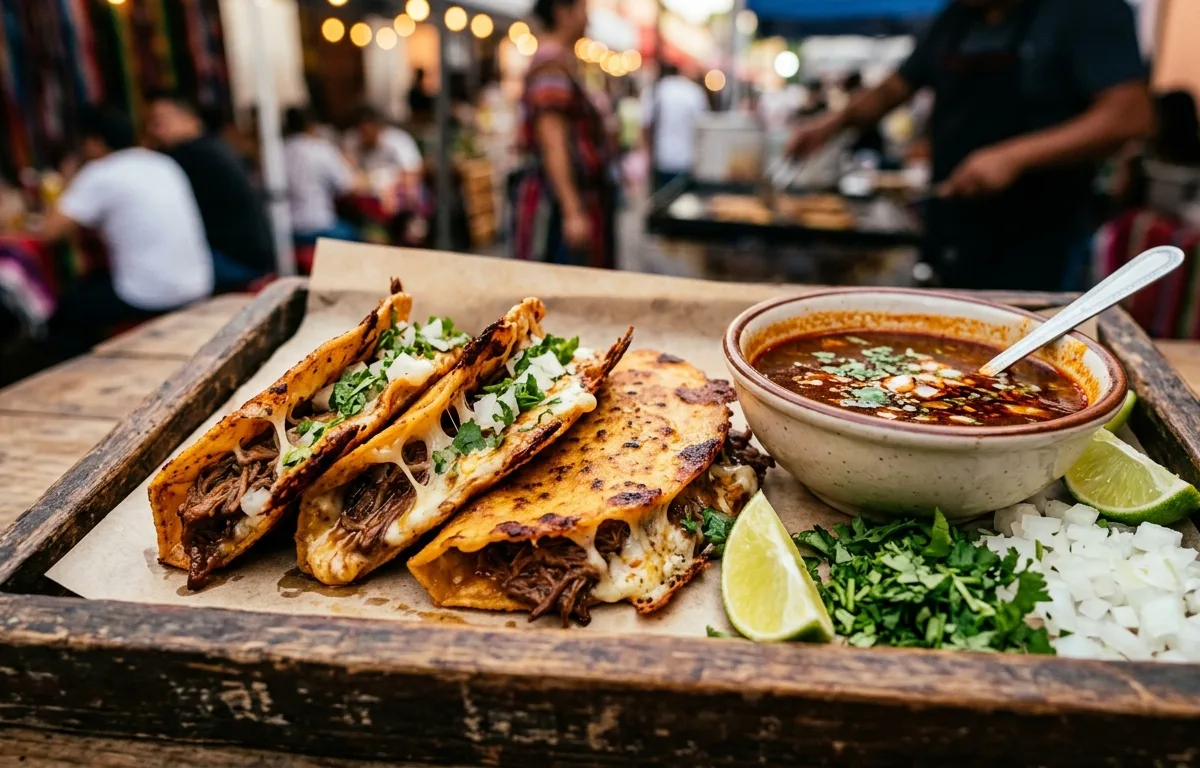
Slow-Simmered Beef Birria with Rich Ancho-Guajillo Consomé
Instructions
Traditional Mexican beef birria represents an exceptional benchmark in low-temperature braising thermodynamics and colloidal chemistry. Beyond its celebrated aromatic richness, producing meltingly tender shredded beef alongside an unctuous, jewel-toned consomé requires absolute command over four fundamental biophysical principles: connective tissue collagen hydrolysis kinetics, nonpolar lipid extraction of chili carotenoids, acetic acid myofibrillar tenderization, and multi-phase colloidal suspension rheology.
Collagen Hydrolysis Mechanics and Connective Tissue Thermodynamics
The culinary objective in authentic birria is converting tough, locomotion-adapted beef cuts into supple, juicy shreds. Cuts such as beef shank, bone-in short ribs, oxtail, and chuck roast contain dense concentrations of perimysial and epimysial connective tissues. These matrices are dominated by type I and type III fibrillar collagen, which consist of three polypeptide alpha-chains wound tightly into an interlocking tropocollagen triple helix held together by covalent intermolecular cross-links (such as histidino-hydroxymerodesmosine).
Under conventional boiling conditions above 205 °F (96 °C), muscle fibers suffer violent thermal shortening: actomyosin cross-bridges contract severely, purging intracellular moisture into the surrounding broth and leaving the meat dry, stringy, and desiccated. Conversely, collagen denaturation proceeds imperceptibly slowly below 150 °F (65 °C). The thermodynamic sweet spot for birria braising occurs strictly within the 165 °F to 185 °F (75 °C to 85 °C) range.
Maintained steadily over 3.5 to 4 hours, continuous thermal energy systematically disrupts the stabilizing hydrogen bonds of the tropocollagen helices. The rigid triple-helical structure unravels into random-coil gelatin peptides that dissolve directly into the braising liquid. Furthermore, marrow bones present in the pot slowly leach gelatinous marrow lipids and bioavailable trace minerals (calcium, phosphorus, and magnesium) into the liquor. This mineral and peptide enrichment increases the osmotic density of the liquid, providing unctuous mouthfeel to the meat fibers while yielding a thick, lip-coating consomé.
Nonpolar Lipid Extraction of Guajillo and Ancho Carotenoids
The characteristic crimson hue and deep flavor profile of authentic birria broth originate from a trio of dried Mexican capsicums: guajillo (providing crisp organic acidity, bright color, and moderate pungency), ancho (the dried form of ripe poblano, imparting dried plum, raisin, and furan-derived caramelized notes), and pasilla (delivering rich umami undertones and smoky minerality). The dominant chromatic pigments in these dried pods are capsanthin and capsorubin—lipophilic carotenoids containing conjugated polyene chains that make them virtually insoluble in water.
Similarly, the pungent sensation of chiles is produced by capsaicin and dihydrocapsaicin, both strongly hydrophobic vanilloid molecules. If chiles are boiled strictly in water, these critical flavor and color molecules remain locked inside the plant cellular matrix, resulting in a thin, watery broth with harsh surface bitterness. To maximize mass transfer, whole dried chiles are first toasted dry between 275 °F and 300 °F (135 °C to 150 °C) to generate aromatic pyrazines and facilitate cellular wall softening without burning the outer cuticle layer.
When stewed together with the marbled beef, the rendered beef tallow (intermuscular stearic and oleic fatty acids) forms an active nonpolar solvent phase across the liquid surface. This hot lipid layer continuously extracts, dissolves, and stabilizes the carotenoids and capsaicinoids. As the braise reduces, this nutrient-dense, fragrant red tallow rises to the top of the pot—forming the famous birria fat cap that is carefully skimmed and utilized to fry and hydrate corn tortillas prior to assembling crispy quesabirria tacos.
Acidic Tenderization and Myofibrillar Swelling via Acetic Acid
Prior to applying braising heat, coating the raw beef cuts in an acidic chili marinade containing raw apple cider vinegar induces critical biochemical alterations. Acetic acid lowers the meat surface pH from its neutral range down to roughly 4.2 to 4.5. This pH depression shifts myofibrillar proteins away from their isoelectric point (around pH 5.3), establishing net like-charges across adjacent actin and myosin filaments.
Due to electrostatic repulsion, the contracted muscle filaments push apart, opening microscopic interstitial channels that absorb seasoned moisture through osmotic hydration. Moreover, this mild acidic bath activates endogenous acid proteases (cathepsins) while weakening the tensile integrity of surface elastin and reticulin fibers. The meat enters the cooking vessel partially tenderized, allowing dissolved salt ions, eugenol from whole cloves, and cuminaldehyde from toasted cumin to diffuse uniformly into the core of each muscle block.
Consomé Colloidal Suspension and Viscosity Dynamics
A true birria consomé is not a clarified bouillon; it is a stable, multi-phase colloidal suspension. Dispersed insoluble micro-particles of roasted tomato pulp, pulverized aromatics, and insoluble chile fibers remain evenly distributed throughout an aqueous phase loaded with dissolved gelatin peptides and emulsified tallow micro-droplets.
Gelatin acts as a natural amphiphilic surfactant: its hydrophobic amino acid residues bind to fat droplets while its hydrophilic residues bind to water molecules, creating an emulsion that resists separation when served piping hot. Rheologically, this creates a pseudoplastic fluid that flows effortlessly off a soup spoon yet coats the palate with luxurious oral lubricity, prolonging flavor release and sustaining deep sensory persistence.
Estimated Nutritional Breakdown per Serving
| Nutritional Parameter | Amount per Serving (10.5 oz / 300 g with consomé) |
|---|---|
| Calories | 540 kcal |
| Complete High-BV Protein | 46 g |
| Total Fat (Rendered & Structural) | 32 g |
| Net Carbohydrates | 14 g |
| Bioavailable Heme Iron | 5.1 mg (28% DV) |
| Dietary Sodium | 890 mg |
Chef-Grade Induction Cookware: Alva Tri-Ply Multi-Clad
Professional sauce reduction and searing demand flawless thermal response. Alva Cookware combines a fast-heating aluminum core with heavy-gauge 18/10 stainless steel for zero-hotspot culinary control.
Discover Alva Cookware →Editorial Disclosure & Affiliate Notice: FoxyChef evaluates culinary gear and cooking methods under strict kitchen laboratory standards. Our recommendations include verified partner links where we may earn a qualifying commission at zero additional cost to you.
Chef-Grade Induction Cookware: Alva Tri-Ply Multi-Clad
Professional sauce reduction and searing demand flawless thermal response. Alva Cookware combines a fast-heating aluminum core with heavy-gauge 18/10 stainless steel for zero-hotspot culinary control.
Discover Alva Cookware →