
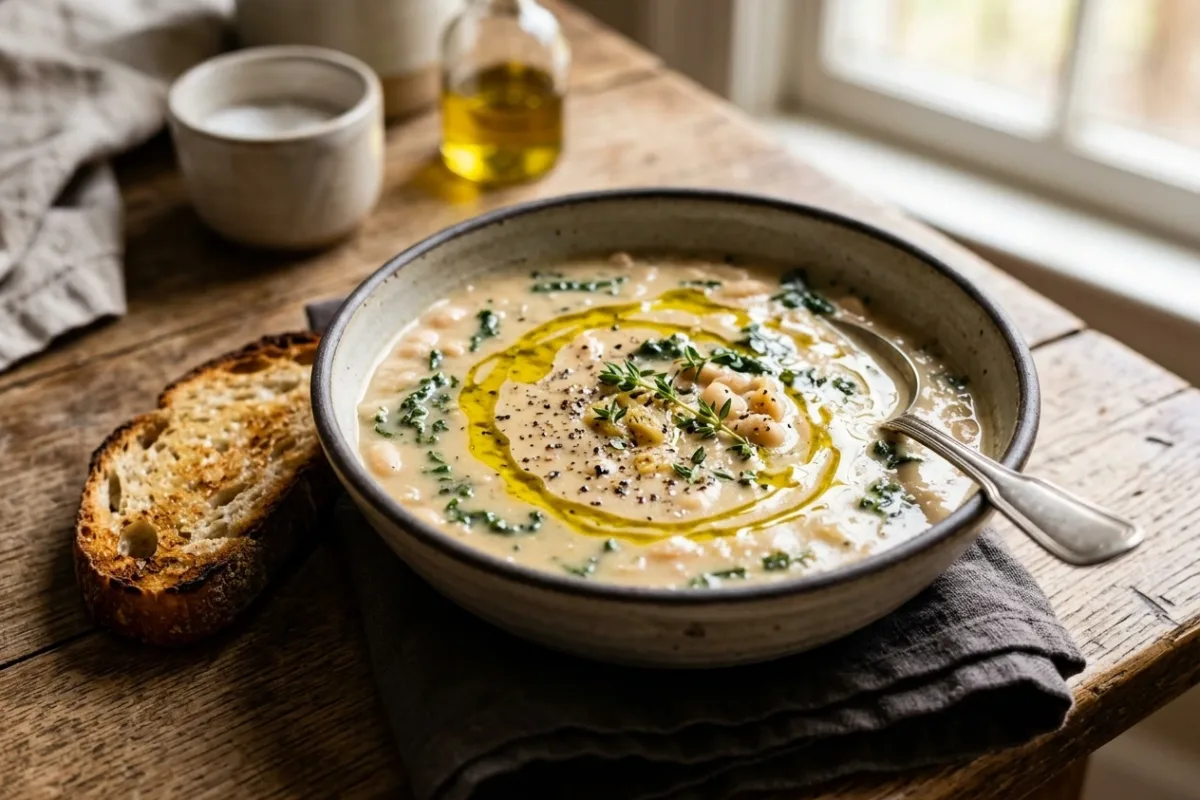
Creamy Tuscan White Bean and Roasted Garlic Kale Soup
Instructions
Classic Tuscan white bean and kale soup (rooted in the culinary lineages of zuppa di fagioli and rustic ribollita) stands as an elegant model of carbohydrate colloidal physics in plant-based cooking. Achieving an opulent, velvety broth without heavy cream, butter, or industrial thickening agents requires precise orchestration of four biochemical mechanics: starch granule gelatinization and phaseolin protein emulsification in Cannellini beans, thermal degradation of pungent sulfur volatiles via whole bulb garlic roasting, lipid partitioning of rosemary terpenes, and the preservation of porphyrin-bound magnesium in Tuscan Lacinato kale.
Starch Gelatinization and Natural Bean Emulsion Rheology
Cannellini beans (Phaseolus vulgaris) possess a dense carbohydrate architecture comprising approximately 60% complex polysaccharides, distributed between linear amylose and branched amylopectin polymers safely contained within the cotyledon cell walls. When dried beans are simmered in an aromatic mirepoix broth at sub-boiling temperatures between 185 °F and 195 °F (85 °C to 90 °C), water molecules migrate across the seed coat (testa) and diffuse into the starch granules.
Upon reaching their gelatinization threshold (roughly 155 °F to 167 °F / 68 °C to 75 °C), the tightly packed semi-crystalline intermolecular bonds of the starch relax. The granules absorb substantial liquid, swell to multiple times their native volume, and begin leaching soluble amylose chains into the cooking medium. Rather than relying on dairy fats to build body, this recipe harvests the natural mechanical properties of the legumes.
By siphoning roughly one-third of the cooked beans along with hot vegetable stock into an immersion blender and shearing at high rotational velocity, the cellular walls are ruptured. This mechanical shear releases soluble amylose and phaseolin (the primary globular storage protein of white beans). When this smooth bean slurry is returned to the pot and emulsified with a steady stream of cold-pressed extra virgin olive oil, phaseolin acts as an amphiphilic hydrocolloid. Its hydrophobic amino acid domains adhere to olive oil lipid micro-droplets while its hydrophilic domains associate with surrounding water molecules. This biochemical bonding creates a velvety, shear-thinning colloidal suspension that delivers rich oral coating and sumptuous mouthfeel without a single drop of dairy.
Allicin Pyrolysis and Sulfur Modulation via Slow Bulb Roasting
Fresh raw garlic contains alliin and the enzyme alliinase segregated in separate cellular compartments. Slicing, crushing, or mincing raw garlic ruptures these compartments, triggering instantaneous enzymatic cleavage of alliin into allicin (diallyl thiosulfinate). Allicin provides intense pungency, stinging volatility, and harsh sulfurous top notes engineered as a botanical defense mechanism. In a delicate, comforting bean broth, unmitigated raw allicin aggressively overpowers subtle vegetal aromatics.
To fundamentally redirect this organosulfur reaction pathway, whole heads of garlic are roasted intact at 350 °F (175 °C) enclosed in parchment paper with a drop of olive oil. The sustained oven heat rapidly denatures the heat-sensitive alliinase enzyme before extensive allicin synthesis can occur. Simultaneously, long-chain fructan polysaccharides (the bulb’s primary energy store) undergo gentle thermal saccharification, cleaving into free fructose and glucose monosaccharides.
Concurrently, residual sulfur precursors break down into sweet, mellow organosulfur derivatives—namely diallyl sulfide, dimethyl disulfide, and cyclic vinyldithiins. Squeezed from their caramelized papery skins, the roasted garlic cloves crush into a rich, paste-like purée with complex balsamic sweetness, savory umami depth, and zero sulfurous sharpness, effortlessly dissolving into the bean emulsion to form an aromatic foundation.
Lipid Extraction of Rosemary Monoterpenes
Fresh rosemary (Salvia rosmarinus) introduces woody, pine-like aromatic complexity dominated by hydrophobic volatile terpenes—principally 1,8-cineole (eucalyptol), camphor, and alpha-pinene. Because these secondary plant metabolites are poorly soluble in pure water, boiling them in stock leads to rapid vapor loss rather than culinary integration.
By blooming finely chopped fresh rosemary directly in warm extra virgin olive oil during the initial mirepoix sweat, the oleic acid lipid matrix serves as a hydrophobic solvent. The monoterpenes partition efficiently into the oil phase. When this infused oil is later emulsified into the starch-thickened bean broth, the flavor molecules become dispersed throughout the entire soup, shielding them from heat degradation and ensuring an even, harmonious release across the palate.
Chlorophyll Pigment Stabilization in Tuscan Lacinato Kale (Cavolo Nero)
Lacinato kale (Brassica oleracea var. acephala, also known as dinosaur or black kale) provides necessary textural contrast and an exceptional nutritional payload of glucosinolates, lutein, and photosynthetic pigments. The deep emerald pigmentation of healthy brassica leaves depends entirely upon intact chlorophyll a and chlorophyll b molecules, where a centrally coordinated magnesium ion (Mg²⁺) is stabilized within a tetrapyrrole porphyrin ring.
During thermal processing, two forces threaten this vibrant chromatic integrity: endogenous chlorophyllase enzymes and volatile organic plant acids released from disrupted cellular vacuoles. Prolonged boiling or acidic exposure causes protonation: hydrogen ions displace the central magnesium cation from the porphyrin ring, converting vivid green chlorophyll into dull, olive-drab pheophytin a and b. This chemical shift damages both visual vibrancy and volatile aromatic freshness.
To retain peak aesthetic brilliance and crisp-tender fibrous chew, destemmed kale leaves are finely shredded and introduced into the pot during the final 4 to 6 minutes of simmering at 190 °F to 195 °F (88 °C to 90 °C). This rapid, controlled thermal blanching immediately denatures heat-labile chlorophyllase and softens tough hemicellulose cell walls without triggering magnesium displacement. The result is a vibrant, deeply emerald soup teeming with active antioxidants, crisp texture, and pristine garden freshness.
Estimated Nutritional Breakdown per Serving
| Nutritional Parameter | Amount per Serving (12 oz / 350 ml) |
|---|---|
| Calories | 340 kcal |
| Plant-Based Complete Protein | 16 g |
| Total Fat (Cold-Pressed Monounsaturates) | 10 g |
| Complex Digestible Carbohydrates | 48 g |
| Total Dietary Fiber (Soluble & Insoluble) | 14 g (56% DV) |
| Bioavailable Plant Calcium | 185 mg (19% DV) |
Chef-Grade Induction Cookware: Alva Tri-Ply Multi-Clad
Professional sauce reduction and searing demand flawless thermal response. Alva Cookware combines a fast-heating aluminum core with heavy-gauge 18/10 stainless steel for zero-hotspot culinary control.
Discover Alva Cookware →Editorial Disclosure & Affiliate Notice: FoxyChef evaluates culinary gear and cooking methods under strict kitchen laboratory standards. Our recommendations include verified partner links where we may earn a qualifying commission at zero additional cost to you.
Chef-Grade Induction Cookware: Alva Tri-Ply Multi-Clad
Professional sauce reduction and searing demand flawless thermal response. Alva Cookware combines a fast-heating aluminum core with heavy-gauge 18/10 stainless steel for zero-hotspot culinary control.
Discover Alva Cookware →