
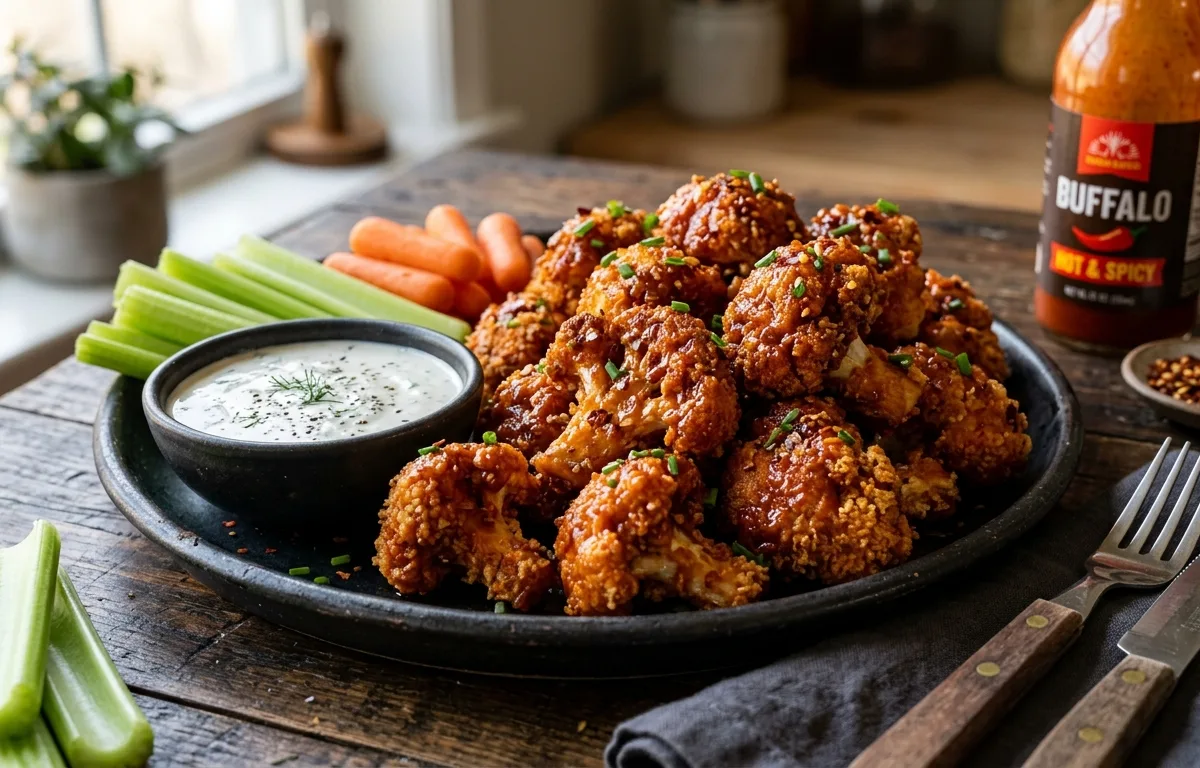
Crispy Air Fryer Buffalo Cauliflower Wings with Garlic Herb Dip
Instructions
Transforming fresh cauliflower florets into shattering, pub-style buffalo wings in an air fryer requires resolving a core food science challenge: neutralizing cellular pectin dissolution and expelling internal capillary water before the vegetable tissue turns soggy and collapses.
Plant Tissue Architecture: Pectin Degradation and Capillary Water Control
Cauliflower (Brassica oleracea var. botrytis) is composed of approximately 92 percent water enclosed within plant cells bounded by rigid cell walls rich in cellulose, hemicellulose, and structural pectins. In traditional hot-air preparation, when vegetable tissue is heated above 60 °C (140 °F), endogenous pectin methylesterase enzymes and heat-induced beta-elimination break down the calcium-pectate mortar holding neighboring plant cells together. If this thermal breakdown takes place under slow, humid conditions, cellular turgor fails completely, dumping intracellular water into the intercellular void and transforming the vegetable into a mushy, watery mass.
To retain structural integrity and deliver a toothsome, meaty bite, the convective heat transfer rate must outpace internal pectin softening. Operating the air fryer at 200 °C (400 °F) produces a high thermal gradient. Superheated air circulating at 2 meters per second rapidly desiccates the outer boundaries of each floret, while internal steam cooking is compressed into an 14-minute window. This cooks the core to an al dente tenderness—retaining over 70 percent of cellular stiffness—while establishing a dry, porous foundation capable of supporting an ultra-crisp coating.
Starch Mechanics: The Rice Flour and Cornstarch Slurry Retrogradation
Standard all-purpose wheat flour batters fail in oil-less air fryer environments. Wheat flour contains glutenin and gliadin, which cross-link into an elastic gluten matrix upon hydration. Lacking the continuous high-temperature heat flux of deep submersion oil, this gluten mesh traps internal moisture, resulting in a rubbery, leather-like exterior rather than a brittle crunch.
Our culinary lab formulation solves this with a gluten-free starch composite: a 1:1 ratio of superfine white rice flour and pure cornstarch (maize starch). Cornstarch contains roughly 25 to 28 percent linear amylose. When this wet slurry contacts the 200 °C basket environment, the starch granules absorb available surface water and swell until they burst—a phenomenon known as starch gelatinization (occurring between 65 °C and 72 °C). As circulating air drives rapid evaporative dehydration, the uncoiled amylose polymers undergo rapid retrogradation, re-aligning into an intensely rigid, glassy crystalline network that yields a light, micro-vesicular crunch.
Concurrently, superfine white rice flour possesses an exceptionally small starch granule size (2 to 8 microns) and zero gluten-forming prolamin proteins. As water vapor erupts from the florets, the rice flour matrix develops microscopic micro-fractures that allow steam to escape freely into the air fryer vortex rather than condensing beneath the crust and making the batter soggy.
Emulsion Stability: Acidic Cayenne Pepper and Lipid Dynamics
Authentic Buffalo sauce is not a simple solution, but a metastable oil-in-water colloidal emulsion. Fermented cayenne pepper mash contains free acetic acid (distilled vinegar), capsicum oleoresin pigments, capsaicin, and plant particulates. The aggressively low pH (typically 3.2 to 3.6) presents a hostile environment for lipid stabilization.
To maintain a rich, clingy glaze without dairy butter, we incorporate melted high-smoke-point plant butter based on fractionated coconut and sunflower oils, emulsified at 45 °C with a trace of Dijon mustard or plant lecithins. The mucilage and phospholipid structures create stable micellar envelopes around the lipid droplets, producing a silky, viscous glaze that coats every microscopic nook of the starch crust without immediately breaking down the crunchy amylose lattice.
Calibrated Ingredients & Formulation (4 Servings)
- 1 large head fresh cauliflower (approx. 800g), broken down into symmetrical, bite-sized florets (1.5-inch / 3.5 cm pieces with short stems)
- 1/2 cup (70g) superfine white rice flour (non-glutinous small-granule starch base)
- 1/2 cup (70g) non-GMO cornstarch (high-amylose polymer donor for structural glass transition)
- 1 tsp garlic powder and 1 tsp onion powder (dry aromatic precursors)
- 1 tsp smoked Spanish paprika (phenolic smoke notes and natural browning coloration)
- 3/4 cup (180 ml) ice-cold filtered water (inhibits premature starch swelling during mixing)
- 1/2 tsp fine sea salt (saline calibration)
- 1/2 cup (120 ml) aged cayenne hot pepper sauce (calibrated acetic acid and capsaicin carrier)
- 3.5 tbsp (50g) melted high-quality plant-based butter (lipid emulsion phase)
- 1 tsp apple cider vinegar (pH stabilizer)
- For the garlic herb dip: 1/2 cup vegan aquafaba mayo, 2 cloves crushed roasted garlic, 1 tbsp fresh lemon juice, 1 tbsp chopped fresh dill and chives
Step-by-Step Culinary Masterclass
Step 1: Floreting and Thorough Dehydration
Trim the cauliflower into uniform 1.5-inch florets. Uniformity is mandatory to prevent smaller pieces from dehydrating to carbon while larger pieces remain raw. Wash thoroughly and spin dry in a salad spinner, then spread across clean kitchen towels and pat vigorously. Any residual water droplets on the florets will dilute the starch slurry, creating bald patches on the coating.
Step 2: Slurry Synthesis & Starch Hydration
In a large bowl, whisk together the rice flour, cornstarch, garlic powder, onion powder, smoked paprika, and sea salt. Slowly pour in the ice-cold water, whisking continuously until the mixture forms a smooth batter resembling heavy cream. Allow the slurry to rest for 5 minutes; this allows the starch polymers to achieve uniform hydration without settling out of suspension.
Step 3: Dredging and Air Fryer Preheating
Drop the dried cauliflower florets into the batter in batches, turning them until every fissure is coated. Lift each piece with tongs or a slotted spoon and pause for 3 seconds to let excess batter drip back into the bowl. Meanwhile, preheat your air fryer to 200 °C (400 °F) for 5 minutes so the perforated basket achieves full convective and conductive equilibrium.
Step 4: Initial Convection Fry (Crust Glass Transition)
Arrange the coated florets into the preheated basket in a single, well-spaced layer. Mist lightly with an avocado or high-heat oil spray. Air-fry at 200 °C (400 °F) for 14 minutes. At the 8-minute mark, vigorously shake the basket to invert the florets and redistribute contact points. When properly cooked, tapping a floret with a fork should produce a hollow, crisp click.
Step 5: Emulsion Glazing and Flash Setting
While the cauliflower cooks, whisk together the melted plant butter, cayenne hot pepper sauce, and cider vinegar until a creamy, glossy emulsion forms. Transfer the hot, crispy cauliflower directly into a large stainless steel bowl, pour the warm buffalo sauce over top, and toss swiftly for 15 seconds to achieve uniform glaze adhesion. Return the coated wings to the air fryer at 200 °C (400 °F) for precisely 2 minutes. This flash-cooks the emulsion onto the surface, locking the flavor into the crust without softening it.
Step 6: Plate and Garnish with Chilled Dip
Whisk together the roasted garlic, vegan mayo, lemon juice, dill, and chives in a small serving dish. Plate the steaming buffalo wings alongside crisp celery sticks and the chilled garlic herb dip. The sharp temperature and texture contrast between the fiery, shattering wings and the cool, creamy dip delivers an exceptional sensory experience.
Critical Pitfalls & Scientific Diagnostics
- Using Wheat Flour in the Batter: Developing gluten networks in an air fryer produces a tough, chewy, bread-like shell. The combination of cornstarch and rice flour is strictly essential for retrograded amylose crispness.
- Pre-Boiling or Steaming the Cauliflower: Introducing excess thermal moisture into the plant vacuoles before air-frying destroys cellular turgor, causing the wings to collapse into a waterlogged mush during cooking. Start with raw, fresh cauliflower florets every time.
- Extended Resting After Sauce Application: The water and acetic acid in hot sauce will eventually soften starch crystals via capillary penetration. Serving immediately after the 2-minute sauce-setting flash bake is essential for optimal crunch.
- Choking Airflow in the Basket: Overfilling the basket traps hot water vapor, effectively turning your convective air fryer into an inefficient vegetable steamer. Always cook in batches if needed to maintain ample spacing.
Macro Breakdown & Nutritional Analysis
| Nutrient Metric | Amount Per Serving (200g cooked) | % Daily Value* |
|---|---|---|
| Total Energy | 240 kcal | 12% |
| Plant-Based Protein | 6 g | 12% |
| Healthy Lipids / Fat | 10 g | 13% |
| Net Carbohydrates | 32 g | 11% |
| Prebiotic Dietary Fiber | 5.5 g | 20% |
| Bioactive Vitamin C | 58 mg | 64% |
| Sodium | 580 mg | 25% |
Lab-Tested Nonstick Performance: Swiss Diamond Classic
High-heat cooking and delicate proteins require zero-stick release and scratch-resistant durability. Swiss Diamond's real diamond crystal coating delivers edge-to-edge heat conduction with effortless cleanup.
Shop Swiss Diamond Skillets →Editorial Disclosure & Affiliate Notice: FoxyChef evaluates culinary gear and cooking methods under strict kitchen laboratory standards. Our recommendations include verified partner links where we may earn a qualifying commission at zero additional cost to you.
Lab-Tested Nonstick Performance: Swiss Diamond Classic
High-heat cooking and delicate proteins require zero-stick release and scratch-resistant durability. Swiss Diamond's real diamond crystal coating delivers edge-to-edge heat conduction with effortless cleanup.
Shop Swiss Diamond Skillets →