
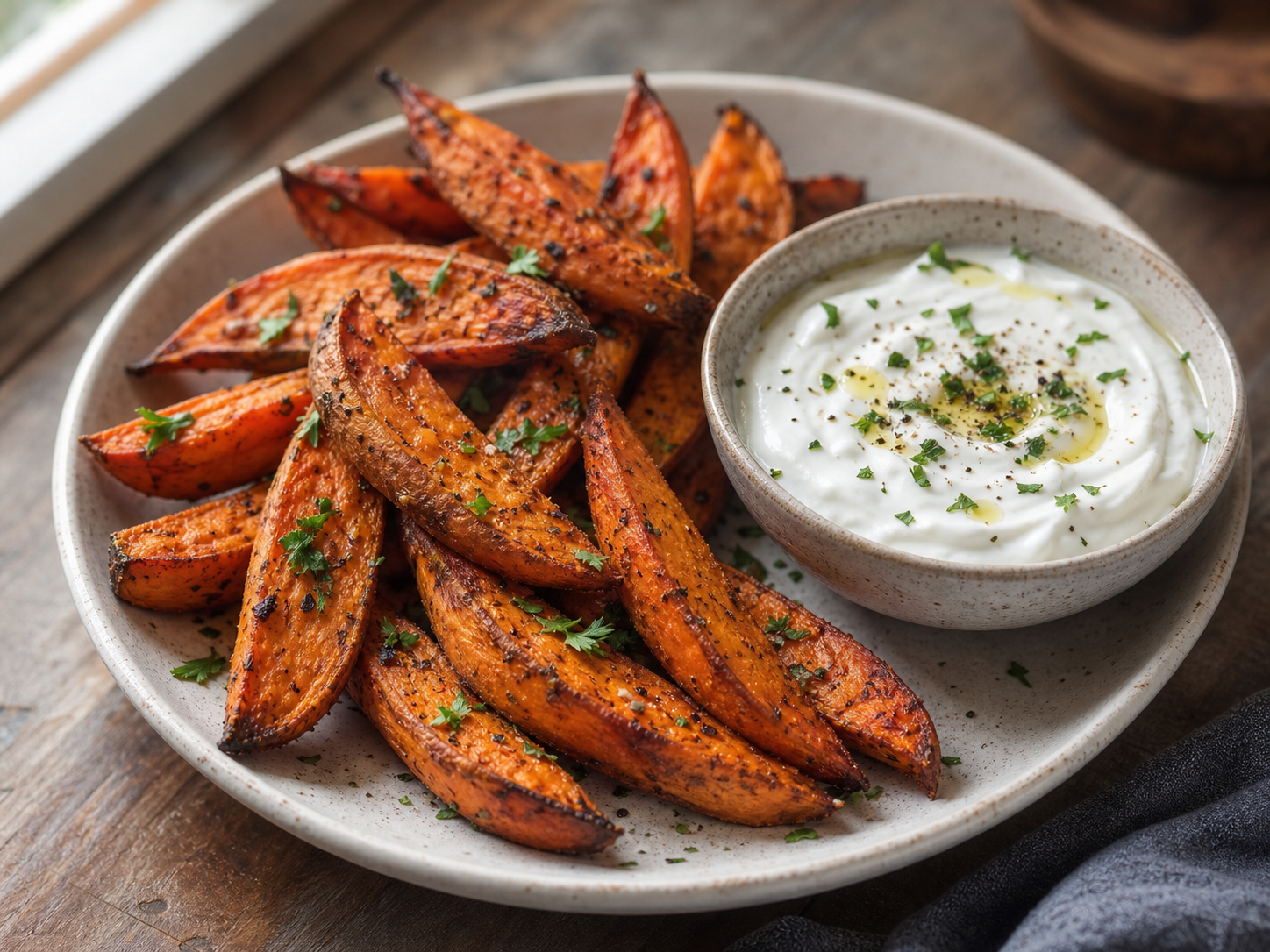
Crispy Spiced Sweet Potato Wedges with Garlic Aioli Dip
Instructions
Engineering true shatteringly crisp sweet potato wedges using forced convective air rather than deep immersion frying is a formidable challenge in plant carbohydrate physics. Unlike white potatoes, sweet potatoes are deficient in crystalline amylose and laden with free reducing sugars that promote structural limpness and premature scorching. By leveraging a targeted osmotic leaching protocol, an exogenous starch dusting, and high-velocity 385 °F (195 °C) convection, home cooks can achieve a resilient, glass-like exterior surrounding a creamy, velvety core.
Sweet Potato Biochemistry: The Beta-Amylase and Reducing Sugar Dilemma
The tuberous root of *Ipomoea batatas* possesses a carbohydrate profile fundamentally distinct from russet tubers (*Solanum tuberosum*). While conventional baking potatoes contain 18% to 22% native starch dominated by linear, crystalline amylose polymers, sweet potatoes contain abundant branched amylopectin and extraordinary concentrations of endogenous beta-amylase enzymes.
During the gentle temperature ramp between 135 °F and 170 °F (57 °C to 77 °C), beta-amylase undergoes hyper-activation, breaking down native starch granules into simple maltose disaccharides. This influx of maltose, joined by native glucose and fructose, creates severe thermodynamic vulnerability: free reducing sugars undergo pyrolysis and carbonization at temperatures as low as 320 °F (160 °C). If unwashed sweet potato wedges are exposed directly to high heat, these surface sugars burn into bitter melanoidins long before internal water vaporizes sufficiently to permit structural hardening.
Surface Sugar Leaching Protocol
To eliminate this destructive chemical pathway, we employ an aggressive cold-water agitation wash. Slicing raw tubers into uniform 0.6-inch (1.5 cm) wedges fractures hundreds of thousands of cellular vacuoles along the cut topography, coating the exterior surfaces in viscous, unbound sugars and damaged starch paste.
Submerging the wedges in an ice-water bath with vigorous agitation for 30 minutes drives osmotic extraction of these surface sugars away from the cut face. The wedges are then transferred to lint-free kitchen towels and dried completely. Stripping away this sticky mono- and disaccharide barrier leaves the cellular cellulose framework completely exposed, establishing a neutral foundation that readily bonds with an engineered crisping agent.
Exogenous Starch Mechanics: Amylose Gelatinization and Glass Transition
Because the sweet potato’s internal carbohydrate matrix cannot synthesize a rigid, dehydrated crust on its own due to high water-binding pectin and low amylose, we apply pure cornstarch (*Zea mays*), containing roughly 28% linear amylose chains.
After thorough drying, the wedges are lightly coated with a high-smoke-point oil (such as cold-pressed avocado oil) to serve as a hydrophobic adhesive. A micro-thin layer of cornstarch (calculated at exactly 2% of total tuber weight) is sifted evenly alongside smoked paprika, ground cumin, and sea salt. When exposed to heat, the dry cornstarch granules absorb capillary moisture from the potato surface and undergo gelatinization between 144 °F and 158 °F (62 °C to 70 °C), swelling into an interconnected hydrogel net. As hot convective air drives surface moisture below 3%, this hydrated gel undergoes a glass transition, solidifying into an inflexible, micro-perforated crust that remains crisp long after cooling.
Forced Air Convection Thermodynamics at 385 °F (195 °C)
Air fryer cooking relies on rapid forced convection rather than passive radiant heating. In a static oven cavity, a stagnant boundary layer of evaporated water vapor clings to the food surface, lowering effective heat transfer and steaming the exterior into sogginess.
In a dynamic convective vortex at 385 °F (195 °C), high-velocity airflow continuously strips away this moist boundary layer, drastically increasing the vapor pressure differential between the food surface and the surrounding air. Over an 18-minute cycle with a mechanical toss at the 9-minute mark, the exterior starch film rapidly dehydrates, while heat slowly conducts inward to heat the interior parenchyma to 205 °F (96 °C). This gelatinizes internal starches into a luscious, sweet puree while the outside retains uncompromising structural crispness.
Seasoning Chemistry and Pyrolysis Thresholds
Balancing aromatic seasoning against thermal degradation requires careful consideration of smoke points and volatile organic compounds. Ground cumin contains cuminaldehyde and terpenes that decompose into harsh acrid off-notes when exposed to dry heat above 350 °F (177 °C). Similarly, the carotenoid pigments in smoked paprika are vulnerable to oxidative bleaching under high-velocity dry airflow.
To shield these delicate phytochemicals, spices are suspended directly within the hydrophobic lipid phase before dusting with cornstarch. The oil coating encapsulates volatile aroma molecules, limiting their direct exposure to oxygen and convective shear forces. Furthermore, coarse kosher salt crystals remain insoluble within the oil barrier, preventing premature osmotic weeping during the initial heating phase and ensuring that moisture remains trapped within the core while the outer crust hardens.
Colloidal Emulsion Chemistry of the Vegan Garlic Aioli
The companion dip is an unctuous garlic emulsion formulated entirely without egg yolk proteins. Crushing fresh garlic cloves (*Allium sativum*) with coarse sea salt shears cellular membranes, liberating alliinase enzymes alongside water-soluble plant mucilages and pectin fragments that possess natural amphiphilic properties.
As extra-virgin olive oil is introduced drop by drop under high mechanical shear, these botanical surfactants reduce interfacial surface tension between oil droplets and the acidic lemon juice phase. The resulting densely packed oil-in-water suspension exhibits robust viscoelasticity, providing a cooling, pungent fat matrix that balances the roasted, spicy notes of the crispy wedges.
Laboratory Nutritional Breakdown per Serving
| Nutritional Metric | Amount per Serving (200 g wedges + dip) |
|---|---|
| Total Calories | 280 kcal |
| Plant Protein | 4 g |
| Heart-Healthy Fats (Monounsaturated) | 11 g |
| Complex Carbohydrates | 42 g |
| Dietary Fiber (Soluble & Insoluble) | 6 g |
| Provitamin A Beta-Carotene | 9500 mcg (1050% DV) |
| Potassium | 540 mg (12% DV) |
Lab-Tested Nonstick Performance: Swiss Diamond Classic
High-heat cooking and delicate proteins require zero-stick release and scratch-resistant durability. Swiss Diamond's real diamond crystal coating delivers edge-to-edge heat conduction with effortless cleanup.
Shop Swiss Diamond Skillets →Editorial Disclosure & Affiliate Notice: FoxyChef evaluates culinary gear and cooking methods under strict kitchen laboratory standards. Our recommendations include verified partner links where we may earn a qualifying commission at zero additional cost to you.
Lab-Tested Nonstick Performance: Swiss Diamond Classic
High-heat cooking and delicate proteins require zero-stick release and scratch-resistant durability. Swiss Diamond's real diamond crystal coating delivers edge-to-edge heat conduction with effortless cleanup.
Shop Swiss Diamond Skillets →