
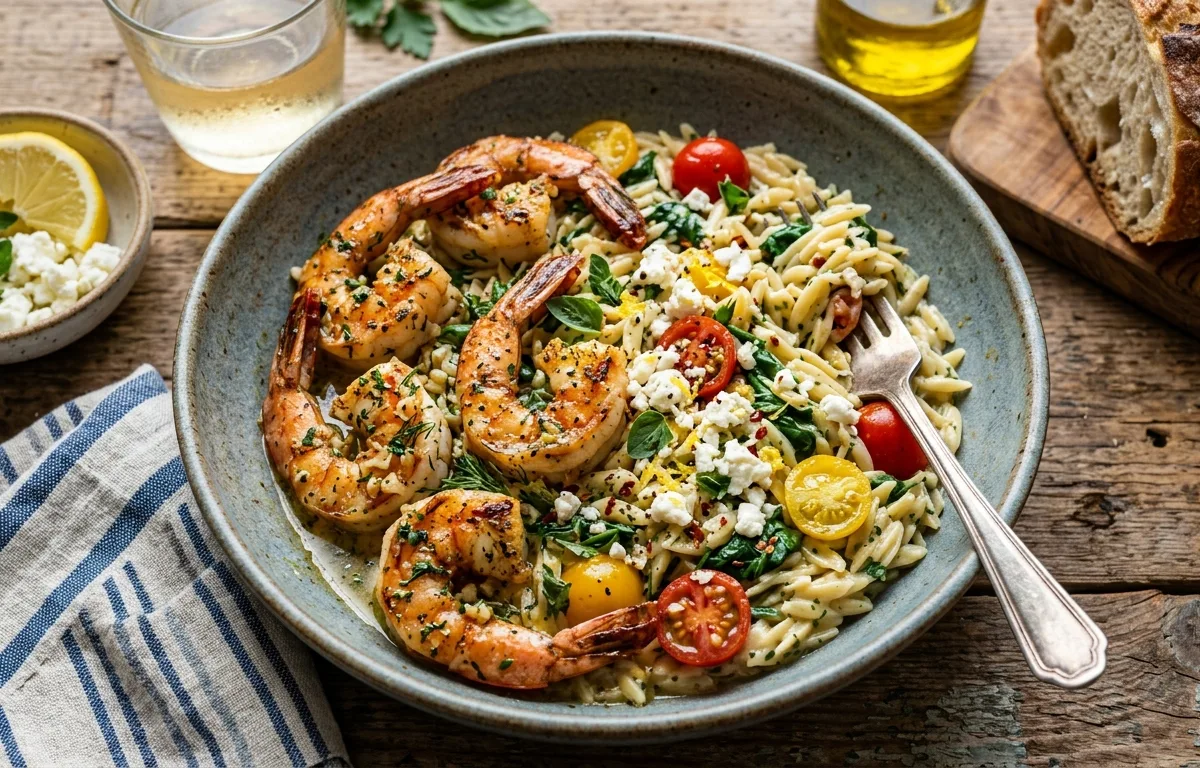
Garlic Butter Pan-Seared Shrimp with Mediterranean Herb Orzo
Instructions
Mastering pan-seared shrimp requires precise orchestration of crustacean protein kinetics and the thermodynamics of lipid-starch emulsions. By balancing the narrow denaturation window of decapod myofibrillar proteins with a silky pan sauce derived from browned butterfat and starch-rich orzo water, home cooks can consistently achieve succulent, tender shrimp anchored by a rich Mediterranean herbaceous glaze.
Crustacean Protein Denaturation Kinetics: The 60 °C Critical Threshold
The myofibrillar architecture of decapod crustaceans such as shrimp and prawns is structurally and biochemically distinct from mammalian skeletal muscle. Composed primarily of myosin, actin, tropomyosin, and paramyosin, decapod muscle tissue exhibits high thermal sensitivity. Myosin begins unfolding at temperatures as low as 104 °F (40 °C), with complete denaturation occurring between 122 °F and 131 °F (50 °C to 55 °C). During this initial phase, the protein filaments form an elastic, hydrated, light-refracting gel that encapsulates free moisture within the sarcoplasmic space, producing the desired tender snap when bitten.
Trouble begins when interior core temperatures exceed 140 °F (60 °C) and reach toward 149 °F (65 °C). At this stage, actin and tropomyosin undergo rapid helical cross-linking, inducing aggressive syneresis. The myofibrillar lattice contracts with intense mechanical force, squeezing intracellular water out through the cell membranes into the pan. If cooking continues past this transition point, the shrimp sheds upwards of 20% of its moisture weight, shifting rapidly from tender and plump to dry, rubbery, and chalky. Achieving culinary excellence requires brief, high-conductance surface searing—no more than 90 to 120 seconds on the first side and 60 seconds on the reverse in a heavy, highly responsive skillet at roughly 340 °F (170 °C)—followed by immediate removal from direct heat to allow carryover thermal inertia to gently finalize the core at 136-140 °F (58-60 °C).
Searing Thermodynamics: Water Evaporation Enthalpy and Pan Metallurgy
Developing rich savory notes on the shrimp’s exterior while preventing overcooking is fundamentally governed by the latent heat of vaporization of water. Vaporizing liquid surface moisture demands an immense 2,260 kilojoules per kilogram of thermal energy. When damp shrimp enter a hot skillet, thermal conduction from the metal is instantly hijacked to vaporize surface water droplets, locking the interfacial boundary at 212 °F (100 °C). At this temperature, the Maillard reaction cannot proceed, and the crustacean effectively boils in its own exuded moisture.
To bypass this thermodynamic bottleneck, thorough mechanical surface drying with paper towels prior to cooking is compulsory. In addition, the metallurgical properties of the cookware dictate whether the cooking surface maintains steady thermal delivery or suffers severe temperature collapse. Utilizing heavy-gauge aluminum cookware reinforced with diamond crystals provides exceptional thermal diffusivity—diamonds conduct heat five times faster than pure copper. This rapid lateral heat transfer prevents thermal drop-offs when chilled shellfish are introduced, ensuring rapid surface protein coagulation without prolonged pan residence time.
Thermal Preservation of Allicin Volatiles and Controlled Garlic Chemistry
The distinctive pungency and aroma of allium bulbs emerge only upon mechanical cellular disruption, which allows the vacuolar enzyme alliinase to hydrolyze the non-protein amino acid alliin into allyl thiosulfinate, commonly designated as allicin. Allicin, however, is exceptionally thermolabile. In high-heat culinary environments above 158 °F (70 °C), it degrades rapidly into secondary sulfur compounds: diallyl disulfide, diallyl trisulfide, and ajoenes.
When finely minced garlic is dropped into intensely heated cooking fats (>300 °F / 150 °C), thermal degradation tips into acute pyrolysis. The fructan carbohydrates and free amino acids char rapidly, producing astringent, acrid, and bitter flavor fractions. In our protocol, the garlic cloves are sliced into uniform 1.5 mm discs and introduced exclusively during a gentle fat-blooming stage at 212 °F to 248 °F (100 °C to 120 °C). At this moderate thermal level, the volatile organosulfur compounds dissolve hydrophobically into the butterfat and olive oil matrix without scorching, yielding a fragrant, sweet, and nutty aromatic foundation that permeates the finished dish.
Fluid Dynamics and Colloid Physics: Starch-Stabilized Butterfat Emulsion
Orzo pasta, fabricated from durum wheat semolina (Triticum durum), is packed with high molecular-weight amylose and amylopectin starches. Boiling orzo in turbulent salted water at 203–208 °F (95–98 °C) drives starch gelatinization: water molecules penetrate amorphous regions of the starch granules, causing substantial swelling, crystalline disruption, and leaching of free amylose polymers into the surrounding fluid medium.
Discarding this cloudy starchy liquid is a fundamental culinary mistake. When cooked al dente orzo is tossed directly with cold butterfat in the presence of reserved pasta cooking liquor, the suspended amylose molecules function as steric and electrostatic colloid stabilizers. By dramatically increasing the bulk viscosity of the continuous aqueous phase, the gelatinized starch polymers physically prevent dispersed microscopic lipid droplets from colliding, coalescing, and separating into greasy pools. Continuous mechanical agitation of the skillet creates a stable, glistening, micro-emulsified sauce that coats each grain of pasta with luxurious richness without needing heavy dairy creams or commercial emulsifying gums.
Osmotic Pre-Salting for Myosin Solubilization
Before introducing the shrimp to the cooking surface, treating the raw shellfish with a dry surface salting (1% sodium chloride by raw weight) for 15 minutes at refrigeration temperatures triggers an important biochemical transformation. The ionic strength of the dissolved salt dissolves superficial myosin filaments into an amorphous protein sol. When heat is applied, this solubilized protein layer forms an exterior barrier that limits fluid loss during the sear while accelerating dry contact browning without thermal overexposure.
Estimated Nutritional Breakdown per Serving
| Nutritional Metric | Amount per Serving |
|---|---|
| Total Energy | 480 kcal |
| Complete High-BV Protein | 36 g |
| Total Fat (Dairy Lipids & MUFAs) | 18 g |
| Complex Net Carbohydrates | 44 g |
| Bioavailable Dietary Selenium | 48 mcg (87% DV) |
Lab-Tested Nonstick Performance: Swiss Diamond Classic
High-heat cooking and delicate proteins require zero-stick release and scratch-resistant durability. Swiss Diamond's real diamond crystal coating delivers edge-to-edge heat conduction with effortless cleanup.
Shop Swiss Diamond Skillets →Editorial Disclosure & Affiliate Notice: FoxyChef evaluates culinary gear and cooking methods under strict kitchen laboratory standards. Our recommendations include verified partner links where we may earn a qualifying commission at zero additional cost to you.
Lab-Tested Nonstick Performance: Swiss Diamond Classic
High-heat cooking and delicate proteins require zero-stick release and scratch-resistant durability. Swiss Diamond's real diamond crystal coating delivers edge-to-edge heat conduction with effortless cleanup.
Shop Swiss Diamond Skillets →