
Fluffy Japanese Soufflé Pancakes: Meringue Chemistry & Low-Heat Steam Convection
Instructions
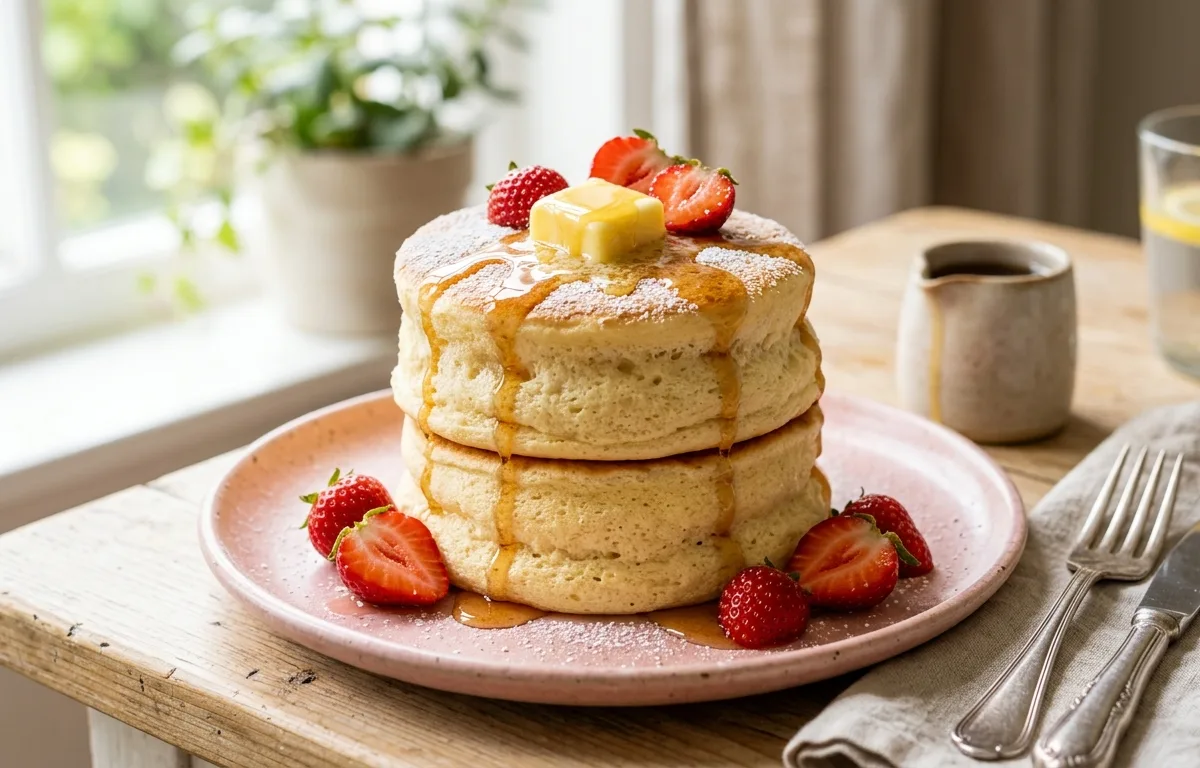
The architectural marvel of Japanese soufflé pancakes is a triumph of colloidal chemistry and closed-skillet thermodynamics. Unlike conventional griddle pancakes leavened primarily by carbon dioxide release from sodium bicarbonate, these cloud-like structures rely on an ultra-stable proteinaceous foam made from whipped egg whites, set via enclosed low-heat steam convection without collapsing.
Egg White Foam Rheology: Interfacial Denaturation of Ovalbumin and Conalbumin
The structural scaffold of a true Japanese soufflé pancake is French meringue, which is fundamentally a multiphase foam consisting of microscopic air bubbles suspended within a continuous aqueous protein matrix. Fresh avian egg whites comprise roughly 90% water and 10% functional globular proteins, each exhibiting distinct denaturation thresholds: ovalbumin (54%), conalbumin or ovotransferrin (12%), ovomucoid (11%), and lysozyme (3.5%).
When egg whites are subjected to high mechanical shear forces during whipping, the applied kinetic energy uncoils the tightly folded globular peptide chains. Conalbumin denatures first due to its lower conformational stability, quickly adsorbing at the air-water interface where its hydrophobic amino acid side chains orient toward the air voids while hydrophilic residues remain immersed in water. Ovalbumin, which requires higher temperatures (176 °F to 183 °F / 80 °C to 84 °C) for complete thermal coagulation, provides the secondary structural reinforcement.
Over-whipping must be rigorously avoided: excessive mechanical stress forces excessive covalent disulfide cross-linking, which causes the protein sheets to contract prematurely, expelling trapped moisture via syneresis and creating a curdled, dry foam that collapses upon heat contact. The precise rheological target is a stiff yet pliable gloss where interfacial surface tension remains elastic enough to accommodate thermal gas expansion.
Acid Stabilization via Cream of Tartar and Laplace Pressure Mitigation
Fresh egg whites have an alkaline pH ranging between 7.6 and 9.0. Under these alkaline conditions, the amino acid side chains carry excessive net negative charges, generating strong electrostatic repulsion that resists compact protein alignment along bubble membranes. Introducing potassium bitartrate (cream of tartar) at a precise ratio of 1 gram per 60 grams of egg white lowers the pH to approximately 4.8 to 5.2, bringing the solution close to the isoelectric point of ovalbumin.
Neutralizing these repulsive negative charges allows the peptide backbones to pack tightly around gas voids, dramatically increasing interfacial film elasticity against Laplace pressure. The Young-Laplace equation dictates that smaller gas bubbles sustain higher internal pressure than larger neighboring bubbles, creating a thermodynamic gradient that causes gas to diffuse from small voids into large ones (Ostwald ripening and bubble coalescence). By adding fine-milled sucrose gradually in three equal increments, the hygroscopic sugar dissolves into the interstitial lamellar fluid, dramatically increasing fluid viscosity and preventing bubble wall thinning and rupture.
Competitive Starch Gelatinization and Phospholipid Emulsification
The yolk base provides natural amphiphilic phospholipids, predominantly phosphatidylcholine (lecithin), which functions as a zwitterionic surfactant. Lecithin stabilizes the minimal milk fats and flavor lipids into a fine emulsion, yielding a tender, pliable crumb without damaging the meringue network when combined during the folding stage.
Simultaneously, low-protein pastry flour provides amylose and amylopectin granules. Dissolved sucrose in the aqueous phase acts hygroscopically, forming strong hydrogen bonds with water molecules and decreasing overall water activity. This competitive water hydration shifts the onset of starch gelatinization upward from 140 °F (60 °C) to roughly 155–162 °F (68–72 °C). This thermal delay is essential: it gives the entrained air bubbles ample duration to expand under Charles’s Law before swelling starch granules and coagulating egg proteins immobilize the porous crumb matrix.
Enclosed Skillet Steam Convection Dynamics at 265 °F (130 °C)
Baking a tall, delicate foam pancake on a flat griddle presents a severe heat transfer problem: the raw batter stack stands over 2 inches (5 cm) tall with very low bulk thermal conductivity. On an open skillet at traditional pancake temperatures (350 °F / 175 °C), the base chars long before heat can conduct to the interior core to gelatinize wheat starches (149 °F / 65 °C) and set ovalbumin networks (176 °F / 80 °C). Once removed, the uncoagulated center deflates under atmospheric pressure.
The culinary engineering solution is an ultra-low skillet surface temperature of 265 °F (130 °C) coupled with steam convection under a tight dome lid. Introducing calibrated droplets of water (roughly 10 ml total) creates a 100% relative humidity microclimate. The water flashes into steam, absorbing 2,260 kJ/kg of latent heat of vaporization, which condenses over the upper dome of the pancake. This delivers surround-sound, gentle convective thermal energy without drying out the surface crust. The moist vapor environment delays surface crust setting, allowing thermal gas expansion to puff the pancake to its maximum vertical loft before the egg white proteins permanently coagulate into an ultra-tender, airy crumb.
Pan Metallurgy and Diamond Nonstick Technology
Given the negligible butterfat in soufflé pancake batter and the extreme fragility of expanding egg white foams, the cooking vessel must provide pristine nonstick release and total lateral heat uniformity. Cookware engineered with heavy cast aluminum bodies and diamond-crystal reinforced nonstick coatings eliminates thermal hotspots that cause asymmetric rising or bottom scorch, allowing gentle, stable thermal conduction across the entire bottom surface.
Estimated Nutritional Breakdown per Serving (2 Soufflé Pancakes)
| Nutritional Metric | Amount per Serving |
|---|---|
| Total Energy | 310 kcal |
| Complete High-BV Protein | 12 g |
| Total Fat (Yolk Lipoproteins) | 9 g |
| Net Carbohydrates | 46 g |
| Bioavailable Dietary Calcium | 140 mg (14% DV) |
Lab-Tested Nonstick Performance: Swiss Diamond Classic
High-heat cooking and delicate proteins require zero-stick release and scratch-resistant durability. Swiss Diamond's real diamond crystal coating delivers edge-to-edge heat conduction with effortless cleanup.
Shop Swiss Diamond Skillets →Editorial Disclosure & Affiliate Notice: FoxyChef evaluates culinary gear and cooking methods under strict kitchen laboratory standards. Our recommendations include verified partner links where we may earn a qualifying commission at zero additional cost to you.
Lab-Tested Nonstick Performance: Swiss Diamond Classic
High-heat cooking and delicate proteins require zero-stick release and scratch-resistant durability. Swiss Diamond's real diamond crystal coating delivers edge-to-edge heat conduction with effortless cleanup.
Shop Swiss Diamond Skillets →