
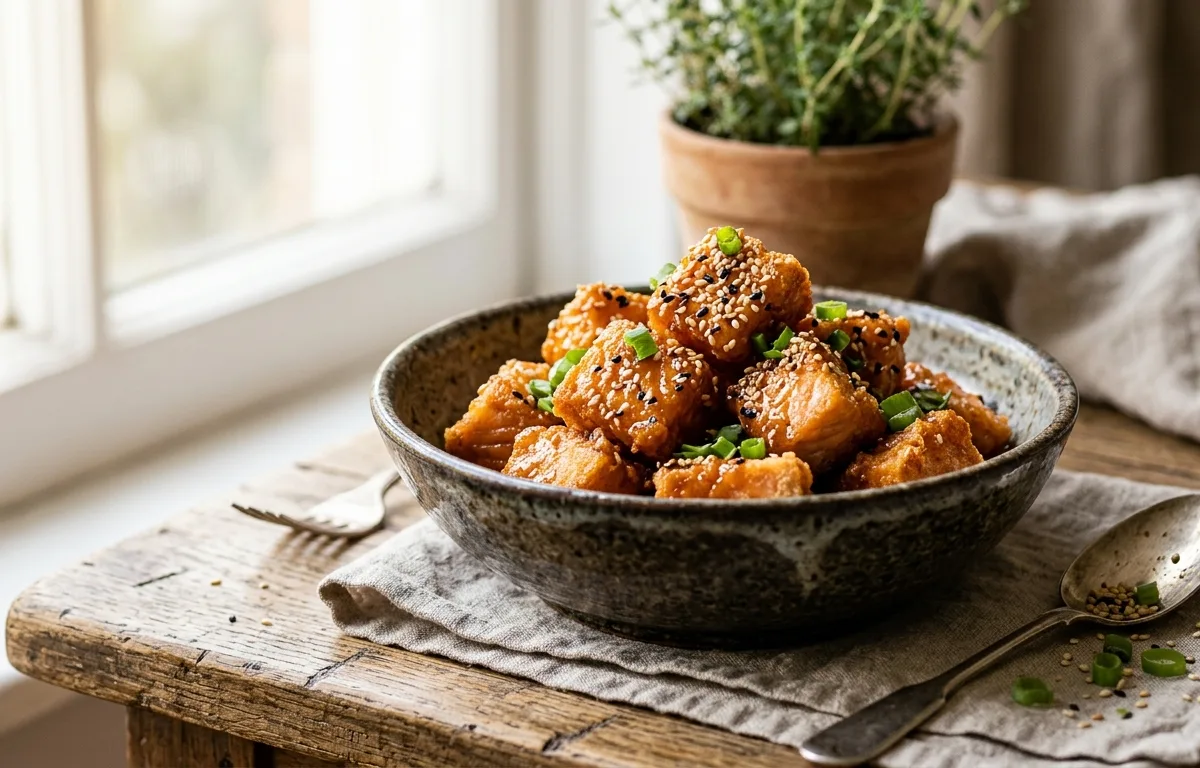
Crispy Air Fryer Honey Sriracha Glazed Salmon Bites
Instructions
Air-frying salmon cubes presents a classical thermodynamic dilemma: driving aggressive surface moisture evaporation to build a crisp, caramelized exterior lacquer while strictly maintaining the delicate core below the thermal threshold that triggers unappealing white albumin extrusion and lipid degradation.
Salmon Albumin Coagulation Kinetics and Heat Transfer Dynamics
The primary technical pitfall when subjecting salmon (Salmo salar) to high dry heat is the sudden eruption of a chalky white film across the surface of the fish. This substance is albumin, an abundant globular sarcoplasmic protein dissolved within the fish’s intracellular fluid. At the histological level, fish muscle consists of short, W-shaped muscle fiber sheets called myotomes, held together by delicate connective tissue sheets known as myocommata. Unlike terrestrial mammalian meats, teleost fish muscle contains little tough collagen, and its contractile proteins—primarily actin and myosin—are substantially more heat-labile.
Myosin begins its denaturation sequence at approximately 40 °C (104 °F), yielding a pleasantly tender and cohesive bite. However, when the internal temperature of the muscle fibers surges past 60 °C (140 °F), the actin filaments undergo rapid and aggressive contraction. This microscopic helical tightening creates significant mechanical pressure throughout the cellular matrix, literally wringing sarcoplasmic moisture out of the muscle fibers. This purged fluid carries liquefied albumin to the exterior. As this protein solution contacts the hot circulating air—exceeding 70 °C (158 °F)—the albumin denatures instantaneously, coagulating into a dense, unattractive curd that robs the fish of moisture and ruins crisping.
To eliminate albumin leakage, two culinary science countermeasures must be deployed. First, an initial surface dry-brining phase creates a localized osmotic barrier and cross-links surface myofibrillar proteins into a tight, resilient seal. Second, short-duration high-heat convection at 200 °C (400 °F) rapidly flash-cooks the outer millimeters of the cube while pulling the fish when its geometric core registers strictly between 50 °C and 52 °C (122 °F to 125 °F), well before actin compression begins.
Forced Convective Boundary Layer Heat Transfer at 200 °C
An air fryer operates not as a quiescent radiant oven, but as a specialized high-speed convective chamber. A high-efficiency vortex fan circulates superheated air across the food at velocities between 1.5 and 2.5 meters per second. In standard oven cooking, foods are enveloped by a stagnant boundary layer of cooler, water-vapor-saturated air that insulates the food and impedes thermal transfer.
The turbulent vortex within the air fryer violently strips away this thermal boundary layer. This increases the convective heat transfer coefficient ($h_c$) by up to 300 percent. The substantial latent heat of water vaporization—2,260 kilojoules per kilogram—is satisfied almost immediately at the surface. Water flashes off as steam within seconds, allowing surface temperatures to ascend past the 140 °C (284 °F) threshold necessary for Maillard browning. A crisp micro-blistered exterior shell develops in less than seven minutes, shielding the delicate core against excessive thermal conduction.
High-Heat Glaze Lacquer Caramelization Without Sugar Scorching
The honey sriracha glaze introduces a high concentration of simple reducing monosaccharides (fructose and glucose in honey) suspended with fermented red chili paste, garlic, and acetic acid. Monosaccharides, particularly fructose, possess notably low thermal decomposition points. Fructose starts to caramelize at a modest 110 °C (230 °F), and prolonged exposure above 160 °C (320 °F) leads directly to destructive pyrolysis—burning the glaze into bitter acrid soot and scorched furans.
For this reason, tossing raw cubes of salmon in honey glaze prior to air-frying is a catastrophic error. The sugar will scorch into blackened carbon minutes before the salmon achieves structural firmness and safe internal temperatures. Our lab protocol dictates air-frying the salmon cubes brushed only with an ultra-thin layer of toasted sesame oil and sea salt for the first 6 minutes. Only during the final 120 seconds of cooking is the hot basket opened, the bites generously coated in the honey-sriracha slurry, and returned to 200 °C (400 °F). In this concentrated 2-minute window, water in the glaze rapidly boils away, transforming the sugars into a clinging, glossy, micro-bubbling culinary lacquer without crossing the threshold of bitter charring.
Preservation of Long-Chain Omega-3 Polyunsaturated Fatty Acids
Salmon is prized for its high content of long-chain polyunsaturated omega-3 fatty acids, specifically eicosapentaenoic acid (EPA) and docosahexaenoic acid (DHA). These fatty acid chains feature multiple unconjugated cis-double bonds, rendering them exceptionally vulnerable to lipid peroxidation and free-radical breakdown under prolonged exposure to heat, light, and atmospheric oxygen.
By portioning the fish into 1-inch (2.5 cm) cubes and accelerating the cooking cycle to under 8 minutes in the air fryer, the cumulative thermal load on the fatty acids is minimized compared to conventional 25-minute baking cycles. The exterior receives the thermal impulse needed for structural crunch, while the core lipids stay within the non-oxidized, nutrient-dense biological window.
Essential Ingredients & Component Selection (Serves 2)
- 1 lb (450g) skinless fresh salmon fillet (center-cut, rich in intramuscular fat, sliced into uniform 1-inch / 2.5 cm cubes)
- 1 tbsp (15 ml) toasted pure sesame oil (serves as a high-heat conductive lipid medium)
- 1 tbsp (15 ml) low-sodium tamari or traditional soy sauce (delivers free glutamic acid and amino precursors for Maillard synthesis)
- 2 tbsp (30 ml) raw unfiltered honey (monosaccharides engineered for high-sheen lacquering)
- 1.5 tbsp (22 ml) authentic sriracha sauce (naturally fermented chili, distilled vinegar, garlic, and sea salt)
- 1 medium clove fresh garlic, finely grated (fresh allicin volatiles)
- 1 tsp freshly grated young ginger root (gingerol and zingiberene aromatics)
- 1 tsp arrowroot or non-GMO cornstarch (hydrocolloid matrix stabilizer that suspends glaze solids)
- 1/2 tsp fine sea salt (calibrated osmotic brining agent)
- 1 tbsp toasted white and black sesame seeds (lipid-rich textural crunch)
- 2 scallions (green onions), thinly sliced on a bias (crisp sulfurous aromatic finish)
Step-by-Step Culinary Masterclass
Step 1: Osmotic Curing & Precision Dehydration
Slice the chilled salmon fillet into symmetrical 1-inch cubes. Symmetrical geometry is critical to maintain an identical surface-area-to-volume ratio across all pieces, guaranteeing synchronized cooking times. Sprinkle the fine sea salt evenly over all surfaces of the cubes and arrange them on a wire rack at room temperature for 10 minutes. The salt draws out surface moisture via osmosis. After 10 minutes, aggressively pat every side of each cube dry with heavy-duty paper towels until completely dry to the touch. This eliminates the evaporative enthalpy barrier.
Step 2: Base Lipid Seasoning & Air Fryer Preheating
In a medium bowl, gently coat the dried salmon cubes with the toasted sesame oil and tamari. The oil forms a microscopic thermal conduction bridge over the fish without reintroducing excess free water. Meanwhile, preheat the air fryer to 200 °C (400 °F) for a full 4 minutes to ensure the metal basket reaches complete thermal equilibrium.
Step 3: Initial Convective Sear (Crust Development)
Place the seasoned salmon bites into the preheated air fryer basket in a single, uncrowded layer, leaving at least 1/2-inch (1.2 cm) of clearance between every piece to allow unobstructed turbulent air circulation. Air-fry at 200 °C (400 °F) undisturbed for exactly 6 minutes. Do not pull the basket during the initial 4 minutes to maintain internal chamber heat and convection velocity.
Step 4: Flash Glazing & Lacquer Synthesis
While the salmon sears, whisk together the honey, sriracha, grated garlic, grated ginger, and cornstarch in a small stainless bowl until smooth. At the 6-minute mark, pull the basket, brush the foaming bites thoroughly with the glaze on all sides, or toss them swiftly in the glaze bowl before returning them to the basket. Air-fry at 200 °C (400 °F) for exactly 2 additional minutes. The sugars will foam violently, shed water vapor, and caramelize into an ultra-glossy glaze.
Step 5: Immediate Thermal Extraction & Garnish
Instantly transfer the salmon bites onto a warm serving platter to halt residual basket heat transfer. Allow them to rest for 2 minutes; during this rest, the glaze’s surface tension sets into a sticky, glossy lacquer while the internal cellular pressures equilibrate. Scatter toasted sesame seeds and fresh scallions over top and serve immediately.
Critical Pitfalls & Scientific Diagnostics
- Glazing Before the Initial Air Fry: Honey sugars burn irreversibly above 160 °C (320 °F). Glazing prior to the initial sear carbonizes the sugars into bitter ash before the fish cooks through. Strictly adhere to the final 2-minute glaze window.
- Basket Overcrowding and Steam Choking: Stacking or clustering fish pieces impedes air circulation. Moisture forced out of the salmon will create a localized steam vapor pocket, resulting in pale, soggy salmon bites instead of a blistered exterior.
- Skipping the Osmotic Dry-Brining Step: Wet surfaces squander convective heat energy on boiling water rather than browning. Thorough surface drying is non-negotiable for rapid Maillard development.
- Overcooking Beyond 55 °C Core Temperature: Exceeding 55 °C internally triggers excessive actin contraction, squeezing white albumin curd outward and drying out the salmon flesh. Aim for an instant-read probe temperature of 50 °C to 52 °C (122 °F to 125 °F) upon extraction.
Macro Breakdown & Nutritional Analysis
| Nutrient Metric | Amount Per Serving (225g cooked) | % Daily Value* |
|---|---|---|
| Total Calories | 430 kcal | 22% |
| High-Bioavailability Protein | 38 g | 76% |
| Total Healthy Fats | 22 g | 28% |
| Net Carbohydrates | 18 g | 7% |
| Active Omega-3 Fatty Acids (EPA + DHA) | 2.8 g | 175% |
| Sodium | 610 mg | 27% |
Lab-Tested Nonstick Performance: Swiss Diamond Classic
High-heat cooking and delicate proteins require zero-stick release and scratch-resistant durability. Swiss Diamond's real diamond crystal coating delivers edge-to-edge heat conduction with effortless cleanup.
Shop Swiss Diamond Skillets →Editorial Disclosure & Affiliate Notice: FoxyChef evaluates culinary gear and cooking methods under strict kitchen laboratory standards. Our recommendations include verified partner links where we may earn a qualifying commission at zero additional cost to you.
Lab-Tested Nonstick Performance: Swiss Diamond Classic
High-heat cooking and delicate proteins require zero-stick release and scratch-resistant durability. Swiss Diamond's real diamond crystal coating delivers edge-to-edge heat conduction with effortless cleanup.
Shop Swiss Diamond Skillets →