
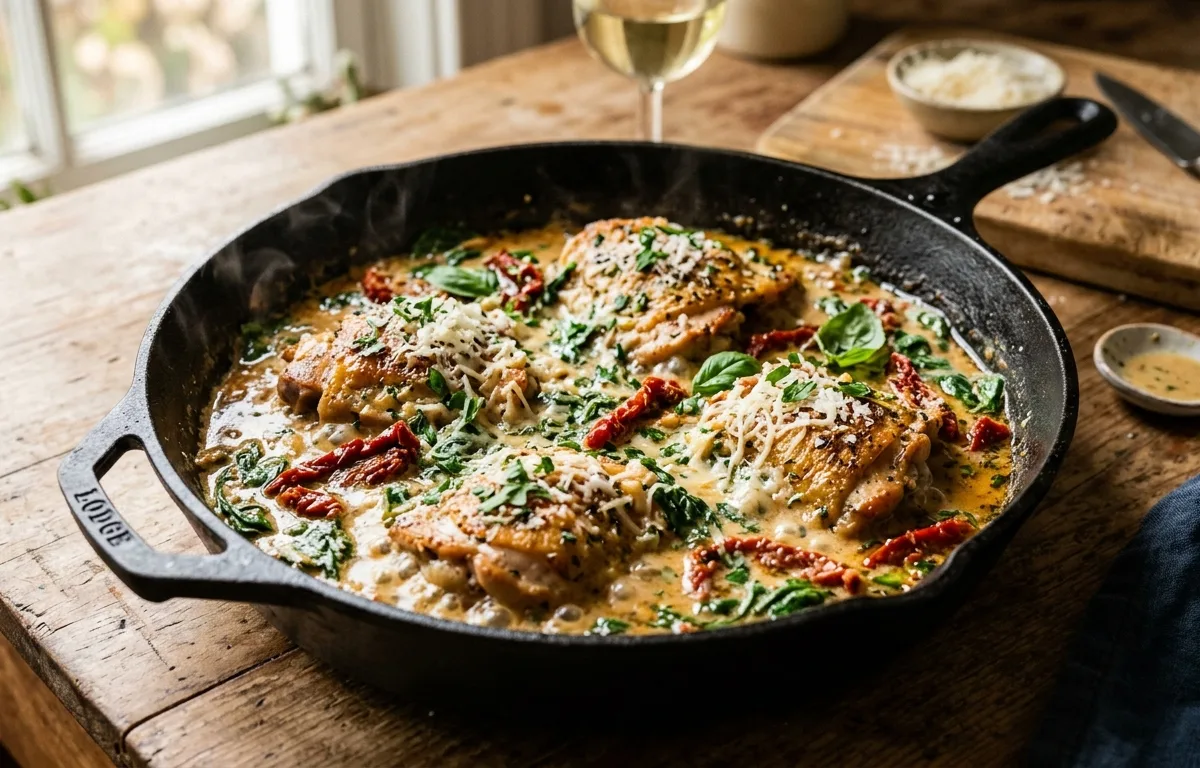
Slow-Baked Tuscan Garlic Chicken with Sun-Dried Tomatoes and Baby Spinach
Instructions
Slow-baked Tuscan garlic chicken with sun-dried tomatoes and tender baby spinach serves as an exemplary showcase of enclosed vessel braising thermodynamics and intermolecular umami synergy. By harnessing the uniform thermal inertia of a heavy lidded stoneware or enameled cast-iron baker, triggering profound nucleotide-glutamate taste receptor binding, and stabilizing a delicate dairy fat-in-water emulsion under low thermal stress, home cooks can consistently produce succulent chicken breast free of cellular moisture purge, enveloped in a silky, deeply savory pan sauce.
Enclosed Vessel Braising Thermodynamics and Myofibrillar Protection
Cooking skinless boneless chicken breasts in an unlidded hot skillet frequently induces severe thermal shock and myofibrillar desiccation. When muscle actomyosin denatures—specifically as myosin unfolds at 60 °C (140 °F) and actin violently contracts past 66 °C (151 °F)—the cylindrical sarcomere filaments squeeze tightly together like a compressed sponge. This physical constriction expels up to 20% of intracellular aqueous weight, resulting in stringy, chalky, desiccated poultry.
To eliminate this fluid loss, our kitchen laboratory employs a two-stage hybrid braising technique inside a high-mass ceramic or enameled cast-iron Dutch oven. In the first phase, we execute a rapid high-temperature sear at 170 °C (338 °F) for just two minutes per side. This kickstarts superficial Maillard melanoidin synthesis on the exterior muscle surface while keeping the interior core completely raw and cold. In the second stage, the heavy lid is sealed in place, and the vessel transfers to a gentle 150 °C (300 °F) oven.
The substantial thermal mass of the cooking vessel absorbs radiant fluctuations, creating an enclosed equilibrium microclimate saturated with localized water vapor. This humid convective environment ensures gentle, non-aggressive conductive heat transfer. The core temperature rises progressively without overshooting the critical 74 °C (165 °F) pasteurization threshold, allowing interstitial collagen to hydrate and soften into gelatin while retaining cellular juices securely inside the muscle fibers.
Molecular Umami Synergy: Inosine Monophosphate and Free L-Glutamate
The intense, savory deliciousness characteristic of classic Tuscan chicken is grounded in receptor-level neurobiology: specifically, the synergistic allosteric activation of human lingual T1R1/T1R3 umami taste receptors.
Avian skeletal muscle tissue naturally contains high concentrations of purine nucleotides, predominantly inosine monophosphate (IMP). Concurrently, sun-dried tomatoes contain extraordinary reserves of free L-glutamic acid (often exceeding 1,200 mg per 100 g dried weight), synthesized during enzymatic protein breakdown under solar dehydration. When consumed independently, either IMP or glutamate binds moderately to taste buds. However, when IMP molecules dock at the allosteric sub-site of the T1R1/T1R3 receptor in the simultaneous presence of free glutamate—amplified further by aged 24-month Parmigiano Reggiano cheese—the receptor undergoes a conformational lock. This molecular synergy multiplies perceived umami intensity by up to eightfold, producing an intensely rich, mouth-coating savoriness that lingers across the palate without artificial seasoning additives.
Thermal Stability of the Dairy Fat Emulsion
A common culinary defect in cream-based pan sauces is lipid syneresis, commonly known as “breaking” or “curdling,” wherein free butterfat separates into an oily slick atop grainy protein coagulates. This breakdown occurs when elevated heat (surpassing 85 °C / 185 °F) or uncontrolled fruit acids rupture the protective casein micelle shells suspended in water.
To maintain a velvety, unified emulsion, we manage three specific physical factors: butterfat volume fraction, thermal blending boundaries, and acid dilution. We utilize fresh heavy cream containing a minimum of 36% milk fat. These spherical dairy globules, cloaked in amphiphilic phospholipid membranes, provide steric hindrance that shields casein micelles against clumping. After deglazing the pan fond with dry Italian white wine (allowing tartaric acids to boil off and ethanol to flash away) and rich chicken bone broth, the heat is modulated down to 75 °C (167 °F). Whisking the cold cream into this warm, gelatin-rich stock forms an elastic oil-in-water emulsion that effortlessly suspends rendered garlic oils and tomato carotenoids without breaking.
Garlic Confiture and Allyl Sulfide Transformation
Raw garlic cloves store alliin and the enzyme alliinase in segregated cellular compartments. When crushed at room temperature, alliinase cleaves alliin into diallyl thiosulfinate (allicin), generating aggressive pungent heat. In this slow-baked preparation, whole crushed cloves are submerged into warm extra virgin olive oil at 90 °C (194 °F) in the base of the vessel for 8 minutes.
This gentle thermal submersion rapidly denatures alliinase before excessive allicin can evolve. Concurrently, prolonged mild heat catalyzes the thermal hydrolysis of garlic fructan oligosaccharides into sweet, caramelized fructose monosaccharides. Sulfurous volatiles decompose into diallyl sulfide and diallyl trisulfide, infusing the cooking oil with mellow, nutty, roasted undertones that enrich the creamy sauce without harsh garlic burn.
Carotenoid Solubilization and Hydrostatic Equilibrium Resting
Sun-dried tomatoes harbor exceptional concentrations of lipid-soluble carotenoids, most notably lycopene and beta-carotene. These vibrant pigments and their associated aromatic volatile compounds are entirely insoluble in aqueous media. Within the warm dairy-fat-in-water emulsion of our braising sauce, however, these lipophilic molecules dissolve completely into the suspended cream globules, turning the sauce a rich Tuscan sunset orange while acting as flavor carriers directly to the retronasal olfactory epithelium.
Following the slow bake, resting the poultry inside the covered vessel for 6 to 8 minutes is paramount. Conductive carryover energy gently finishes pasteurizing the center, while relaxed actomyosin myofibrils re-imbibe concentrated moisture from the surrounding sauce. This hydrostatic stabilization locks in natural poultry juices, ensuring maximum succulent tenderness when carved and served.
Estimated Nutritional Breakdown per Serving
| Nutritional Parameter | Amount per Serving (1 generous breast portion with sauce, approx. 320 g) |
|---|---|
| Total Calories | 460 kcal |
| High-Biological-Value Protein | 48 g |
| Total Lipids (Dairy Butterfat & Olive Oil) | 26 g |
| Net Carbohydrates | 9 g |
| Bioavailable Potassium | 720 mg (21% DV) |
Chef-Grade Induction Cookware: Alva Tri-Ply Multi-Clad
Professional sauce reduction and searing demand flawless thermal response. Alva Cookware combines a fast-heating aluminum core with heavy-gauge 18/10 stainless steel for zero-hotspot culinary control.
Discover Alva Cookware →Editorial Disclosure & Affiliate Notice: FoxyChef evaluates culinary gear and cooking methods under strict kitchen laboratory standards. Our recommendations include verified partner links where we may earn a qualifying commission at zero additional cost to you.
Chef-Grade Induction Cookware: Alva Tri-Ply Multi-Clad
Professional sauce reduction and searing demand flawless thermal response. Alva Cookware combines a fast-heating aluminum core with heavy-gauge 18/10 stainless steel for zero-hotspot culinary control.
Discover Alva Cookware →