
Cream Types: Heavy Cream vs Half-and-Half vs Whipping Cream
Why won't your cream whip? Learn the critical differences in butterfat percentages, curdling thresholds, and culinary uses for heavy cream, half-and-half, and whipping cream.
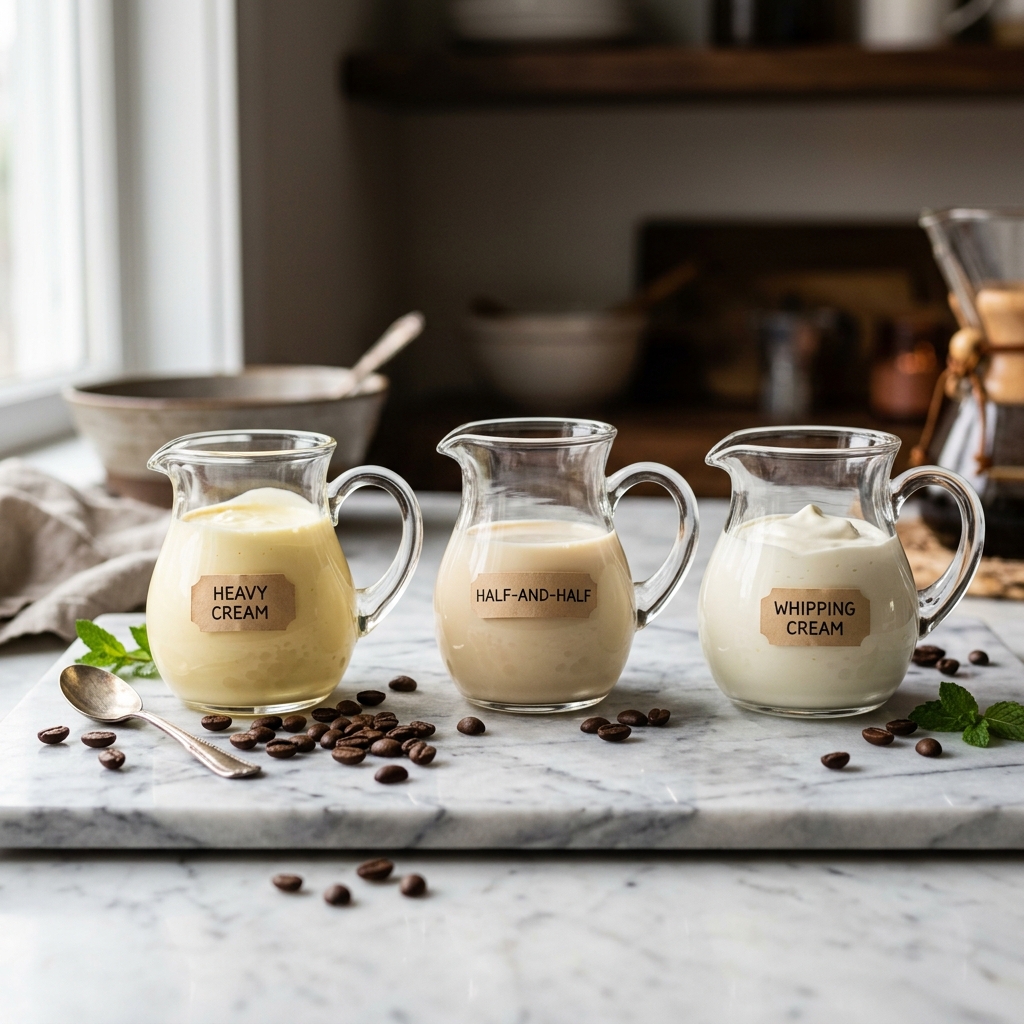
| Cream Product | Butterfat % (Standard) | Calories / 2 tbsp (30g) | Fat / 2 tbsp (g) | Protein / 2 tbsp (g) | Carbs / 2 tbsp (g) | Whip-ability & Peak Structure | Heat & Acid Boiling Behavior |
|---|---|---|---|---|---|---|---|
| Half-and-Half | 10.5% – 18.0% | 39 kcal | 3.5g | 0.9g | 1.3g | 0% (Will NOT whip) | Breaks in rapid acidic boils |
| Light / Table Cream | 18.0% – 30.0% | 59 kcal | 5.7g | 0.8g | 1.1g | Traces only; deflates in seconds | Moderate simmer; avoid hard boil |
| Whipping Cream | 30.0% – 35.0% | 88 kcal | 9.3g | 0.7g | 0.9g | Whips well; soft, pillowy peaks | High simmer stability; softens over 4h |
| Heavy Cream | 36.0% – 40.0% | 102 kcal | 10.8g | 0.6g | 0.8g | Exceptional; stiff, durable peaks | Boils without breaking; stable in ganache |
| Double Cream (UK) | 48.0% | 134 kcal | 14.3g | 0.5g | 0.7g | Ultra-rapid (<90s); overwhipping makes butter | Extreme heat tolerance; direct sauce glaze |
Kitchen rule: Whipping cream (30–35%) and heavy cream (36–40%) swap 1:1 in sauces. For structured cake piping, heavy cream holds shape for days while whipping cream deflates after 4 hours.
Editorial Disclosure: FoxyChef is an independent culinary research and testing portal. All nutritional comparisons, kitchen temperature benchmarks, and whipping analyses are performed in our studio test kitchen. When you buy recommended kitchen equipment through our links, we may earn an affiliate commission at no extra cost to you.
The Fundamental Butterfat Hierarchy
When selecting dairy cream in the supermarket, every culinary outcome—from creating velvety pan sauces to piping decorative pastry rosettes—is dictated by a single chemical measurement: butterfat percentage. Butterfat consists of microscopic lipid droplets suspended in watery skim milk, surrounded by a fragile protective phospholipid membrane. The concentration of these lipid droplets dictates whether a cream can form a rigid foam, withstand rolling boil heat, resist citrus curdling, or thin out into an unctuous coffee pour.
Under United States FDA regulations (21 CFR Part 131), dairy creams are strictly categorized by their minimum legal fat content. In Europe and the United Kingdom, classification extends further into high-density single and double creams. Understanding these precise distinctions guarantees that your pastry frostings never weep and your savory pan reductions never separate into greasy curd pools.
Full 5-Cream Empirical Macro & Performance Dataset
The following empirical data table compares all five standard culinary cream varieties across butterfat ranges, caloric density, macro distribution per two-tablespoon (30g) household serving, foam stability, and high-heat tolerance.
The Physics of Whipping: Why Low-Fat Cream Fails
To understand why half-and-half and light cream cannot be whipped, consider the physical mechanics of culinary foam creation. When you whisk liquid cream, beaters introduce millions of tiny air bubbles into the watery serum. Simultaneously, the mechanical shearing force strips away portions of the delicate phospholipid membrane shielding each fat globule.
When cream contains at least 30% butterfat, these exposed hydrophobic fat cores rapidly collide and fuse into an interlocking three-dimensional lattice. This rigid network of coalesced fat droplets lines the perimeter of every air pocket, physically trapping the bubbles and preventing water drainage (syneresis). However, this structural phenomenon only occurs when two critical environmental conditions are met:
- Sufficient Fat Concentration (>30%): In half-and-half (10.5% to 18% fat), fat globules are spaced too far apart in the water phase. Whisking introduces air, but bubbles immediately rise to the surface and pop because there are too few lipid droplets to establish structural walls.
- Cold Temperature Control (<40°F / 4°C): Butterfat melts between 90°F and 95°F (32°C to 35°C), but it softens and loses structural rigidity at room temperature (68°F / 20°C). If you attempt to whip cream above 50°F (10°C), colliding fat globules liquefy and merge into large greasy oil slicks rather than establishing an elastic scaffolding. Always chill your stainless steel mixing bowl and wire whisk attachments for 15 minutes before beating.
Whipping Cream (30–35%) vs Heavy Cream (36–40%): Practical Pastry Differences
While standard whipping cream and heavy cream appear interchangeable on retail shelves, their performance in bakery applications diverges dramatically after four hours of resting:
- Texture and Mouthfeel: Whipping cream incorporates a higher volume of air, producing a lighter, delicate foam that melts cleanly on the palate. It is the premier choice for folding into chocolate mousses, topping warm fruit pies, or dolloping over Irish coffee.
- Structural Longevity & Weeping: Because heavy cream contains 36% to 40% fat, its cell walls are substantially thicker and denser. Whipped heavy cream retains sharp piped edges and resists weeping for up to 48 hours in the refrigerator. In contrast, standard whipping cream begins leaking watery serum and deflating after 3 to 4 hours. When frosting an elaborate celebration cake or piping éclairs, always choose heavy cream.
Sauce Reductions & Curdling Resistance: Why Alfredo Requires Heavy Cream
In hot pan cookery, dairy products face intense thermal stress and potential acid shocks from wine reductions, tomatoes, or citrus juices. When milk or half-and-half is subjected to boiling temperatures, water rapidly evaporates while casein proteins precipitate, forming an unsightly curdled appearance with floating white grains.
Heavy cream is completely immune to this problem. At 36% to 40% fat, the sheer volume of lipid micelles physically buffers casein proteins from clumping together, even during vigorous boiling. In a classic Fettuccine Alfredo or pan-seared steak au poivre, heavy cream can be boiled vigorously and reduced by half without breaking, forming a naturally emulsified, glossy glaze that clings tightly to pasta strands without needing cornstarch or flour roux thickeners.
Culinary Limitations & Drawbacks (Cons)
- Structural Degradation in Whipping Cream: Standard whipping cream (30% to 35% fat) begins weeping watery serum and deflates within three to four hours in the refrigerator, making it unsuitable for freestanding tiered cakes without added stabilizers.
- Thermal Separation in Lower-Fat Creams: Half-and-half cannot be reduced over vigorous boiling heat without splitting into separate curds and whey unless tempered with starch or flour.
- Substantial Caloric Density in Heavy Cream: Heavy cream delivers over 100 calories and 10.8 grams of fat per two tablespoons, requiring strict portion control in calorie-conscious meal planning.
Kitchen Replacement Ratios & Equivalency Formulas
When you find yourself short of a specific cream product mid-recipe, apply these tested kitchen ratios:
1. Whipping Cream for Heavy Cream (Direct Swap)
Ratio: 1:1 direct volume replacement. In hot sauces, soups, and ganache, whipping cream swaps seamlessly. For pastry decorating, add 1 tablespoon of powdered sugar (which contains cornstarch) or ¼ teaspoon of bloomed gelatin per cup of whipping cream to reinforce peak rigidity.
2. Heavy Cream to Half-and-Half (Baking & Sauces)
To substitute 1 cup of heavy cream using half-and-half in batters, quiches, or soups:
Formula: Combine ⅞ cup (210ml) of Half-and-Half with 2 tablespoons (28g) of melted unsalted butter. Whisk until emulsified. Note: This substitution will enrich fat content for cooking but will not whip.
3. Heavy Cream to Whole Milk (Emergency Cooking Blend)
To substitute 1 cup of heavy cream in savory cooking or quick breads using whole milk:
Formula: Combine ¾ cup (180ml) of Whole Milk with ⅓ cup (75g) of melted unsalted butter. Whisk thoroughly while warm before incorporating into the pan.