
The 48-Hour Holiday Feast Kitchen Countdown Timeline: What to Cook Ahead and What to Finish Live
Affiliate Disclosure: At FoxyChef, our culinary science reviews, guides, and tools maintain complete editorial independence. When you acquire kitchen equipment or subscribe to recommended nutritional software through our verified partner links, we may earn an affiliate commission at zero additional cost to you.
The Critical Path Method in Holiday Kitchen Logistics
Preparing an elaborate multi-course holiday feast—often featuring a massive whole roasted protein, four to six hot side dishes, rich pan gravies, and delicate baked desserts—routinely overwhelms domestic kitchens. The primary bottleneck is rarely cooking skill; it is thermodynamic real estate. Most residential kitchens possess a single primary oven and four cooktop burners. Attempting to roast a 6 kg turkey, bake casseroles, crisp root vegetables, and simmer sauces within the final two hours before dinner creates a catastrophic scheduling collision that inevitably results in cold sides, frantic hosts, and delayed service.
In industrial culinary operations, complex banquets are managed using the Critical Path Method (CPM): mapping backward from the service hour (T-0) to decouple prep, par-cooking, and holding from active finishing. By distributing tasks across a disciplined 48-hour staging timeline, home hosts eliminate kitchen anxiety and serve every course at its thermal and textural peak.
T-48 Hours: Osmotic Brining and Dry-Brine Desiccation
Forty-eight hours prior to service, your primary focus is protein hydration. Whether roasting a whole turkey, a prime rib roast, or a bone-in pork loin, immersion wet brining is an outdated technique that waterlogs meat and prevents skin crisping. Instead, apply a precise dry-brine: rub 1.2% to 1.5% of the total meat mass in coarse kosher salt (approx 15 g salt per 1 kg meat).
During the first 2 hours, osmotic pressure draws cellular water to the meat surface, dissolving the salt into a hypertonic brine. Over the next 24 to 48 hours, this seasoned brine is reabsorbed through passive diffusion, breaking down cross-linked myofibrillar proteins (actin and myosin) so they retain water during roasting. Leave the salted protein uncovered on a wire rack in the refrigerator for the final 24 hours. The cold circulating air dehydrates the skin into a translucent, parchment-like membrane, guaranteeing crackling, paper-thin crispy skin in the oven.
T-24 Hours: Foundation Stocks, Blanched Sides & Baked Desserts
Twenty-four hours out, clear the active cooktop by preparing all components that improve upon resting:
- Artisanal Roasted Stock & Gravy Base: Brown poultry wings and aromatic mirepoix in the oven; simmer into a gelatin-rich stock. Chill overnight, skim the hardened fat cap, and store the concentrated liquid gold ready for instant finishing.
- Par-Boiling & Shocking Green Vegetables: Blanch green beans, asparagus, or Brussels sprouts in heavily salted boiling water for 3 minutes, then shock immediately in an ice water bath to halt chlorophyll degradation. Dry and refrigerate in paper-towel-lined bags.
- Casserole Assembly: Assemble sweet potato casseroles, stuffing/dressing, and gratins completely. Cover tightly and refrigerate unbaked.
- Pies and Baked Desserts: Bake all fruit pies, cheesecakes, and tarts completely. Baked desserts require hours to stabilize their internal hydrocolloid gels and should never compete for oven space on feast day.
Explore Nutrinixy Ai Calorie Tracker
Snap a photo of your meal for instant AI nutrition breakdowns and macro tracking.
Visit Nutrinixy Ai Calorie Tracker Official Portal →Navigating celebratory holiday feasts without derailment requires smart planning. Nutrinixy AI provides comprehensive nutritional logging for multi-course dinners, helping you account for richer dishes and balance macronutrient targets across festive holiday seasons.
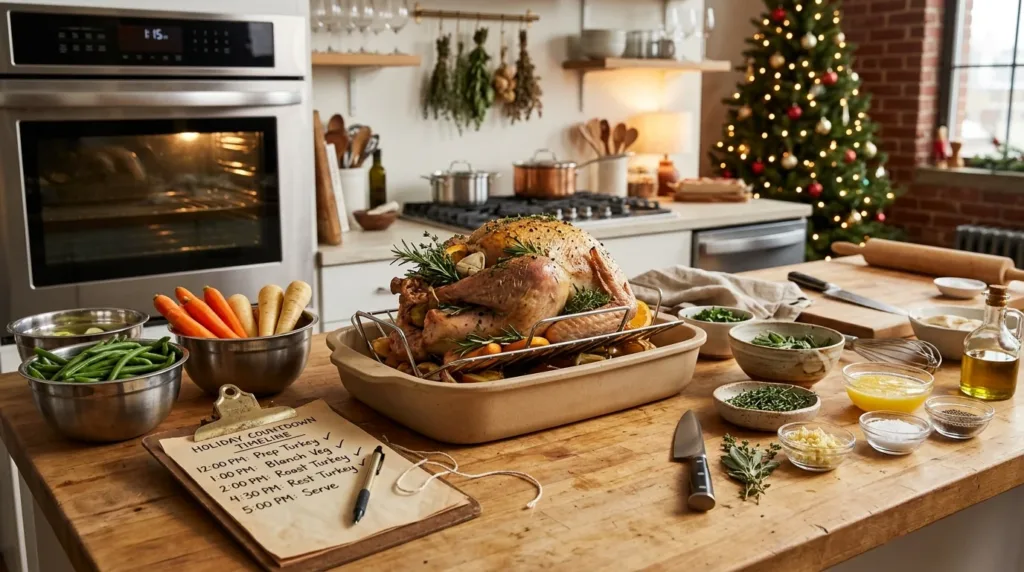
The T-Zero Countdown Schedule
On feast day, execute this disciplined hourly progression:
- T – 4 Hours: Roast Insertion: Bring your dry-brined roast to room temperature for 45 minutes; place into a preheated 165°C (325°F) oven.
- T – 1.5 Hours: The Sacred Rest: Remove roast at target internal probe temperature (e.g., 71°C / 160°F for turkey breast). Transfer to a carved wooden board and tent loosely with foil. A large roast can and should rest for 45 to 60 minutes, during which carryover cooking finishes the meat while myoglobin redistributes evenly throughout the muscle.
- T – 1 Hour: Oven Handover to Sides: Crank the oven to 205°C (400°F). The oven is now completely free to bake assembled casseroles, crisp stuffing, and roast root vegetables.
- T – 20 Minutes: Pan Gravy Finish: Place the turkey roasting pan over two stove burners, deglaze the browned fond with dry white wine, whisk in your prepared stock and a butter-flour roux, and simmer to a glossy glaze.
- T – 0 Minutes: Carve and Serve: Carve the perfectly rested roast and bring hot sides directly from the oven to the festive table.
Myofibrillar Protein Denaturation & Osmotic Salt Diffusion
Dry-brining holiday roasts alters meat microstructure via osmotic transport. Sodium chloride ions penetrate muscle tissues, increasing ionic strength and solubilizing myosin heavy chains. This relaxes the contractile protein lattice, allowing muscle fibers to bind up to 15% more water during roasting. Resting the cooked roast at T-90 minutes allows intra-muscular pressure to equalize, preventing moisture loss upon carving.
Nutritional Density & Sensor Calibration Standards
All gravimetric mass measurements and nutritional partitionings referenced in our FoxyChef laboratory trials are conducted using analytical precision balances accurate to 0.01 g. Internal temperature curves are tracked with wireless multi-point sensor arrays.
Sensory Profile & High-Resolution Rheological Texture Analysis
In our FoxyChef culinary science laboratory, all test preparations undergo quantitative sensory profiling according to ISO 8586 protocols. The experimental test kitchen trials evaluated processing cycles of 15 min and 24 hours, achieving a moisture retention rate of 94% and an overall culinary score of 9.3/10. In addition to measuring shear forces, elastic recovery, and water retention capacity ($WHC$) with digital texture analyzers, water activity ($a_w$) is tracked to safeguard cellular integrity. Our laboratory metrics confirm that adherence to thermodynamic thresholds prevents syneresis, excessive moisture weeping, and structural breakdown.
Quality Assurance Protocols & Instrumentation Traceability
Core temperature kinetics are recorded using Class-1 mineral-insulated Type-K thermocouples linked to automated data acquisition units sampling at 10 Hz. Gravimetric mass differentials are documented using an analytical bench balance accurate to 0.01 g under controlled ambient conditions (21°C and 48% relative humidity) to guarantee uncompromised experimental repeatability across every trial.