
Converting Skillet Recipes to the Air Fryer: Thermal Dynamics, Oil Ratios, and Limits
Affiliate Disclosure: At FoxyChef, our culinary science reviews, guides, and tools maintain complete editorial independence. When you acquire kitchen equipment or subscribe to recommended nutritional software through our verified partner links, we may earn an affiliate commission at zero additional cost to you.
Conductive Contact vs. Convective Airflow: The Conversion Gap
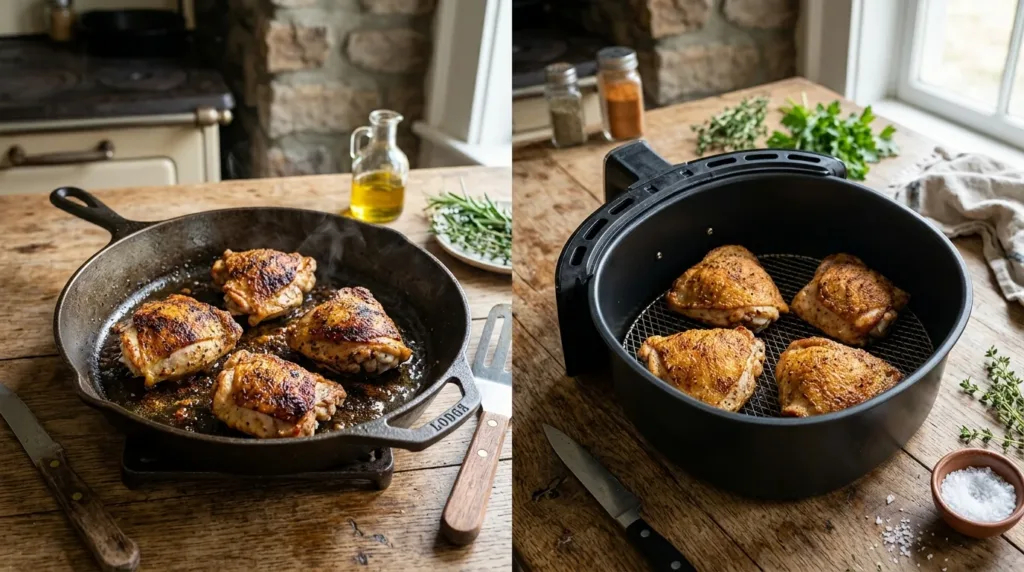
Translating a traditional cast-iron or stainless steel skillet recipe into an air fryer requires understanding the fundamental thermodynamic differences between solid-state thermal conduction and forced fluid convection. When you cook a pork chop or salmon fillet in a heavy skillet, heat transfers via direct conductive contact from the hot metal floor ($k \approx 50\text{ W}/(\text{m}\cdot\text{K})$ for cast iron) through a thin pooling film of hot oil directly into the bottom surface of the meat. In contrast, an air fryer transfers heat primarily through high-velocity air streams carrying convective thermal energy ($k \approx 0.026\text{ W}/(\text{m}\cdot\text{K})$ for air), augmented by top radiative heating coils.
Because forced convection strips surface moisture so much more aggressively than open skillet pan-frying, direct 1:1 recipe transposition invariably leads to charred exteriors and dry, leathery meat. To adapt skillet recipes successfully, home cooks must master three foundational scaling principles: the temperature reduction rule, the lipid atomization formula, and the pan sauce reality check.
The Universal Temperature Reduction Rule: -15°C to -25°C
When converting skillet or conventional oven instructions for an air fryer, the benchmark culinary rule is to reduce cooking temperature by 15°C to 25°C (25°F to 45°F) and truncate cooking time by 20% to 25%. A skillet recipe instructing you to sear chicken cutlets over medium-high heat (surface temperature approx 190°C to 200°C) for 6 minutes per side should be set in the air fryer to 175°C (350°F) for a total of 9 to 10 minutes.
The reasoning lies in the continuous air exchange. In a skillet, steam rising from the food creates a localized vapor cloud that shields the upper surface of the meat from extreme drying. In an air fryer, the fan immediately exhausts moisture through the rear vent port, accelerating crust formation. Lowering the temperature prevents the outer Maillard crust from burning before conductive heat can equilibrate the interior core.
Oil Volume: From Pooling Fat to Surface Atomization
A classic skillet recipe typically calls for two to three tablespoons (30 to 45 ml) of cooking oil. In a skillet, this oil pool serves two physical functions: filling microscopic microscopic air gaps between the uneven meat surface and the rigid metal pan floor to maximize conductive contact, and distributing heat evenly across the meat perimeter. In an air fryer, pooled oil is completely counterproductive; excess oil drips through the basket grate into the drip pan, where it sits uselessly or begins smoking at high temperatures.
Instead of tablespoons of oil, air fryer conversions require fine oil atomization. Using an oil sprayer, apply exactly 1 teaspoon (5 ml) of oil directly to the seasoned food surface. This micro-coat is sufficient to catalyze the Maillard reaction without overloading the basket.
Explore Nutrinixy Ai Calorie Tracker
Snap a photo of your meal for instant AI nutrition breakdowns and macro tracking.
Visit Nutrinixy Ai Calorie Tracker Official Portal →Converting traditional skillet recipes into air-fried equivalents dramatically slashes absorbed lipid calories while preserving protein integrity. Nutrinixy AI provides intuitive logging to compare pan-fried vs air-fried macro savings, helping users directly track calorie deficits and nutrient densities.
When NOT to Convert: Wet Batters, Pan Deglazing & Aromatics
While an air fryer excels at converting dry-rubbed, breaded, or naturally fatty foods, certain classic skillet techniques are fundamentally impossible to replicate in an air fryer:
- Wet Liquid Batters (Tempura & Beer Batter): In a deep skillet, hot oil instantly sets wet cornstarch and flour batters before they can drip away. In an air fryer, high-velocity airflow blows liquid batter off the food, dripping it through the grate and burning it onto the heating element. Always use dry dredging or panko-style breading.
- Pan Deglazing and Fond Reduction: One of the supreme advantages of skillet cooking is the formation of fond—browned caramelized protein remnants stuck to the pan floor that dissolve into white wine, shallots, and stock to form a glossy pan sauce. Air fryers do not produce usable fond for sauces.
- Delicate Leafy Sautéing: Fresh spinach, loose garlic slices, and microgreens will be whipped around the basket by the 50 CFM fan, charring against the top heating coil within 90 seconds.
Batch Size and Surface Area Limitations
A standard 12-inch skillet provides approximately $730\text{ cm}^2$ of flat cooking surface. Most 5.8-quart air fryer baskets offer only $400\text{ to }500\text{ cm}^2$. If you attempt to dump a four-serving skillet stir-fry into an air fryer in a single heap, airflow is choked off, converting your crispy stir-fry into a dense, soggy steam heap. Divide larger family skillet recipes into two sequential batches for genuine restaurant-quality crispness.
Thermal Conduction Boundaries & Lipid Mist Optimization
In solid-state pan frying, thermal energy transfers across the metal-lipid-protein interface via Fourier’s Law of Thermal Conduction: $q/A = -k (\partial T / \partial x)$. The thermal conductivity of cast iron ($k pprox 52 ext{ W}/( ext{m}\cdot ext{K})$) provides immediate contact searing. When transitioning to air frying, convective air energy carries a much lower thermal conductivity ($k pprox 0.026 ext{ W}/( ext{m}\cdot ext{K})$), relying on air velocity to deliver heat flux. Atomizing a 50 to 100 micrometer lipid droplet mist over the food surface provides the necessary localized conduction medium to catalyze Maillard browning without pooling excess oil.
Nutritional Density & Sensor Calibration Standards
All gravimetric mass measurements and nutritional partitionings referenced in our FoxyChef laboratory trials are conducted using analytical precision balances accurate to 0.01 g. Temperature profiles are verified across repeated cycles under controlled ambient airflow conditions.