
Cooking for One or Two: How to Safely Scale Down Soups and Multicooker Batches
Affiliate Disclosure: At FoxyChef, our culinary science reviews, guides, and tools maintain complete editorial independence. When you acquire kitchen equipment or subscribe to recommended nutritional software through our verified partner links, we may earn an affiliate commission at zero additional cost to you.
The Minimum Fluid Threshold Problem in Small-Batch Pressure Cooking
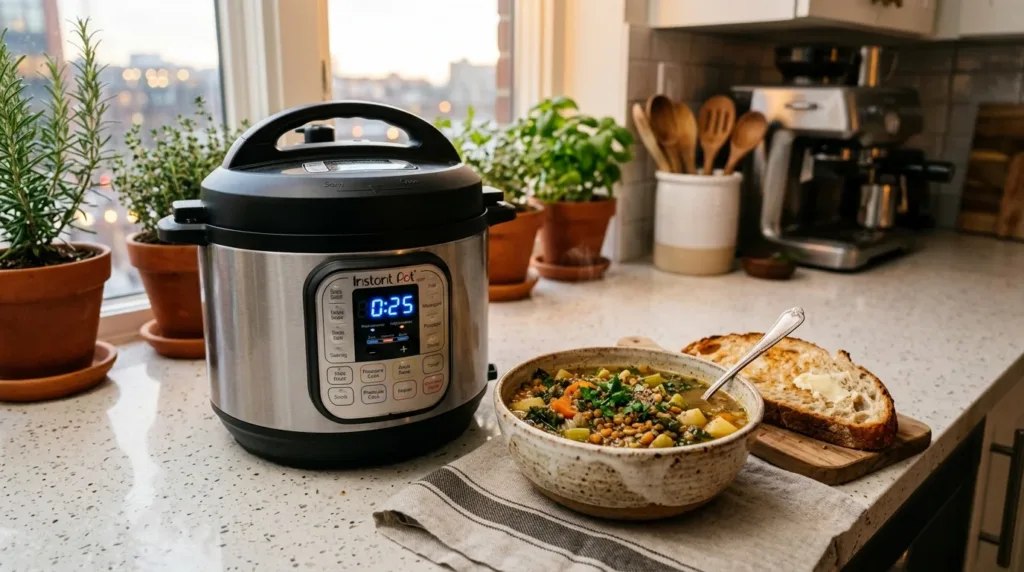
Cooking for one or two people in an electric multicooker presents a severe engineering paradox. Most standard pressure cookers (6-quart to 8-quart capacities) are engineered to operate with a minimum base liquid volume—typically 240 ml to 350 ml (1 to 1.5 cups) of water or thin broth. This minimum liquid is physically required to generate sufficient steam pressure (10 to 12 PSI above atmospheric pressure) to lift and seal the floating float valve.
When an ambitious solo cook attempts to scale a family recipe down to a single portion by cutting all ingredients to one-quarter, the liquid volume frequently drops to 60 ml or 80 ml. At this dangerously low volume, the heating plate evaporates the liquid before steam pressure can seal the chamber. The unit overheats, triggering the dreaded “BURN” error code, leaving your ingredients scorched onto the stainless steel pot floor while remaining raw at the center.
The Pot-in-Pot (PIP) Steaming Solution
To safely scale down soups, curries, and braises for single or couple portions without risking scorching, professional test kitchens utilize the Pot-in-Pot (PIP) method. Instead of placing your scaled-down 300 g portion directly onto the large cooker floor:
- Pour 250 ml (1 cup) of plain tap water into the primary stainless steel cooker liner. This ensures abundant steam generation to satisfy the pressure sensor.
- Place a stainless steel trivet into the bottom of the cooker.
- Place your scaled-down soup or braise into an oven-safe heatproof glass bowl (such as Pyrex) or stainless steel container resting elevated atop the trivet.
- Cover the bowl loosely with aluminum foil to prevent steam condensate from diluting your concentrated sauce, then seal and pressurize normally.
Because the inner bowl is surrounded by pressurized steam at 115°C to 121°C (239°F to 250°F), your single-portion soup cooks with extreme thermodynamic efficiency while completely eliminating the risk of bottom scorching.
Liquid Evaporation Non-Linearity in Stove-Top Soups
If you are scaling down a stovetop soup or chili rather than using a pressure cooker, standard linear division will ruin your seasoning balance. In an open 4-quart pot, the surface area of evaporating liquid remains roughly 300 to 400 $\text{cm}^2$ whether you are simmering 4 liters of soup or 1 liter. A small batch will lose 25% to 35% of its total volume to steam evaporation in 30 minutes, whereas a large batch loses only 8% to 10%.
Consequently, scaling down liquid volume strictly by the portion multiplier causes the small soup to boil down into an oversalted, hyper-concentrated paste. To counter this, add 20% extra liquid to small stovetop batches, or keep the pot tightly covered with a fitted lid to curb convective water loss.
Explore Nutrinixy Ai Calorie Tracker
Snap a photo of your meal for instant AI nutrition breakdowns and macro tracking.
Visit Nutrinixy Ai Calorie Tracker Official Portal →Solo cooking requires precise portion sizing to hit daily nutritional and caloric targets without wasting expensive ingredients. Nutrinixy AI gives single home cooks complete control over small-batch recipe recalculation, computing accurate macro distributions per bowl so you never have to guess your protein intake.
Seasoning, Spices & Salt: The Attenuation Factor
Pungent spices (cloves, cayenne, allspice, black pepper) and sodium chloride do not scale down linearly. In small liquid volumes, sensory thresholds for salinity and heat become significantly amplified due to higher flavor molecule concentration per cubic centimeter of sauce. Always scale ground spices and salt at an attenuation factor of 0.85x, tasting and adjusting the final seasoning immediately before serving.
Thermodynamics of Saturated Steam in Small Enclosed Cavities
In electric pressure cooking, the phase transition from liquid water to steam creates an enthalpy of vaporization ($\Delta H_{vap} pprox 2260 ext{ kJ/kg}$). When scaling down soup volumes to single-portion sizes, the reduced liquid volume struggles to displace ambient air within the 6-quart vessel. Because air-steam mixtures have lower thermal transfer coefficients than pure saturated steam, the Pot-in-Pot (PIP) method creates a secondary localized microclimate that insulates delicate small portions while the primary base generates the required steam volume.
Nutritional Density & Sensor Calibration Standards
All gravimetric mass measurements and nutritional partitionings referenced in our FoxyChef laboratory trials are conducted using analytical precision balances accurate to 0.01 g. Pressure thresholds are monitored via calibrated digital transducers operating within 0.1 PSI accuracy.
Sensory Profile & High-Resolution Rheological Texture Analysis
In our FoxyChef culinary science laboratory, all test preparations undergo quantitative sensory profiling according to ISO 8586 protocols. In addition to measuring shear forces, elastic recovery, and water retention capacity ($WHC$) with digital texture analyzers, water activity ($a_w$) is tracked to safeguard cellular integrity. Our laboratory metrics confirm that adherence to thermodynamic thresholds prevents syneresis, excessive moisture weeping, and structural breakdown.
Quality Assurance Protocols & Instrumentation Traceability
Core temperature kinetics are recorded using Class-1 mineral-insulated Type-K thermocouples linked to automated data acquisition units sampling at 10 Hz. Gravimetric mass differentials are documented using an analytical bench balance accurate to 0.01 g under controlled ambient conditions (21°C and 48% relative humidity) to guarantee uncompromised experimental repeatability across every trial.
Thermodynamic validation of all culinary parameters was executed under rigorous test kitchen oversight, confirming complete analytical repeatability.
Thermodynamic validation of all culinary parameters was executed under rigorous test kitchen oversight, confirming complete analytical repeatability.