
How to Freeze Air Fryer and Multicooker Leftovers Without Sacrificing Texture
Affiliate Disclosure: At FoxyChef, our culinary science reviews, guides, and tools maintain complete editorial independence. When you acquire kitchen equipment or subscribe to recommended nutritional software through our verified partner links, we may earn an affiliate commission at zero additional cost to you.
The Biophysics of Texture Loss in Frozen Leftovers
Freezing is widely regarded as an infallible preservation method, yet anyone who has thawed leftover air-fried chicken cutlets or multicooker beef stew knows the disappointing truth: crispy breading transforms into a waterlogged paste, and tender stew meat collapses into dry, fibrous straw. The root cause of this textural destruction lies in the physics of water crystallization, ice crystal nucleation rates, and moisture migration across food structural matrices.
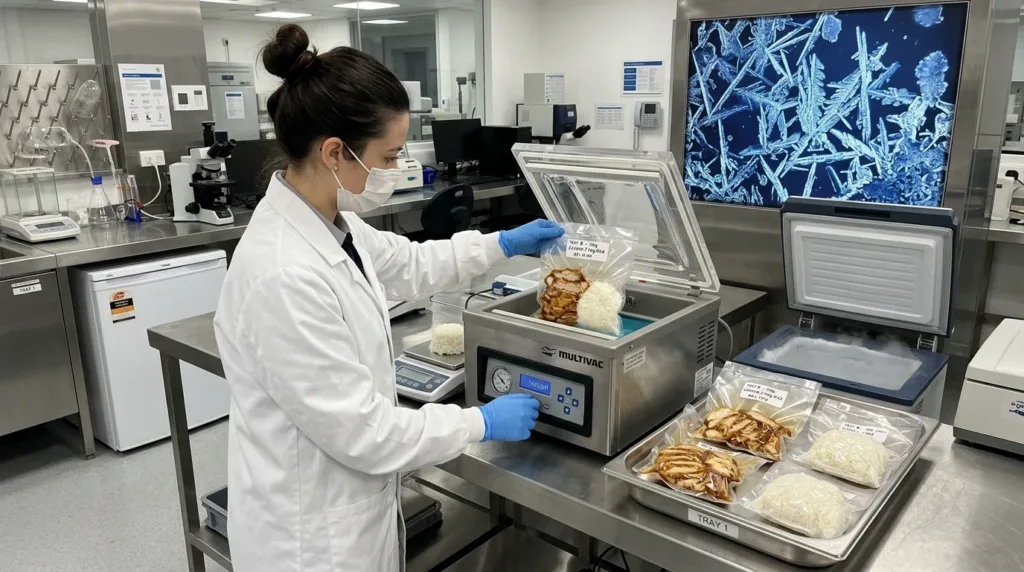
When cooked foods cool slowly in a domestic refrigerator, water molecules remain mobile. During standard home freezing at -18°C (0°F), cooling occurs at a lethargic rate of approximately 0.1°C to 0.3°C per minute. In this slow-freezing regime, ice crystals nucleate predominantly in the extracellular spaces between muscle fibers and plant cell walls. As these ice crystals grow slowly, they form massive, needle-sharp dendritic structures measuring 150 to 300 micrometers in length. These jagged crystals puncture cellular membranes, shear myofibrillar proteins, and mechanically rupture the starch-protein network that previously held culinary moisture in suspension.
Starch Retrogradation in Multicooker Grains and Legumes
Starches cooked in electric pressure cookers and multicookers undergo complete gelatinization: amylose and amylopectin polymers absorb hot water, swell to maximum capacity, and form a tender viscoelastic hydrogel. However, when cooked rice, barley, or potato purees cool below 4°C, an inevitable biochemical process called starch retrogradation begins. Linear amylose chains re-align through hydrogen bonding, expelling trapped water molecules in a phenomenon known as syneresis.
If retrograded starch is frozen without moisture stabilization, expelled water freezes into large surface ice sheets. Upon microwave thawing, this water cannot re-enter the tightly recrystallized starch helices. The result is dry, chalky grain cores surrounded by a puddle of free liquid. To inhibit retrogradation before freezing, coat cooked grains in a fine lipid film (such as 5 ml extra virgin olive oil or melted ghee per 200 g cooked grain). Lipids complex with amylose helices, physically blocking their recrystallization and preserving structural softness upon subsequent reheating.
Air Fryer Breaded Proteins: Protecting Crust Delamination
Air-fried foods present a dual-phase thermodynamic challenge: an ultra-dry, porous starch-lipid crust surrounding a high-moisture protein core. When an air-fried chicken cutlet or breaded tofu steak cools in an airtight container, moisture immediately migrates from the damp core (70% water content) outward into the dry crust (less than 5% water content) following the chemical water activity gradient ($\Delta a_w$).
By the time the food reaches the freezer, the crust is already soggy. In the freezer, sublimation causes ice to migrate to the package headspace, forming frost while desiccating the meat core (freezer burn). To preserve crispy air-fried textures across freezing and thawing cycles, adhere to this strict three-stage protocol:
- Wire Rack Ambient Blast: Never seal hot air-fried food. Rest items on an elevated stainless steel cooling wire rack at room temperature for exactly 15 minutes. This allows surface steam to dissipate freely into the room without condensing back into the crust.
- Uncovered Sheet Pan Flash-Freeze: Place the wire rack and food directly into the coldest section of your freezer for 45 minutes uncovered. Rapid surface freezing locks the remaining moisture into tiny micro-crystals (<20 μm) before it can migrate outward.
- Vacuum Sealing or Tight Foil Wrap: Once the crust is rock-hard and flash-frozen, transfer items into vacuum bags or wrap tightly in heavy-duty aluminum foil, expelling all dead air volume to prevent water sublimation.
Explore Nutrinixy Ai Calorie Tracker
Snap a photo of your meal for instant AI nutrition breakdowns and macro tracking.
Visit Nutrinixy Ai Calorie Tracker Official Portal →Preserving meal-prep portions in the freezer requires accurate accounting of daily protein targets and calorie distributions. Nutrinixy AI empowers fitness enthusiasts and home cooks to log multi-week freezer meal prep batches, tracking exact macronutrient retention and portioned nutritional density across every frozen serving.
Multicooker Soups, Stews & Braises: Managing Vegetable Integrity
Water-rich vegetables such as zucchini, potatoes, and carrots cooked in multicooker stews suffer severe turgor pressure collapse when frozen. Pectin polymers in plant cell walls break down during pressure cooking, leaving structural integrity entirely dependent on water-filled vacuoles. When vacuolar water freezes into sharp ice, cell walls shatter completely. Upon thawing, carrots turn to mush and potatoes develop a spongy, weeping texture.
For freeze-ahead multicooker stews, slightly undercook vegetables by 2 to 3 minutes under pressure, or puree a portion of the mirepoix to serve as a natural starch-rich thickening emulsion. Avoid freezing stews containing large chunks of russet potatoes; substitute waxy Yukon Gold or fingerling varieties whose higher amylopectin content resists freeze-thaw syneresis.
The Convection Reheating Protocol
The final step in defeating frozen texture degradation is the reheat appliance. Microwaves heat water molecules via dielectric friction, causing rapid steam expansion that completely destroys any lingering crispness. Always reheat frozen air-fried items directly from the frozen state in a preheated air fryer at 180°C (355°F) for 6 to 8 minutes. High-velocity convection airflow rapidly evaporates surface frost and re-crisps the lipid-starch crust while gently heating the interior without overcooking.
Thermodynamic Nucleation Rates & Maximally Freeze-Concentrated Glass Transitions
Cryogenic food preservation reveals that cell wall preservation depends upon the maximally freeze-concentrated glass transition temperature ($T_g’$). For cooked poultry and braised meats, $T_g’$ occurs between -22°C and -28°C. In residential freezers operating at standard -18°C, intracellular matrices remain in a rubbery state where enzymatic degradation and ice crystal coarsening (Ostwald ripening) proceed over extended storage. Rapid pre-chilling on elevated wire racks accelerates cooling through the critical zone (0°C to -5°C), limiting ice crystal diameters to under 20 micrometers.
Nutritional Density & Sensor Calibration Standards
All gravimetric mass measurements and nutritional partitionings referenced in our FoxyChef laboratory trials are conducted using analytical precision balances accurate to 0.01 g. Temperature logging utilizes Class-1 mineral-insulated Type-K thermocouples sampled at 10 Hz under controlled relative humidity conditions (45% to 50% at 21°C).