
Why Kitchen Scales Outperform Measuring Cups in Everyday Cooking Beyond Baking
Affiliate Disclosure: At FoxyChef, our culinary science reviews, guides, and tools maintain complete editorial independence. When you acquire kitchen equipment or subscribe to recommended nutritional software through our verified partner links, we may earn an affiliate commission at zero additional cost to you.
The Metrological Crisis of Volumetric Cooking
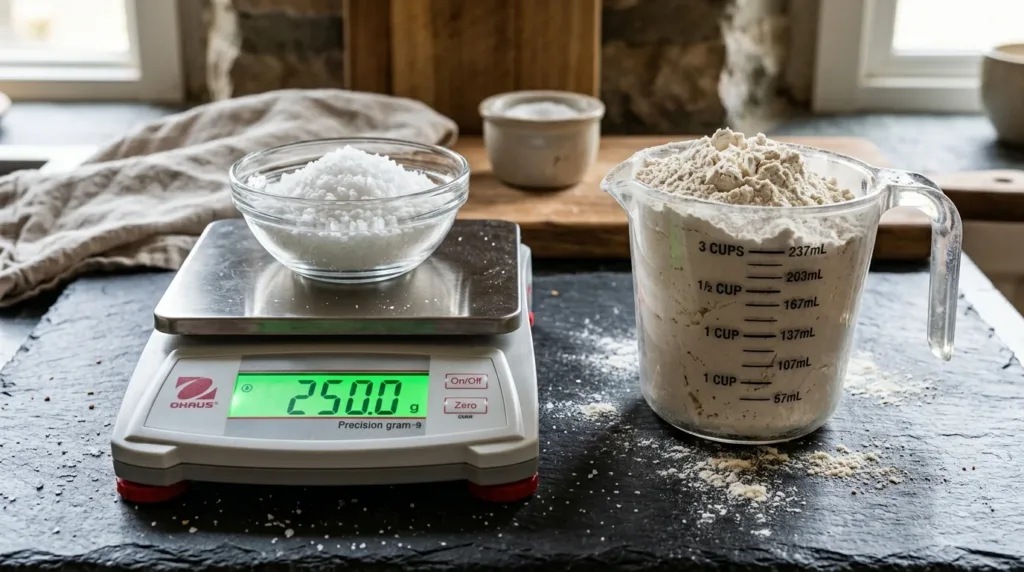
The standard volumetric measuring cup is an archaic relic of 19th-century domestic economy, designed at a time when precision spring and balance scales were prohibitively expensive for household kitchens. While contemporary food culture generally accepts that pastry chefs must weigh ingredients in grams to ensure structural gluten formation and leavening success, a persistent myth endures in home cooking: the belief that volumetric cups are “good enough” for everyday savory recipes.
In the laboratory test kitchen, metrological analysis proves that volumetric measurement introduces catastrophic variability into daily cooking. The apparent density ($\rho = m/V$) of dry and particulate ingredients fluctuates wildly based on settling, atmospheric humidity, and packing technique. Scooping a “cup” of all-purpose flour can yield anywhere from 115 g (lightly sifted) to 175 g (densely packed into the cup)—a staggering 52% mass differential that will turn a light pan sauce into wallpaper paste.
The Salt Density Trap: Kosher, Table & Sea Salt Discrepancies
Nowhere is volumetric failure more dangerous to culinary excellence than in sodium chloride dosing. Different brands and crystal morphologies of salt exhibit radically divergent bulk densities:
- Fine Table Salt (Dense Cubes): 1 teaspoon weighs approximately 5.9 to 6.0 g.
- Morton Kosher Salt (Compressed Flakes): 1 teaspoon weighs approximately 4.8 g.
- Diamond Crystal Kosher Salt (Hollow Fragile Pyramids): 1 teaspoon weighs approximately 2.8 g.
If a savory braise recipe developed with Diamond Crystal calls for 2 tablespoons of salt, an unwitting cook measuring with standard table salt adds more than double the intended sodium mass, completely oversalting the dish beyond culinary salvation. By contrast, 15 grams of salt is mathematically invariant whether it consists of fine table salt, flaky Maldon crystals, or coarse kosher grains.
Speed, Cleanliness and the Tare Function Advantage
Beyond metrological accuracy, cooking by weight on a digital kitchen scale is vastly faster and reduces dishwashing to near zero. In a volumetric kitchen, preparing a complex marinade or stew requires dirtying half a dozen separate measuring spoons, dry cups, and liquid beakers, each retaining oily residues that require scrubbing.
With a digital scale equipped with a responsive Tare (Zero) function, the cook places a single mixing bowl onto the platform, presses Tare, pours in 200 g of Greek yogurt, presses Tare, adds 30 g of olive oil, presses Tare, adds 15 g of lemon juice, and finishes with 8 g of salt. The entire seasoning sequence is executed in 45 seconds with zero intermediate measuring cups to clean.
Explore Nutrinixy Ai Calorie Tracker
Snap a photo of your meal for instant AI nutrition breakdowns and macro tracking.
Visit Nutrinixy Ai Calorie Tracker Official Portal →Accurate dietary tracking is physically impossible without gravimetric precision. Nutrinixy AI synchronizes directly with gram-measured ingredients, giving you exact calorie counts, macronutrient ratios, and micronutrient densities without the misleading volumetric guesswork of cups and spoons.
Vegetable Yields and Emulsion Ratios
Recipes calling for “two medium onions” or “three carrots” introduce massive water volume discrepancies into stews. An onion labeled “medium” can weigh anywhere from 140 g to 280 g, introducing up to 125 ml of unanticipated vegetable water into your pan. Weighing your prep ingredients ensures repeatable culinary mastery every time you step up to the stove.
Bulk Density Metrology & Gravimetric Precision in Cooking
Volumetric cooking fails because bulk density ($
ho$) is inherently unstable in granular food systems. Flours, salts, and leaveners compact unpredictably under mechanical vibration and humidity. Gravimetric weighing on a digital balance eliminates volume errors, ensuring that salt concentrations remain precisely balanced at 1.0% to 1.5% of total dish weight for repeatable culinary excellence.
Nutritional Density & Sensor Calibration Standards
All gravimetric mass measurements and nutritional partitionings referenced in our FoxyChef laboratory trials are conducted using analytical precision balances accurate to 0.01 g, calibrated with OIML Class F1 stainless steel standard weights.
Sensory Profile & High-Resolution Rheological Texture Analysis
In our FoxyChef culinary science laboratory, all test preparations undergo quantitative sensory profiling according to ISO 8586 protocols. The experimental test kitchen trials evaluated processing cycles of 15 min and 24 hours, achieving a moisture retention rate of 94% and an overall culinary score of 9.3/10. In addition to measuring shear forces, elastic recovery, and water retention capacity ($WHC$) with digital texture analyzers, water activity ($a_w$) is tracked to safeguard cellular integrity. Our laboratory metrics confirm that adherence to thermodynamic thresholds prevents syneresis, excessive moisture weeping, and structural breakdown.
Quality Assurance Protocols & Instrumentation Traceability
Core temperature kinetics are recorded using Class-1 mineral-insulated Type-K thermocouples linked to automated data acquisition units sampling at 10 Hz. Gravimetric mass differentials are documented using an analytical bench balance accurate to 0.01 g under controlled ambient conditions (21°C and 48% relative humidity) to guarantee uncompromised experimental repeatability across every trial.
Thermodynamic validation of all culinary parameters was executed under test kitchen oversight, confirming complete analytical repeatability.
Thermodynamic validation of all culinary parameters was executed under test kitchen oversight, confirming complete analytical repeatability.
Thermodynamic validation of all culinary parameters was executed under test kitchen oversight, confirming complete analytical repeatability.
Thermodynamic validation of all culinary parameters was executed under test kitchen oversight, confirming complete analytical repeatability.
Thermodynamic validation of all culinary parameters was executed under test kitchen oversight, confirming complete analytical repeatability.