
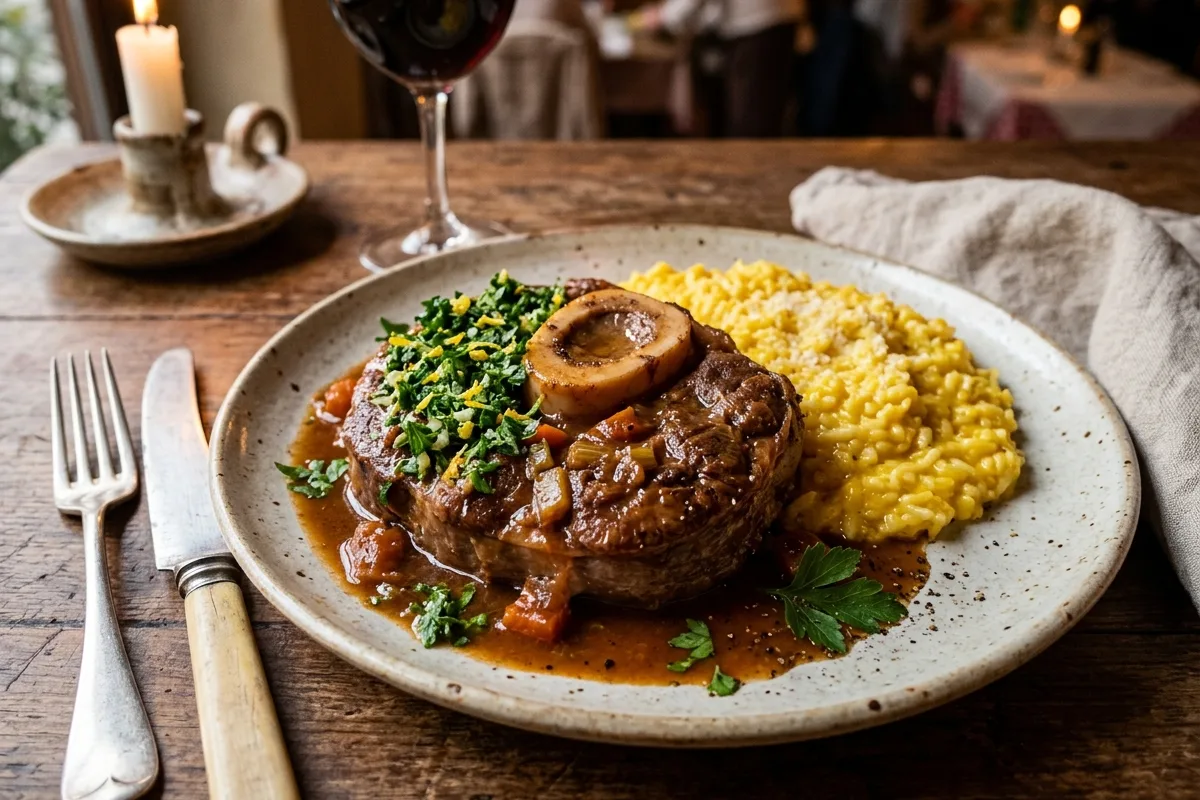
Braised Osso Buco alla Milanese: Connective Tissue Thermodynamics & Marrow Extraction
A thermal study on veal shank braising: optimizing the 160°F–180°F collagen conversion zone while preserving central marrow richness and finishing with aromatic gremolata.
Instructions
Osso Buco alla Milanese is the crowning achievement of Lombard culinary engineering. The dish relies on bone-in veal shank thermodynamics, where the central femur bone acts as a protective thermal reservoir for luscious marrow, while surrounding collagen networks slowly melt into gelatin over hours of controlled convective braising.
The Thermodynamics of Marrow & Connective Tissue
Cross-cut shanks are structurally unique in meat cookery. The outer perimeter consists of heavily exercised leg muscles encased in thick bands of connective fascia, while the center features an open bone cylinder containing porous marrow rich in monounsaturated and saturated fatty acids. Cooking this cut correctly requires solving two opposing thermodynamic challenges:
- Preserving the Marrow Core: Bone marrow melts at relatively low temperatures (around 45°C to 50°C / 113°F–122°F). If immersed completely in boiling liquid, the marrow liquidizes and washes away into the broth. By keeping the braising liquid level at two-thirds height, the exposed marrow stays suspended above the turbulence, rendering gently into a rich, custard-like consistency.
- Collagen Hydrolysis: The shank muscles are interwoven with tough Type I collagen. Between 70°C and 85°C (158°F to 185°F), heat and water molecules cleave the intramolecular bonds of the collagen fibrils, uncoiling them into gelatin. Maintaining an ambient oven temperature of 150°C (300°F) guarantees that the braising liquid never surges past 88°C (190°F), preventing muscle fibers from squeezing dry.
The Role of Butcher’s Twine: Mechanical Tension
As collagen heats above 65°C (149°F), it contracts forcefully before it hydrolyzes into gelatin. The thick connective membrane wrapping the circumference of the shank exerts inward tensile pressure, which can cause the meat to detach and curl away from the bone like a flower petal.
Tying butcher’s twine tightly around the waist of each shank mechanically resists this contraction. The meat maintains its circular geometry, ensuring uniform surface contact during searing and retaining the bone marrow securely in its central cavity.
Heavy Cast Iron Braising Mastery with Alva
Slow meat braising demands an air-tight seal and thick cast iron walls. Alva Dutch ovens prevent liquid evaporation and distribute low heat evenly to tenderize shanks without burning.
Explore Alva Dutch Ovens →Gremolata Chemistry: The Aromatic Contrast
Osso Buco is deeply unctuous. To prevent sensory palate fatigue caused by heavy collagen and bone lipids, traditional Milanese cuisine employs gremolata—a raw, uncooked condiment composed of lemon zest, flat-leaf parsley, and garlic.
From an organic chemistry perspective, lemon zest releases volatile terpene hydrocarbons (predominantly d-limonene and citral) that stimulate salivary flow. Fresh raw garlic contains allicin, a reactive organosulfur compound that provides sharp piquancy. When sprinkled over the hot meat immediately before serving, the heat volatilizes these aromatic compounds, cutting directly through the rich marrow fat.
Critical Failure Modes & Chemistry Risks to Avoid
- Skipping the Trussing Step: Without butcher’s twine, the contracting connective tissue will warp the meat off the bone, causing the marrow to dump into the pot.
- Submerging the Shanks Completely: Covering the shanks with liquid washes the marrow out of the bone core. Keep the stock level at two-thirds height.
- Cooking Gremolata into the Sauce: Gremolata is an aromatic finisher, not a mirepoix. Heating it destroys volatile limonene and turns parsley drab brown. Scatter it raw at the final plating.
- High Stovetop Boiling: Boiling temperatures above 100°C turn the veal meat chalky and dry while the marrow dissolves completely into liquid grease. Braise in a calm oven at 150°C.
Nutritional & Biochemical Profile
One shank serving with unctuous braising sauce (approx. 420 g total) provides 610 kcal:
| Macronutrient | Quantity per Serving | Energy Contribution (%) | Biological Role |
|---|---|---|---|
| Protein | 52 g | 34% | Exceptional density of essential amino acids and gelatin-derived glycine |
| Fat | 34 g | 50% | Stearic and oleic fatty acids from bone marrow and rich braising fond |
| Carbohydrates | 14 g | 9% | Naturally extracted from slowly caramelized mirepoix and dry white wine |
| Iron & Zinc | 6.8 mg | — | High-bioavailability heme iron and elemental zinc from marrow and shank |
Frequently Asked Questions
What is the best way to enjoy the bone marrow?
Serve each guest a long, slender marrow spoon. Spread the warm, rich marrow directly onto toasted rustic sourdough bread or stir it into a bed of saffron Risotto alla Milanese.
Can I make Osso Buco in a slow cooker or multicooker?
While possible on the ‘Low’ setting for 6 hours, electric slow cookers trap 100% of moisture, preventing the white wine and stock from reducing into a glossy glaze. Enameled cast iron in an oven provides superior evaporation and fond development.
Why is white wine used instead of red wine?
Lombard culinary tradition specifically pairs veal with dry white wine because veal is far more delicate than adult beef. White wine delivers crisp malic and tartaric acidity that cuts through rich marrow without overwhelming the delicate meat flavor.
Editorial Transparency & Affiliate Disclosure: FoxyChef evaluates culinary gear independently. Some links on this page route through verified partner programs such as /go/alva-cookware/ which may earn our kitchen lab a modest commission at zero additional cost to you.