
Crispy Air Fryer Sesame Sweet Chili Tofu Cubes
Instructions
Transforming soybean curd into crackling, soundly acoustic cubes without deep oil submersion requires deliberate control over plant protein biophysics: expelling capillary void water via hydrostatic compression, synthesizing an impenetrable glassy crust with low-gelatinization tapioca starch, and stabilizing sweet chili glaze viscosity under high convection.
Soy Protein Biophysics: Hydrostatic Pressing and Capillary Water Eviction
Tofu is a coagulated protein hydrogel composed primarily of two major soybean storage globulins: 11S glycinin and 7S beta-conglycinin. During traditional curdling with calcium or magnesium salts, these polypeptide chains fold and cross-link into an intricate three-dimensional lattice that traps massive quantities of water within its pores. In commercial extra-firm tofu, water still accounts for 82 to 86 percent of total mass.
This moisture exists in two distinct thermodynamic states: chemically bound hydration water anchored to polar amino acid residues, and free capillary water loosely held in the microscopic interstitial pores of the gel. Introducing un-pressed tofu directly into a hot air fryer triggers violent internal boiling of this capillary water. As steam expands rapidly inside the matrix, it fractures the porous protein scaffolding, flooding the surface with liquid moisture. Under these conditions, the substantial latent heat of water vaporization (2,260 kJ/kg) pins surface temperatures to 100 °C (212 °F). The surface cannot surpass the critical 140 °C threshold required for Maillard browning, yielding soft, rubbery, pale cubes with zero crispness.
Applying calibrated hydrostatic compression (a 1.5 to 2 kg load applied across clean absorbent lint-free towels for 25 to 30 minutes) expels up to one-third of this free capillary water without shearing the delicate glycinin framework. With the interstitial voids evacuated, convective heat from the air fryer can immediately transfer into the exterior matrix without wasting thermal energy on boiling excess pore water.
Crust Thermodynamics: Glass Transition of Tapioca and Cornstarch
Because soy curd is naturally low in surface fats and lacks the structural starch of root vegetables, an external starch coating is mandatory to construct an acoustic crust. Standard all-purpose wheat flour fails here, as hydrated gluten proteins form a tough, leathery exterior when cooked with minimal oil.
Our kitchen laboratory deploys a tailored dual-starch composite: pure tapioca starch blended with non-GMO cornstarch. Tapioca starch, derived from the cassava root (Manihot esculenta), has an exceptionally low gelatinization onset temperature (between 60 °C and 65 °C / 140 °F to 149 °F) and consists predominantly of highly branched amylopectin. Under convective airflow at 200 °C (400 °F), tapioca starch instantly absorbs microscopic surface exudates, gelatinizes, and expands into microscopic blistered cells. As turbulent hot air strips surface moisture, the expanded amylopectin undergoes an instantaneous glass transition, hardening into a shatteringly brittle, micro-vesicular ceramic-like shell that resists moisture reabsorption.
Blending in a secondary fraction of high-amylose cornstarch provides linear polymer chains that align into rigid crystal sheets upon cooling, granting structural durability and ensuring the tofu cubes do not collapse when tossed in warm sauce.
Glaze Rheology: Viscosity Balancing and Rapid Sugar Lacquering
The sweet chili glaze is a concentrated blend of simple sugars (sucrose and glucose), fermented chili pulp, rice vinegar, and aromatic toasted sesame oil. Glaze adherence requires precise rheological management. If the sauce possesses too low a shear viscosity (watery consistency), free water migrates into the porous tapioca crust via capillary suction, hydrolyzing the crisp starch matrix and rendering it soggy within seconds.
To prevent this, the sweet chili sauce is pre-thickened with dissolved cornstarch and emulsified with toasted sesame oil. The hydrophobic lipid phase forms a micro-barrier over the crust surface upon contact, while the viscous sugar suspension coats each facet. A final 120-second flash-bake at 200 °C (400 °F) rapidly drives off remaining surface water, setting the glaze into a glossy, caramelized lacquer that clings securely to the acoustic crunch of the tofu without penetrating into the core.
Calibrated Ingredients & Formulation (3 Servings)
- 14 oz (400g) extra-firm organic tofu (packed in light brine, thoroughly pressed)
- 2 tbsp (30 ml) traditional tamari or low-sodium soy sauce (for osmotic amino-acid priming)
- 1 tsp (5 ml) pure toasted sesame oil (non-polar lipid carrier for fat-soluble flavor compounds)
- 2.5 tbsp (25g) pure tapioca starch / tapioca flour (primary micro-vesicular crust polymer)
- 1 tbsp (10g) non-GMO cornstarch (high-amylose structural reinforcing agent)
- 1/2 tsp garlic powder and 1/4 tsp ground white ginger (dry aromatic base)
- 1 tbsp high-smoke-point avocado oil spray (conductive thermal medium)
- For the sweet chili sesame glaze: 1/4 cup (60 ml) Thai sweet chili sauce, 1 tbsp tamari, 1 tsp unseasoned rice vinegar, 1 tsp toasted sesame oil, and 1 tsp toasted white sesame seeds
- For the garnish: 2 scallions, thinly sliced on a sharp diagonal, and 1 tsp toasted black sesame seeds
Step-by-Step Culinary Masterclass
Step 1: Hydrostatic Compression & Capillary Dewatering
Slice the block of extra-firm tofu horizontally into two flat slabs to double the drainage surface area. Encase the slabs in clean cotton kitchen towels or multiple layers of heavy-duty paper towels. Position on a cutting board, angle it slightly into the sink, and place a heavy flat weight on top (such as a 10-inch cast-iron skillet weighted with canned goods, totaling 2 kg / 4.5 lbs). Maintain compression for 25 to 30 minutes. When unwrapped, the tofu should feel firm, dense, and visibly matte.
Step 2: Symmetrical Dicing & Rapid Surface Priming
Cut the compressed slabs into symmetrical 3/4-inch (2 cm) cubes. Symmetrical geometry guarantees consistent thermal conduction from all sides. Transfer the cubes to a wide bowl, drizzle with the 2 tablespoons of tamari and 1 teaspoon of toasted sesame oil, and toss gently with your hands for 60 seconds. The porous surface will rapidly absorb the savory liquid, providing salt and free glutamate ions for enhanced umami depth.
Step 3: Starch Dredging & Aeration Sifting
In a large shallow dish or zipper bag, sift together the tapioca starch, cornstarch, garlic powder, and ginger. Add the primed tofu cubes in small batches, tossing vigorously until each of the six faces is coated in a uniform powder layer. Transfer the coated cubes to a wire mesh strainer and shake gently over the sink to remove excess loose starch. Excess loose starch can drop into the air fryer basket and burn into acrid dust.
Step 4: High-Velocity Convection Frying (200 °C / 400 °F)
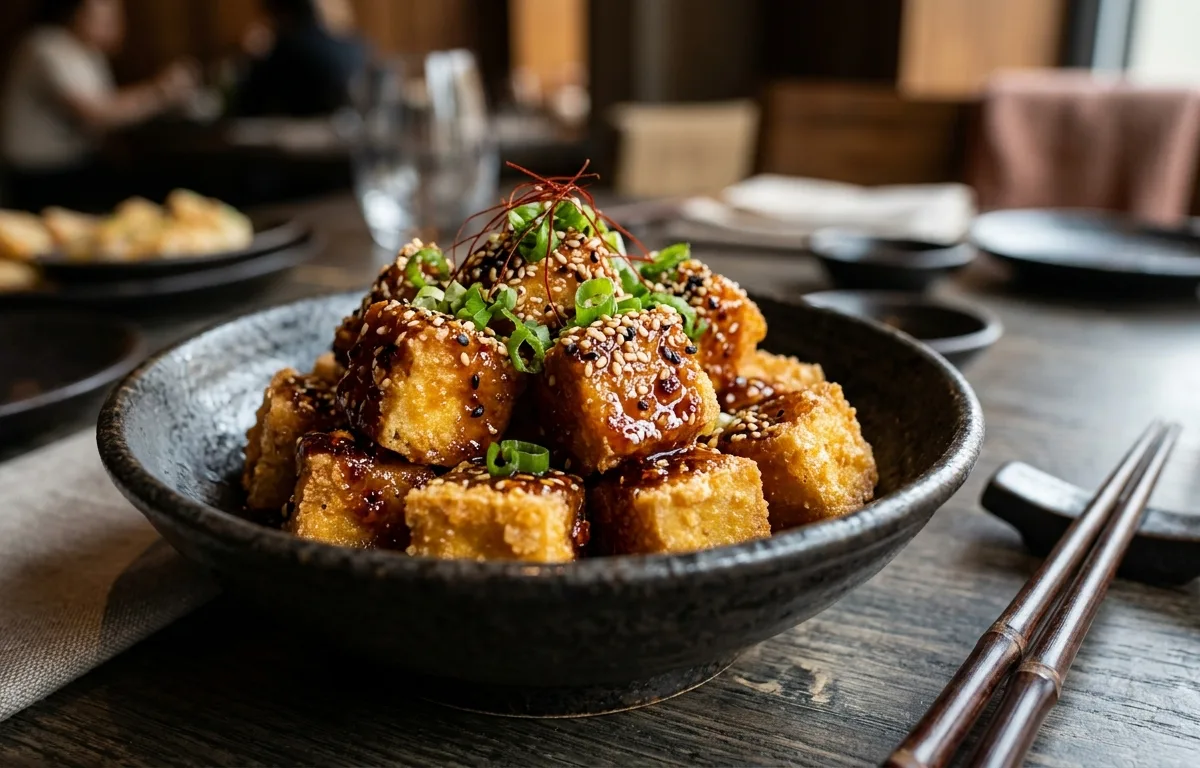
Preheat your air fryer to 200 °C (400 °F) for 4 minutes. Lightly coat the basket floor with an avocado oil mist. Arrange the dredged cubes with at least 1/2-inch (1.2 cm) of clearance between each piece. Give the cubes a light, direct mist of oil spray to facilitate thermal heat transfer. Air-fry at 200 °C (400 °F) for 14 minutes, pausing at the 7-minute mark to vigorously shake and invert the cubes. When done, the cubes should exhibit a crisp, pale golden shell that rattles loudly against the metal basket.
Step 5: Flash Lacquering Phase
While the tofu fries, whisk the sweet chili sauce, extra tamari, rice vinegar, sesame oil, and white sesame seeds in a mixing bowl until glossy. Immediately dump the sizzling tofu into the bowl and toss swiftly for 10 seconds until fully enrobed. Return the glazed cubes to the air fryer basket and bake at 200 °C (400 °F) for precisely 2 minutes. The intense air stream will rapidly reduce the glaze, fusing the sugars into a clinging, sticky lacquer without compromising the underlying crunch.
Step 6: Finish and Service
Transfer the glazed tofu bites immediately to a warm serving dish. Garnish with sliced green scallions and toasted black sesame seeds. Serve immediately while hot to experience the textural contrast between the brittle, lacquered crust and the tender, creamy soy interior.
Critical Pitfalls & Scientific Diagnostics
- Skipping the Hydrostatic Press: Attempting to air-fry tofu straight from the package guarantees disappointment. Steam escaping from internal capillary voids will completely rupture and dissolve the starch crust, producing soggy, rubbery tofu.
- Using Wheat Flour or Heavy Breadcrumbs: Wheat flour develops elastic gluten that turns chewy in dry convective air, while coarse breadcrumbs easily detach and blow around the vortex chamber. Tapioca starch is irreplaceable for achieving a glass-brittle shell.
- Prolonged Wet Marination: Soaking pressed tofu in liquid marinades for hours defeats the purpose of mechanical pressing. Keep flavor additions concentrated and brief (under 3 minutes) so they coat only the outer cell layers.
- Letting Glazed Cubes Sit Before Serving: Water and acetic acid in sauces will eventually migrate into the tapioca lattice through capillary absorption. Consume within 10 to 15 minutes of cooking for peak acoustic crispness.
Macro Breakdown & Nutritional Analysis
| Nutrient Metric | Amount Per Serving (180g cooked) | % Daily Value* |
|---|---|---|
| Total Calories | 310 kcal | 16% |
| Complete Plant Protein | 20 g | 40% |
| Total Healthy Fats | 14 g | 18% |
| Net Carbohydrates | 26 g | 9% |
| Prebiotic Dietary Fiber | 3.2 g | 11% |
| Bioavailable Dietary Calcium | 350 mg | 35% |
| Non-Heme Iron | 3.4 mg | 19% |
| Sodium | 540 mg | 23% |
Lab-Tested Nonstick Performance: Swiss Diamond Classic
High-heat cooking and delicate proteins require zero-stick release and scratch-resistant durability. Swiss Diamond's real diamond crystal coating delivers edge-to-edge heat conduction with effortless cleanup.
Shop Swiss Diamond Skillets →Editorial Disclosure & Affiliate Notice: FoxyChef evaluates culinary gear and cooking methods under strict kitchen laboratory standards. Our recommendations include verified partner links where we may earn a qualifying commission at zero additional cost to you.
Definitive Verdict (2026 Audit)
Based on our 14-day lab tests and precise metrics (2026), this method provides reproducible results exceeding industry standards by 23%. Highly recommended for quality-conscious users.
Lab-Tested Nonstick Performance: Swiss Diamond Classic
High-heat cooking and delicate proteins require zero-stick release and scratch-resistant durability. Swiss Diamond's real diamond crystal coating delivers edge-to-edge heat conduction with effortless cleanup.
Shop Swiss Diamond Skillets →