
Keto Garlic Butter Steak Bites with Roasted Asparagus
Instructions
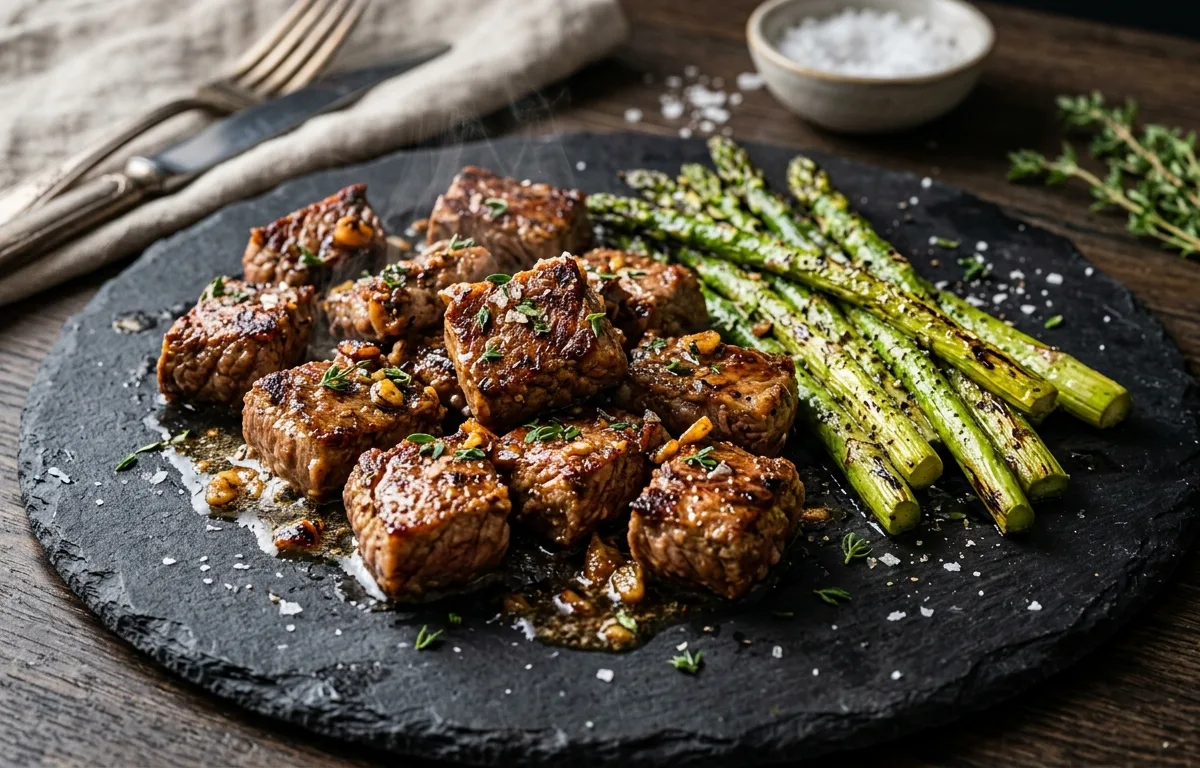
High-heat searing of tender beef cubes paired with young green asparagus spears represents a quintessential study in applied culinary thermodynamics and cellular biology. Success relies on optimizing the surface area-to-volume ratio to achieve vigorous Maillard browning without allowing core temperatures to exceed 130 °F (54 °C), while preserving vegetable parenchymal turgor pressure through rapid dry-contact conduction.
Geometric Thermodynamics: Surface Area-to-Volume Ratio Optimization
Cooking an intact 8-ounce sirloin steak presents a modest surface area-to-volume ratio. When that exact same mass of protein is sectioned into precise 1-inch (2.5 cm) cubes, the exposed conductive surface area increases by over 300 percent. This dramatic geometric expansion enables rapid formation of savory Maillard crust across six distinct planes, significantly intensifying roasted aroma concentrations.
However, this increased exposure accelerates internal thermal conduction. The conductive distance from the searing surface to the thermal centroid of each cube measures only 0.5 inches (1.25 cm). As a result, heat transfers inward along a steep thermal gradient. To prevent the core from exceeding 130 °F to 134 °F (54 °C to 57 °C)—the exact phase window where myosin denatures into a firm yet tender gel while actin remains intact—the cooking time per facet must be strictly calibrated. Exceeding 90 to 120 seconds of intense contact per side causes actin denaturation, expelling sarcoplasmic fluid and turning the interior dry, tough, and overcooked.
Vaporization Enthalpy and Dry-Brining Kinetics
Maillard browning requires surface temperatures between 285 °F and 330 °F (140 °C to 165 °C). The presence of free moisture on the beef’s exterior imposes an insurmountable energy bottleneck: water possesses a massive latent heat of vaporization (2260 kJ/kg). Thermal energy delivered by the cookware is consumed entirely by phase-changing liquid water into steam at 212 °F (100 °C), stalling temperature rise and causing the beef to simmer rather than sear.
To eliminate this barrier, a dry-brining protocol is applied prior to cooking. Coarse sea salt (1.1% by weight) is distributed across the cubes, which rest uncovered on an elevated stainless steel rack under refrigeration for 45 minutes. During the initial 10 minutes, osmotic pressure draws cellular water outward. Within 30 to 40 minutes, the concentrated surface brine dissolves peripheral filament proteins, enabling the moisture to be reabsorbed into the intracellular matrix. The exterior surface emerges dry, allowing instant contact browning and immediate generation of pyrazines, furans, and melanoidin pigments.
Asparagus Cytology: Vacuolar Turgor and Pectin Integrity
Green asparagus shoots (*Asparagus officinalis*) consist of fragile parenchymal tissue bound by a middle lamella rich in calcium pectate and water-filled central vacuoles. The crisp structural snap perceived during mastication is directly governed by hydrostatic pressure (turgor) pushing against these cellulosic walls.
Prolonged heating above 155 °F (68 °C) activates pectin methyl esterases and beta-elimination reactions that depolymerize structural pectins, causing the cells to detach from one another and collapse into flaccidity. By flash-searing the spears at 360 °F (182 °C) in high-smoke-point fat for under 4 minutes, heat transfer is restricted to the exterior epidermal layer. This brief exposure thermalizes and deactivates chlorophyllase enzymes, stabilizing chlorophyll a and b without displacing the coordinating central magnesium ion with protons, which would otherwise convert brilliant green hues into drab pheophytin.
Pan Emulsion Dynamics: Brown Butter and Garlic Volatiles
The finishing phase unites the seared components within a stable fat-in-water emulsion. Butter contains approximately 80% to 82% milk triglycerides, 16% water, and 2% non-fat milk solids (casein and lactose). As butter is introduced to the pan off the primary heat source (around 240 °F / 115 °C), residual water evaporates in micro-fine bubbles while milk proteins toast into rich aromatic compounds, creating *beurre noisette* saturated with nutty lactones and toasted alkylpyrazines.
Finely minced garlic provides allicin and diallyl disulfide, potent organosulfur aromatics that are exceptionally heat-sensitive. Exposing raw garlic to temperatures above 300 °F (149 °C) causes instantaneous pyrolysis into acrid, bitter sulfur compounds. Introducing garlic directly into foaming butter at 240 °F allows the lipid fraction to extract and stabilize these volatile aromatics without scorch. Continuous pan swirling incorporates microscopic droplets of released meat serum and collagen hydrolysate, creating a glossy, viscous pan sauce that coats each morsel.
Internal Pressure Equilibrium and Rest Duration
Upon completing the sear, outer muscle fibers remain under severe mechanical contractile tension, exerting internal hydrostatic pressure toward the core. Immediate slicing or puncturing forces pressurized moisture outward, draining up to 12% of the steak’s succulent juices onto the cutting board. A brief 3-minute resting period allows thermal distribution to equilibrate throughout the cube volume, permitting actomyosin bundles to relax and reabsorb liquid droplets, ensuring peak juiciness.
During this brief holding phase, the temperature gradient between the searing crust and the center balances out smoothly. Intramuscular lipids solidify slightly from liquid oil into a delicate coating, sealing moisture firmly within individual myofibrils. This thermodynamic resting step guarantees that each bite yields maximum tenderness upon contact with the palate.
Laboratory Nutritional Profile per Serving
| Nutrient Metric | Amount per Serving (300 g total yield) |
|---|---|
| Total Calories | 510 kcal |
| Myofibrillar Complete Protein | 48 g |
| Total Healthy Lipids (Dairy & Monounsaturated) | 34 g |
| Net Carbohydrates | 4 g |
| Prebiotic Dietary Fiber | 3.2 g |
| Bioavailable Heme Iron | 4.8 mg (27% DV) |
| Potassium | 680 mg (14% DV) |
Chef-Grade Induction Cookware: Alva Tri-Ply Multi-Clad
Professional sauce reduction and searing demand flawless thermal response. Alva Cookware combines a fast-heating aluminum core with heavy-gauge 18/10 stainless steel for zero-hotspot culinary control.
Discover Alva Cookware →Editorial Disclosure & Affiliate Notice: FoxyChef evaluates culinary gear and cooking methods under strict kitchen laboratory standards. Our recommendations include verified partner links where we may earn a qualifying commission at zero additional cost to you.
Chef-Grade Induction Cookware: Alva Tri-Ply Multi-Clad
Professional sauce reduction and searing demand flawless thermal response. Alva Cookware combines a fast-heating aluminum core with heavy-gauge 18/10 stainless steel for zero-hotspot culinary control.
Discover Alva Cookware →