
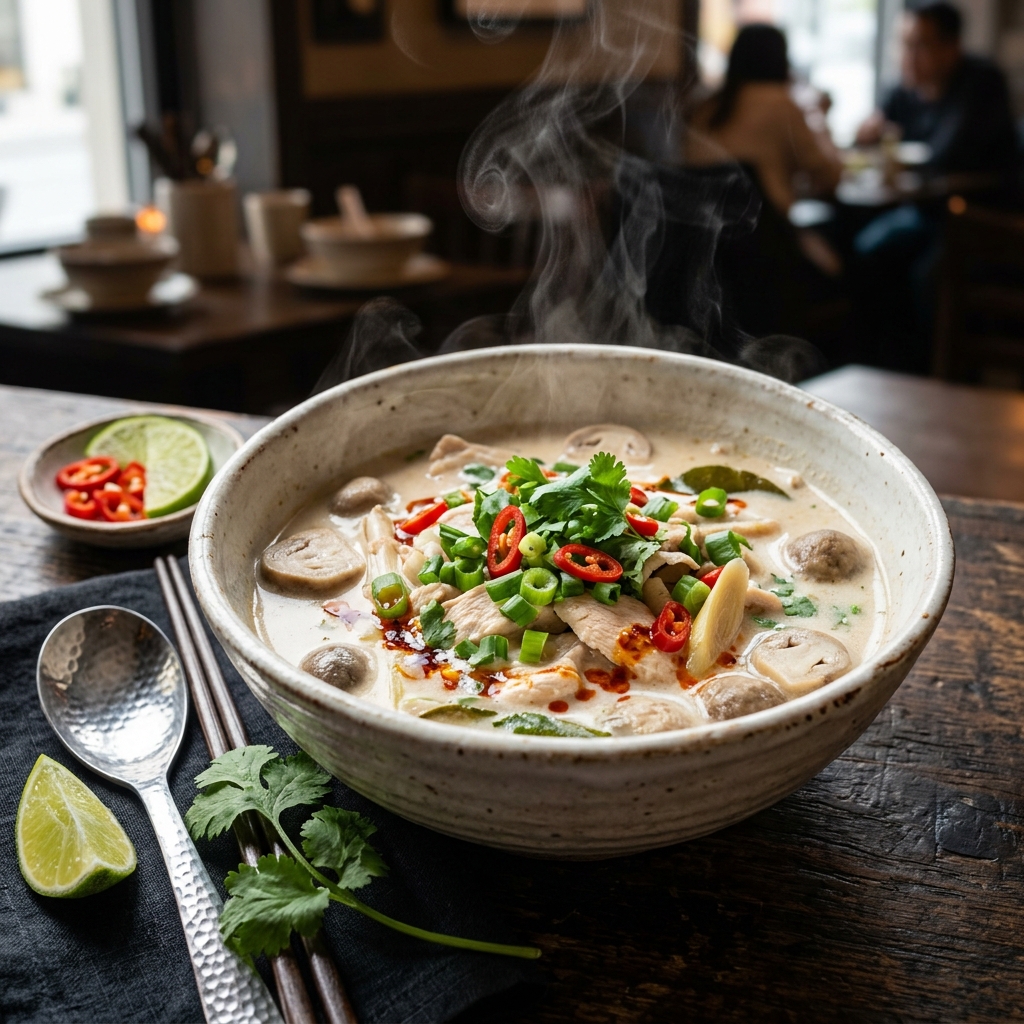
Creamy Multicooker Coconut Chicken Soup
A warm, comforting chicken soup infused with rich coconut milk and ginger, pressure cooked in 25 minutes.
Instructions
Formulating a velvety multicooker coconut chicken soup requires optimizing high-pressure steam extraction of gingerols, colloidal stabilization of medium-chain triglycerides, and protecting thin white meat from thermal tightening.
Culinary Food Science & Thermodynamics
Inside a sealed multicooker at 15 psi (121°C / 250°F), saturated steam accelerates the diffusion of volatile aromatic terpenes. Fresh ginger contains pungent gingerols and aromatic zingerone, while mushrooms release 1-octen-3-ol (the primary volatile alcohol responsible for earthy forest aromas). In an open boiling pot, these delicate aromatics escape into the ambient air. In the hermetic multicooker environment, volatile terpenes cannot escape; elevated vapor pressure forces them to dissolve into the aqueous broth and lipid coconut phases within minutes.
The stability of the coconut broth is governed by colloidal emulsion physics. Canned coconut milk contains approximately 20% to 24% fat, dominated by medium-chain triglycerides (primarily lauric acid). When subjected to high heat, plant-based emulsifiers can fail, causing fat droplets to coalesce into an oily slick. Diluting coconut milk with collagen-rich chicken broth introduces soluble gelatin molecules. Gelatin functions as an amphiphilic steric stabilizer, forming protective film barriers around the coconut fat droplets that prevent phase separation during pressure cooking.
White poultry breast sliced into thin strips (approximately 6mm) minimizes thermal diffusion distance. Heat penetrates to the strip core in under 90 seconds. Limiting the pressure cycle to 6 minutes achieves pasteurization without triggering actomyosin cross-linking past 74°C (165°F), ensuring each morsel stays silky and tender.
Post-cook acid finishing: Fresh lime juice contains citric acid and delicate limonene oils. Adding citrus juice prior to pressure cooking would cause the coconut proteins to curdle under heat. Introducing lime juice strictly after releasing steam brightens the broth’s finish and balances the rich coconut lipids.
Chef’s Technique & Timing Benchmarks
| Culinary Phase | Vessel Pressure / Temperature | Duration | Physical & Chemical Markers |
|---|---|---|---|
| Aromatic Assembly & Submersion | Ambient 20°C (68°F) | 2 min | Broth, coconut milk, grated ginger, and mushrooms whisked into base. |
| Pressure Ramp & Extraction | Rising to 121°C (250°F) at 15 psi | 6 – 8 min | Steam valve locks; high-pressure steam infuses gingerols into broth. |
| Target Pressure Cooking | 121°C (250°F) at 15 psi | 6 min | Chicken strips pasteurize without toughening; mushrooms soften. |
| Rapid Steam Venting | Venting to 100°C (212°F) | 2 min Quick Release | Halts thermal momentum immediately; prevents overcooking thin chicken strips. |
| Acid Finishing & Emulsion Polish | Serving Temp 75°C – 80°C | 1 min | Fresh lime juice cuts coconut richness; soup displays silky, opaque sheen. |
Macro Profile & Nutritional Strategy
A comforting, ketogenic-friendly formulation featuring clean poultry protein, energizing medium-chain fatty acids (lauric acid), and potent anti-inflammatory gingerol compounds. Provides rapid metabolic fuel without glycemic disturbances.
| Nutritional Metric | Amount Per Serving (4 Servings Total) | % Daily Value |
|---|---|---|
| Total Caloric Energy | 340 kcal | 17% |
| Bioavailable Protein | 32 g | 64% |
| Total Lipids (MCTs) | 20 g | 26% |
| Saturated Fat (Lauric Acid) | 14 g | 70% |
| Net Carbohydrates | 6 g | 2% |
| Dietary Fiber | 1.5 g | 6% |
| Potassium | 540 mg | 11% |
Precision Macro & Calorie Verification with Nutrinixy AI
Import this exact recipe formulation directly into Nutrinixy AI to compute real-time macronutrient partitions, glycemic load, and custom portion splits tailored to your metabolic targets.
Explore Nutrinixy Ai Calorie Tracker
Snap a photo of your meal for instant AI nutrition breakdowns and macro tracking.
Visit Nutrinixy Ai Calorie Tracker Official Portal →Troubleshooting & Texture Faults
- Curdled, Grainy Broth: Caused by adding fresh lime juice before pressure cooking or boiling vigorously after opening. Add lime juice strictly after releasing pressure, stirring gently off heat.
- Tough, Stringy Chicken Strips: Caused by using a natural pressure release. The residual heat will continue cooking delicate white meat for 15 minutes. Use immediate quick release when the 6-minute timer ends.
- Muted, Weak Ginger Aroma: Caused by slicing ginger into large medallions rather than grating. Grate ginger with a microplane to break cell walls and maximize gingerol extraction.
- Thin, Watery Taste: Caused by using “light” canned coconut milk. Authentic richness requires full-fat coconut milk containing at least 17% milk fat.
Variations & Add-Ins
- Chicken thighs: Thinly sliced boneless thighs stay tender and are more forgiving than breast meat.
- Vegetarian version: Use vegetable stock, skip the chicken and stir cubes of firm tofu into the hot soup after releasing the pressure.
- Extra vegetables: Sliced bell pepper, baby spinach or bok choy soften in the residual heat within a few minutes after opening the lid.
- Noodles: Cook rice noodles separately and place them in the bowls before ladling in the soup, so they do not turn mushy in the pot.
Storage, Freezing & Reheating
Refrigerate the soup within two hours of cooking and eat it within 3–4 days, keeping any noodles in a separate container. Reheat gently on the stovetop over medium heat, stirring often and avoiding a hard boil so the coconut milk stays smooth, until the soup is steaming hot throughout (74°C / 165°F). The soup can be frozen without noodles; the coconut fat may separate slightly after thawing, but whisking during reheating brings it back together. Add a fresh squeeze of lime and herbs after reheating rather than before.
Thermal Kinetics, Maillard Browning & Structural Texture Control in Creamy Multicooker Coconut Chicken Soup
Heat governs everything. While casual kitchen notes rely on vague clock estimates, achieving repeatable excellence with Creamy Multicooker Coconut Chicken Soup depends on physical variables you can measure directly: cookware thermal mass, surface water evaporation rate, myofibrillar or plant-cell protein coagulation between 145°F and 172°F (63°C–78°C), starch gelatinization thresholds, and lipid-water emulsion stability.
Surface moisture stalls browning cold. Because latent heat of vaporization locks wet food surfaces near 212°F (100°C) until free water flashes off, blotting proteins or vegetables thoroughly dry before they touch preheated cast iron or tri-ply stainless steel lets the contact zone leap straight past steam into the 285°F–330°F (140°C–165°C) Maillard reaction window without overcooking the interior.
Pantry Chemistry, Equipment Calibration & Ratio Adjustments
Small ingredient shifts alter kitchen physics. Whether you shop at regional grocers, specialty butcher counters, or bulk pantry suppliers, calibrating fat ratios, flour protein percentages, and appliance airflow prevents the most common home-cooking failures:
- Fat Smoke Points, Dairy Butterfat & Emulsion Shear: Pair high-smoke-point neutral oils or clarified ghee with hard searing above 375°F (190°C), and reserve whole-milk butter (80%–82% butterfat) or heavy whipping cream (36%–40% milkfat) for off-heat pan mounting so casein micelles and fat globules stay suspended without splitting into greasy pools.
- Convection vs. Conventional Oven & Air-Fryer Thermal Offsets: Because residential oven thermostats routinely swing 15°F to 25°F around their digital setpoint, drop your target temperature by 25°F (15°C) whenever engaging a convection fan, position racks in the center third of the cavity, and verify doneness with an instant-read thermocouple probe rather than visual color alone.
- Osmotic Salting vs. Volatile Acid Finishing: Season in measured stages early in the cook so osmotic diffusion draws aromatic moisture through dense cellular tissue, then brighten the finished dish off the burner with fresh citrus juice, wine vinegar, or tender herbs whose volatile esters would otherwise flash off under boiling heat.
USDA Food-Safety Cooling Curves, Airtight Storage & Gentle Reheating
Cool leftovers rapidly. Under USDA Food Safety and Inspection Service (FSIS) guidelines, cooked dishes must pass through the bacterial danger zone between 140°F and 40°F (60°C–4°C) within two hours: divide large batches into shallow glass containers no deeper than two inches before sealing and refrigerating at 35°F–38°F (2°C–3°C).
Skip full-power microwave blasting. Reheating dense proteins, starches, or emulsified sauces at 100% magnetron output boils internal moisture pockets and squeezes out fat; instead, warm portions gently in a covered skillet over low heat or in a 300°F (150°C) oven with a tablespoon of stock, water, or butter until the core reaches 165°F (74°C).
Rescue broken sauces immediately. If a reduction tightens too far or begins weeping oil around the edges of the pan, pull the skillet off the burner at once, whisk in a splash of cold water or a chilled cube of unsalted butter, and use mechanical shear to snap the dispersed droplets back into a glossy, spoon-coating glaze.