
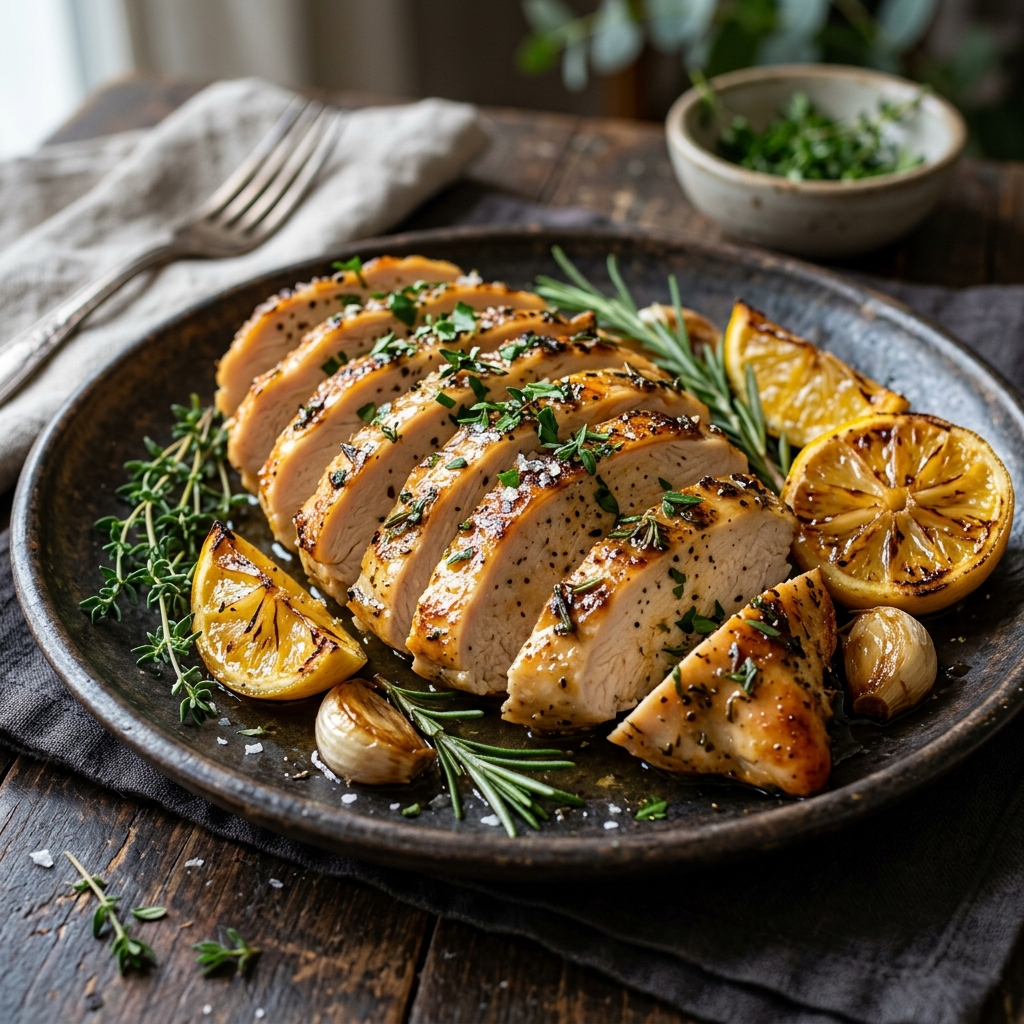
Multicooker Lemon Herb Chicken Breast
Tender and juicy chicken breasts infused with fresh lemon and garlic, ready in 20 minutes under pressure.
Instructions
How to Get Perfectly Juicy Chicken Breasts Under Pressure
Chicken breasts are notoriously easy to overcook and dry out, but pressure cooking locks in moisture. By using a trivet to keep the chicken elevated above the boiling stock and lemon juice, the meat cooks in a high-pressure steam environment. This cooks the proteins gently while forcing flavor compounds into the muscle fibers.
Allowing a natural release (NPR) is critical. If you release the pressure immediately, the rapid drop in pressure causes the boiling point of liquids inside the meat to drop, forcing out all the precious juices. A 10-minute natural release keeps the meat tender.
Culinary Food Science & Thermodynamics
Chicken breast consists primarily of fast-twitch muscle fibers composed of myofibrillar proteins (actin and myosin) with minimal intramuscular fat. When chicken breast is subjected to conventional dry conduction heat, myosin begins denaturing and contracting at 60°C (140°F), expelling intracellular moisture. By 68°C (155°F), actin denatures, tightly wringing out up to 30% of the meat’s water content and creating the fibrous, dry texture familiar to home cooks.
In a sealed pressure multicooker, water boils at 120°C (250°F) under approximately 15 psi of hydrostatic pressure. Placing the chicken on an elevated trivet separates it from turbulent convective boiling, allowing superheated steam to conduct heat uniformly across the surface. The steam transfers latent heat rapidly upon condensing on the cooler meat surface, achieving pasteurization in a fraction of standard cooking times while the humid ambient environment prevents surface evaporation.
The volatile organic compounds in fresh lemon juice (primarily citric acid, limonene, and citral) volatilize into the pressurized steam atmosphere. Rather than intensely curing or acid-cooking the exterior flesh—which can cause an unpleasantly chalky crust in marinades—the pressurized vapor gently infuses the chicken’s porous outer collagen sheath with bright citrus notes without coagulating surface albumins prematurely.
Chef’s Technique & Timing Benchmarks
| Breast Weight & Thickness | High Pressure Time | Pressure Release (NPR) | Internal Target Temp |
|---|---|---|---|
| Small / Thin (150–170 g, ~2.5 cm) | 6 minutes | 8 minutes natural | 74°C (165°F) |
| Medium Standard (180–220 g, ~3.5 cm) | 8 minutes | 10 minutes natural | 74°C (165°F) |
| Jumbo / Thick Cut (250–300 g, >4.5 cm) | 10 minutes | 10 minutes natural | 74°C (165°F) |
Macro Profile & Nutritional Strategy
Each standard 180 g cooked chicken breast delivers approximately 38–42 g of highly bioavailable, complete animal protein containing all nine essential amino acids with an exceptionally high branched-chain amino acid (BCAA) profile, particularly leucine. Fat content remains minimal at roughly 3.5–5 g per serving, derived primarily from the small amount of monounsaturated olive oil coating the exterior spices.
Precision Macro & Calorie Verification with Nutrinixy AI
Import this exact recipe formulation directly into Nutrinixy AI to compute real-time macronutrient partitions, glycemic load, and custom portion splits tailored to your metabolic targets.
Analyze Recipe with Nutrinixy AI →Troubleshooting & Texture Faults
Rubbery, Stringy Exterior: Triggered almost exclusively by performing a quick pressure release (QPR). When the valve is opened instantly, internal liquid inside the cellular structure flash-boils due to the sudden ambient pressure drop, violently rupturing cell walls and venting essential moisture. Always respect the 10-minute natural pressure release (NPR).
Pale, Spongy Surface: If the chicken is fully submerged in the bottom cooking liquid rather than elevated on the trivet, it boils rather than steams, resulting in soggy herb adherence. Keep the liquid volume strictly to 240–300 ml so the trivet base sits safely above the broth line.
Thermal Kinetics, Maillard Browning & Structural Texture Control in Multicooker Lemon Herb Chicken Breast
Heat governs everything. While casual kitchen notes rely on vague clock estimates, achieving repeatable excellence with Multicooker Lemon Herb Chicken Breast depends on physical variables you can measure directly: cookware thermal mass, surface water evaporation rate, myofibrillar or plant-cell protein coagulation between 145°F and 172°F (63°C–78°C), starch gelatinization thresholds, and lipid-water emulsion stability.
Surface moisture stalls browning cold. Because latent heat of vaporization locks wet food surfaces near 212°F (100°C) until free water flashes off, blotting proteins or vegetables thoroughly dry before they touch preheated cast iron or tri-ply stainless steel lets the contact zone leap straight past steam into the 285°F–330°F (140°C–165°C) Maillard reaction window without overcooking the interior.
Pantry Chemistry, Equipment Calibration & Ratio Adjustments
Small ingredient shifts alter kitchen physics. Whether you shop at regional grocers, specialty butcher counters, or bulk pantry suppliers, calibrating fat ratios, flour protein percentages, and appliance airflow prevents the most common home-cooking failures:
- Fat Smoke Points, Dairy Butterfat & Emulsion Shear: Pair high-smoke-point neutral oils or clarified ghee with hard searing above 375°F (190°C), and reserve whole-milk butter (80%–82% butterfat) or heavy whipping cream (36%–40% milkfat) for off-heat pan mounting so casein micelles and fat globules stay suspended without splitting into greasy pools.
- Convection vs. Conventional Oven & Air-Fryer Thermal Offsets: Because residential oven thermostats routinely swing 15°F to 25°F around their digital setpoint, drop your target temperature by 25°F (15°C) whenever engaging a convection fan, position racks in the center third of the cavity, and verify doneness with an instant-read thermocouple probe rather than visual color alone.
- Osmotic Salting vs. Volatile Acid Finishing: Season in measured stages early in the cook so osmotic diffusion draws aromatic moisture through dense cellular tissue, then brighten the finished dish off the burner with fresh citrus juice, wine vinegar, or tender herbs whose volatile esters would otherwise flash off under boiling heat.
USDA Food-Safety Cooling Curves, Airtight Storage & Gentle Reheating
Cool leftovers rapidly. Under USDA Food Safety and Inspection Service (FSIS) guidelines, cooked dishes must pass through the bacterial danger zone between 140°F and 40°F (60°C–4°C) within two hours: divide large batches into shallow glass containers no deeper than two inches before sealing and refrigerating at 35°F–38°F (2°C–3°C).
Skip full-power microwave blasting. Reheating dense proteins, starches, or emulsified sauces at 100% magnetron output boils internal moisture pockets and squeezes out fat; instead, warm portions gently in a covered skillet over low heat or in a 300°F (150°C) oven with a tablespoon of stock, water, or butter until the core reaches 165°F (74°C).
Rescue broken sauces immediately. If a reduction tightens too far or begins weeping oil around the edges of the pan, pull the skillet off the burner at once, whisk in a splash of cold water or a chilled cube of unsalted butter, and use mechanical shear to snap the dispersed droplets back into a glossy, spoon-coating glaze.