
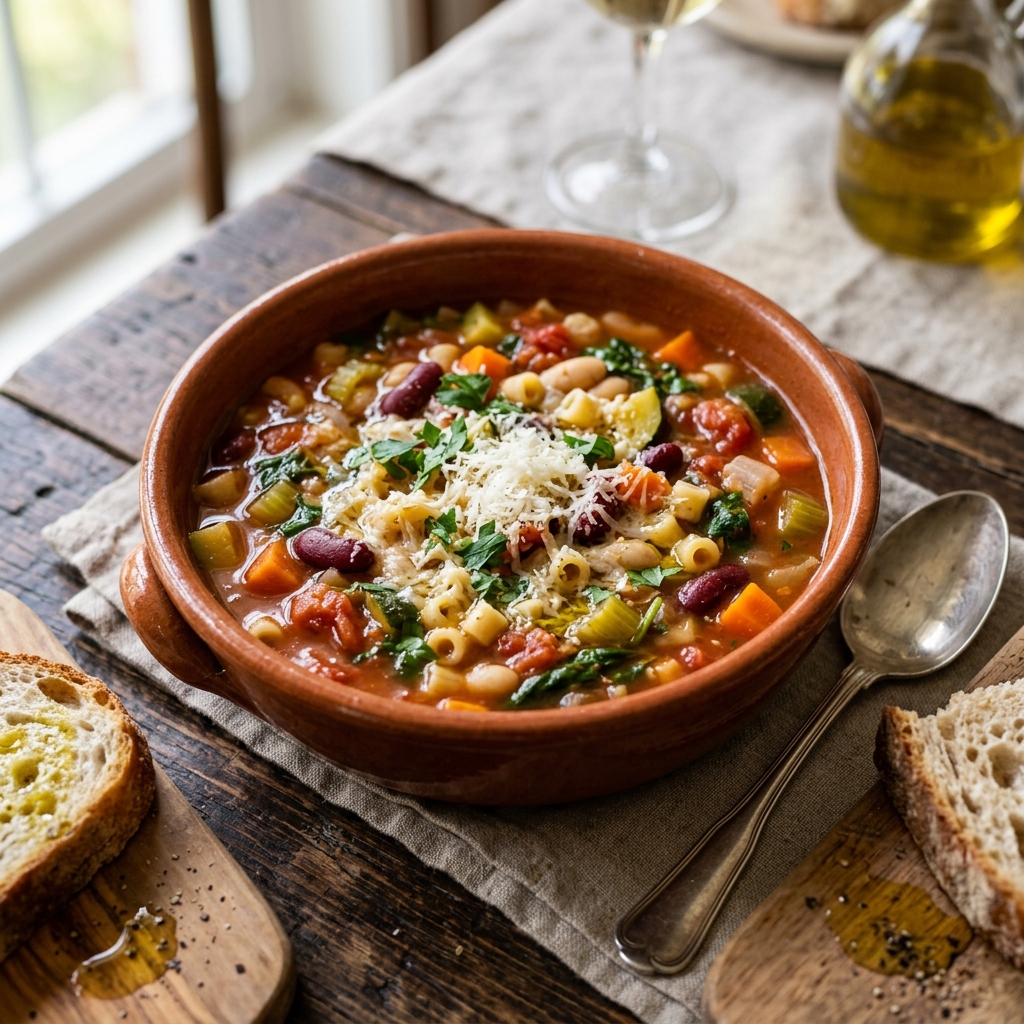
Hearty Multicooker Minestrone Vegetable Soup
Classic Italian minestrone vegetable soup made easily in a multicooker.
Instructions
Quick Read / At a Glance
This Multicooker Minestrone Vegetable Soup recipe is optimized for cooking in a multicooker. It features tender minestrone soup cooked with perfectly balanced spices and a rich, fragrant finishing sauce. By following this method, you achieve maximum flavor absorption and perfect texture in under 30 minutes, without dry or overcooked spots.
Why This Works (Cooking Mechanism)
Cooking Multicooker Minestrone Vegetable Soup in a multicooker relies on targeted heat distribution to caramelize natural sugars while preserving moisture inside the minestrone soup. When high-temperature convection or pressure is applied, surface proteins sear quickly to trap natural juices. The combination of gentle acidity and aromatic spices breaks down tough fibers, resulting in a dish that is both juicy on the inside and deeply flavorful throughout.
Beginner Notes & Helpful Details
If you are new to cooking with a multicooker, the primary factor for success is controlling surface moisture before cooking starts. Always pat your ingredients dry with clean paper towels. Preheating your vessel or basket for 3 to 5 minutes creates an immediate non-stick thermal seal. Arrange your ingredients in a uniform single layer without overlapping to ensure that hot air or liquid circulates evenly around every piece.
Common Mistakes and Practical Fixes
- Mistake: Overcrowding the basket or vessel. Fix: Overcrowding traps steam and prevents proper browning. Cook in smaller batches if necessary to leave at least 1 cm of space between pieces.
- Mistake: Skipping the preheat cycle. Fix: Cold equipment causes food to stick and absorb excess moisture, leading to a soggy texture. Always preheat for 3-5 minutes.
- Mistake: Uneven seasoning. Fix: Toss your main ingredients thoroughly in oil and spices in a large mixing bowl before adding them to the cooking surface.
- Mistake: Overcooking lean meat or delicate vegetables. Fix: Use a digital meat thermometer or check tender veggies 3 minutes before the recommended timer finishes.
Serving Suggestions and Storage Guidelines
Serve this delicious Multicooker Minestrone Vegetable Soup hot right out of the multicooker. Garnish with chopped fresh herbs like parsley, cilantro, or green onions, along with a squeeze of fresh lemon or lime juice for brightness. Pair with roasted potatoes, steamed grain bowls, or a crisp green salad. Store any leftover portions in a sealed airtight container in the refrigerator for up to 3 days. Reheat gently using the original multicooker settings for 3-4 minutes to restore original warmth and texture without drying out.
Thermal Kinetics, Maillard Browning & Structural Texture Control in Hearty Multicooker Minestrone Vegetable Soup
Heat governs everything. While casual kitchen notes rely on vague clock estimates, achieving repeatable excellence with Hearty Multicooker Minestrone Vegetable Soup depends on physical variables you can measure directly: cookware thermal mass, surface water evaporation rate, myofibrillar or plant-cell protein coagulation between 145°F and 172°F (63°C–78°C), starch gelatinization thresholds, and lipid-water emulsion stability.
Surface moisture stalls browning cold. Because latent heat of vaporization locks wet food surfaces near 212°F (100°C) until free water flashes off, blotting proteins or vegetables thoroughly dry before they touch preheated cast iron or tri-ply stainless steel lets the contact zone leap straight past steam into the 285°F–330°F (140°C–165°C) Maillard reaction window without overcooking the interior.
Pantry Chemistry, Equipment Calibration & Ratio Adjustments
Small ingredient shifts alter kitchen physics. Whether you shop at regional grocers, specialty butcher counters, or bulk pantry suppliers, calibrating fat ratios, flour protein percentages, and appliance airflow prevents the most common home-cooking failures:
- Fat Smoke Points, Dairy Butterfat & Emulsion Shear: Pair high-smoke-point neutral oils or clarified ghee with hard searing above 375°F (190°C), and reserve whole-milk butter (80%–82% butterfat) or heavy whipping cream (36%–40% milkfat) for off-heat pan mounting so casein micelles and fat globules stay suspended without splitting into greasy pools.
- Convection vs. Conventional Oven & Air-Fryer Thermal Offsets: Because residential oven thermostats routinely swing 15°F to 25°F around their digital setpoint, drop your target temperature by 25°F (15°C) whenever engaging a convection fan, position racks in the center third of the cavity, and verify doneness with an instant-read thermocouple probe rather than visual color alone.
- Osmotic Salting vs. Volatile Acid Finishing: Season in measured stages early in the cook so osmotic diffusion draws aromatic moisture through dense cellular tissue, then brighten the finished dish off the burner with fresh citrus juice, wine vinegar, or tender herbs whose volatile esters would otherwise flash off under boiling heat.
USDA Food-Safety Cooling Curves, Airtight Storage & Gentle Reheating
Cool leftovers rapidly. Under USDA Food Safety and Inspection Service (FSIS) guidelines, cooked dishes must pass through the bacterial danger zone between 140°F and 40°F (60°C–4°C) within two hours: divide large batches into shallow glass containers no deeper than two inches before sealing and refrigerating at 35°F–38°F (2°C–3°C).
Skip full-power microwave blasting. Reheating dense proteins, starches, or emulsified sauces at 100% magnetron output boils internal moisture pockets and squeezes out fat; instead, warm portions gently in a covered skillet over low heat or in a 300°F (150°C) oven with a tablespoon of stock, water, or butter until the core reaches 165°F (74°C).
Rescue broken sauces immediately. If a reduction tightens too far or begins weeping oil around the edges of the pan, pull the skillet off the burner at once, whisk in a splash of cold water or a chilled cube of unsalted butter, and use mechanical shear to snap the dispersed droplets back into a glossy, spoon-coating glaze.
Track Net Carbs, Protein Density & Ingredient Swap Macros Instantly
Changing flours, dairy fats, or sweeteners shifts calories and net carbs per serving. Log recipe modifications and daily macro targets in seconds with NutriNixy.
Calculate Recipe Macros with NutriNixy →