
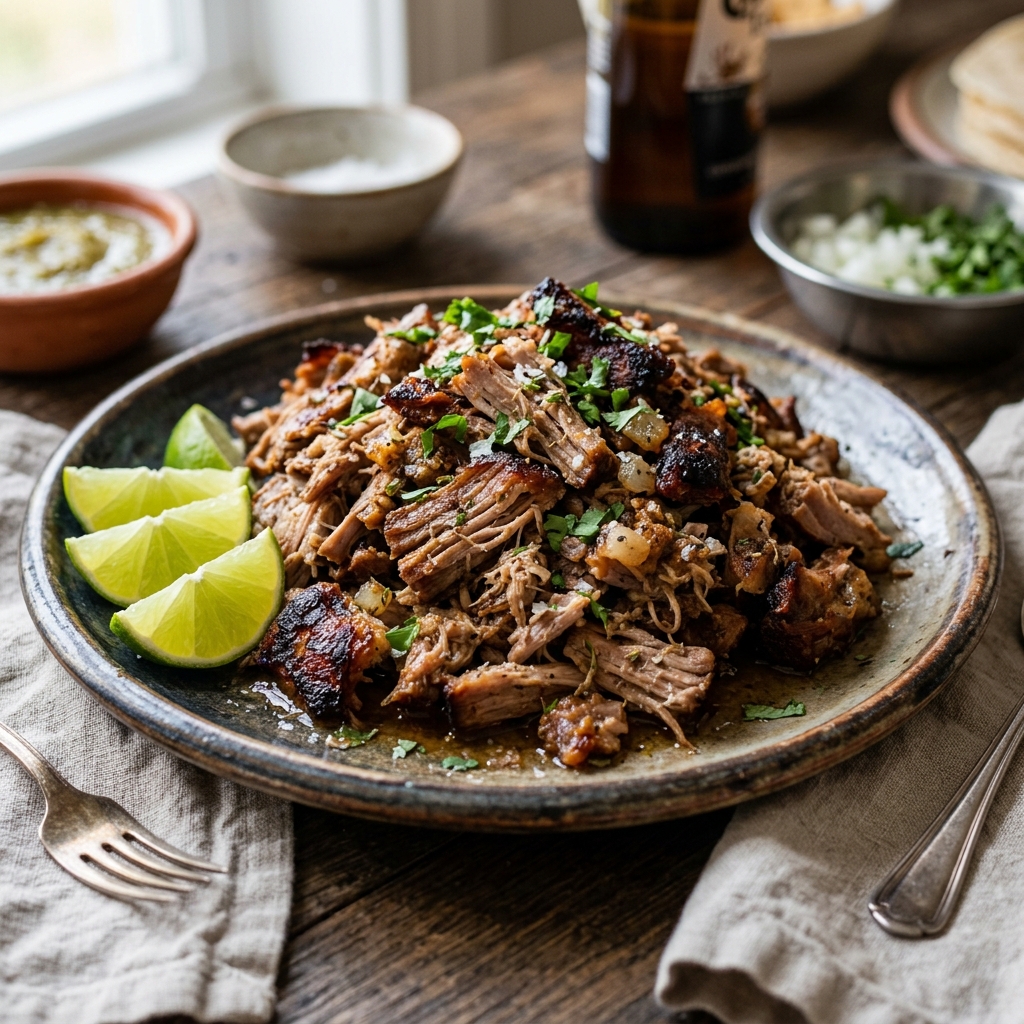
Crispy Multicooker Pork Carnitas
Tender shredded pork shoulder infused with orange and Mexican spices, pressure cooked in 45 minutes.
Instructions
Authentic pork carnitas achieved via multicooker require a two-stage thermodynamic protocol: deep hydraulic collagen gelatinization under high pressure, followed by high-heat convective lipid crisping to caramelize orange-derived sugars.
Culinary Food Science & Thermodynamics
Pork shoulder (Boston butt) contains an intricate network of dense intramuscular collagen fibers and intermuscular fat deposits. Traditional Mexican copper-cazo simmering requires 3 to 4 hours in bubbling lard to achieve tenderness. In a multicooker at 15 psi (121°C / 250°F), steam enthalpy accelerates heat transfer by a factor of four. Under sustained high pressure for 35 minutes, tough Type I collagen completely denatures and hydrolyzes into silky gelatin, allowing muscle fascicles to separate effortlessly under gentle fork pressure.
Citrus biochemistry plays a dual enzymatic and aromatic role. Fresh orange juice provides natural citric and ascorbic acids, lowering the braising environment’s pH to approximately 4.5. This mild acidity loosens superficial myofibrillar proteins during early heating, accelerating liquid uptake. Meanwhile, non-polar limonene and terpene oils in the orange peel dissolve into rendering pork fat, infusing the meat with authentic citrus aromatics.
The culinary masterstroke is Stage 2: convective lipid crisping. After pressure cooking and shredding, the meat is drizzled with reduced braising juices and subjected to high-intensity convective heat (220°C / 425°F in an air fryer or oven broiler). Fructose from the orange juice and amino acids from the pork undergo explosive Maillard browning, creating shatteringly crisp, caramelized exterior tips while the interior meat remains luscious and meltingly tender.
Chef’s Technique & Timing Benchmarks
| Culinary Phase | Temperature / Pressure | Duration | Physical & Chemical Markers |
|---|---|---|---|
| Pressure Hydrolysis & Tenderizing | 121°C (250°F) at 15 psi | 35 min | Collagen liquefies; meat yields effortlessly to fork pressure. |
| Controlled Pressure Dissipation | Descending to 100°C (212°F) | 10 min NPR | Prevents violent boiling; locks gelatinous moisture within shredded strands. |
| Shredding & Lipid Basting | Warm 65°C (149°F) | 3 min | Meat shredded into coarse strands; tossed with seasoned braising lard. |
| Convective Maillard Broil | Air Fryer / Broiler 220°C (425°F) | 5 – 6 min | Surface edges blister into mahogany crackling; audible sizzle. |
Macro Profile & Nutritional Strategy
A highly satiating, nutrient-dense profile rich in complete animal protein, natural collagen peptides, bioavailable zinc, and metabolic B-vitamins (thiamine, B6, B12). Ideal for low-carb and ketogenic dietary protocols.
| Nutritional Metric | Amount Per Serving (6 Servings Total) | % Daily Value |
|---|---|---|
| Total Caloric Energy | 430 kcal | 22% |
| Bioavailable Protein | 38 g | 76% |
| Total Lipids (Pork Lard) | 28 g | 36% |
| Saturated Fatty Acids | 10 g | 50% |
| Net Carbohydrates | 3 g | 1% |
| Bioavailable Zinc | 4.5 mg | 41% |
| Thiamine (Vitamin B1) | 0.8 mg | 67% |
Precision Macro & Calorie Verification with Nutrinixy AI
Import this exact recipe formulation directly into Nutrinixy AI to compute real-time macronutrient partitions, glycemic load, and custom portion splits tailored to your metabolic targets.
Explore Nutrinixy Ai Calorie Tracker
Snap a photo of your meal for instant AI nutrition breakdowns and macro tracking.
Visit Nutrinixy Ai Calorie Tracker Official Portal →Troubleshooting & Texture Faults
- Tough, Un-Shreddable Meat: Caused by cutting pork into oversized chunks or cutting pressure time short. Cut shoulder into uniform 5cm cubes and adhere strictly to 35 minutes of high pressure.
- Dry, Desiccated Meat After Crisping: Caused by broiling the shredded meat without basting in cooking juices. Toss the meat in 3 to 4 tablespoons of rendered cooking fat and juices before exposing to high heat.
- Bland Flavor Profile: Caused by discarding the braising liquor. Reduce the remaining cooking liquid in “Sauté” mode until glossy and drizzle over the finished carnitas.
- Charred, Bitter Meat Edges: Caused by using sweetened commercial orange juice containing high-fructose corn syrup, or placing the meat too close to upper heating elements. Use fresh-squeezed orange juice and maintain 15cm clearance from the heat source.
Make-Ahead, Storage & Reheating
Carnitas are ideal for batch cooking. Pressure-cook and shred the pork a day ahead, but save the final crisping for just before serving. Store the shredded meat together with some of its cooking juices so it stays moist. Refrigerate within two hours of cooking and use within 3–4 days, or freeze in flat, airtight bags with a little liquid and thaw overnight in the fridge. To serve, warm the meat until steaming hot (74°C / 165°F), then crisp it in a hot skillet or the air fryer so the edges caramelize again.
Cut & Seasoning Variations
- Stick with shoulder: Lean cuts such as tenderloin or loin lack the fat and connective tissue that make carnitas juicy, and they turn dry under pressure.
- Spice options: Cumin, dried oregano and a bay leaf are classic additions; a chipotle pepper adds smoky heat.
- Citrus balance: Replacing a little of the orange juice with fresh lime juice gives a sharper, less sweet finish.
Serving Suggestions
Pile the crispy pork into warm corn tortillas with diced white onion, chopped cilantro, a squeeze of lime and salsa verde. Leftovers work well in burrito bowls with rice and beans, on nachos, or in quesadillas.
Common Crisping Mistakes
- Crowding: An overloaded basket or tray steams the meat instead of crisping it. Spread it loosely in one layer and work in batches.
- Walking away: The sugary edges brown very quickly at the end, so stay close for the last few minutes and turn the meat once.
Thermal Kinetics, Maillard Browning & Structural Texture Control in Crispy Multicooker Pork Carnitas
Heat governs everything. While casual kitchen notes rely on vague clock estimates, achieving repeatable excellence with Crispy Multicooker Pork Carnitas depends on physical variables you can measure directly: cookware thermal mass, surface water evaporation rate, myofibrillar or plant-cell protein coagulation between 145°F and 172°F (63°C–78°C), starch gelatinization thresholds, and lipid-water emulsion stability.
Surface moisture stalls browning cold. Because latent heat of vaporization locks wet food surfaces near 212°F (100°C) until free water flashes off, blotting proteins or vegetables thoroughly dry before they touch preheated cast iron or tri-ply stainless steel lets the contact zone leap straight past steam into the 285°F–330°F (140°C–165°C) Maillard reaction window without overcooking the interior.
Pantry Chemistry, Equipment Calibration & Ratio Adjustments
Small ingredient shifts alter kitchen physics. Whether you shop at regional grocers, specialty butcher counters, or bulk pantry suppliers, calibrating fat ratios, flour protein percentages, and appliance airflow prevents the most common home-cooking failures:
- Fat Smoke Points, Dairy Butterfat & Emulsion Shear: Pair high-smoke-point neutral oils or clarified ghee with hard searing above 375°F (190°C), and reserve whole-milk butter (80%–82% butterfat) or heavy whipping cream (36%–40% milkfat) for off-heat pan mounting so casein micelles and fat globules stay suspended without splitting into greasy pools.
- Convection vs. Conventional Oven & Air-Fryer Thermal Offsets: Because residential oven thermostats routinely swing 15°F to 25°F around their digital setpoint, drop your target temperature by 25°F (15°C) whenever engaging a convection fan, position racks in the center third of the cavity, and verify doneness with an instant-read thermocouple probe rather than visual color alone.
- Osmotic Salting vs. Volatile Acid Finishing: Season in measured stages early in the cook so osmotic diffusion draws aromatic moisture through dense cellular tissue, then brighten the finished dish off the burner with fresh citrus juice, wine vinegar, or tender herbs whose volatile esters would otherwise flash off under boiling heat.
USDA Food-Safety Cooling Curves, Airtight Storage & Gentle Reheating
Cool leftovers rapidly. Under USDA Food Safety and Inspection Service (FSIS) guidelines, cooked dishes must pass through the bacterial danger zone between 140°F and 40°F (60°C–4°C) within two hours: divide large batches into shallow glass containers no deeper than two inches before sealing and refrigerating at 35°F–38°F (2°C–3°C).
Skip full-power microwave blasting. Reheating dense proteins, starches, or emulsified sauces at 100% magnetron output boils internal moisture pockets and squeezes out fat; instead, warm portions gently in a covered skillet over low heat or in a 300°F (150°C) oven with a tablespoon of stock, water, or butter until the core reaches 165°F (74°C).
Rescue broken sauces immediately. If a reduction tightens too far or begins weeping oil around the edges of the pan, pull the skillet off the burner at once, whisk in a splash of cold water or a chilled cube of unsalted butter, and use mechanical shear to snap the dispersed droplets back into a glossy, spoon-coating glaze.