
Provençal Confit Byaldi Ratatouille: Uniform Evaporative Layering Physics
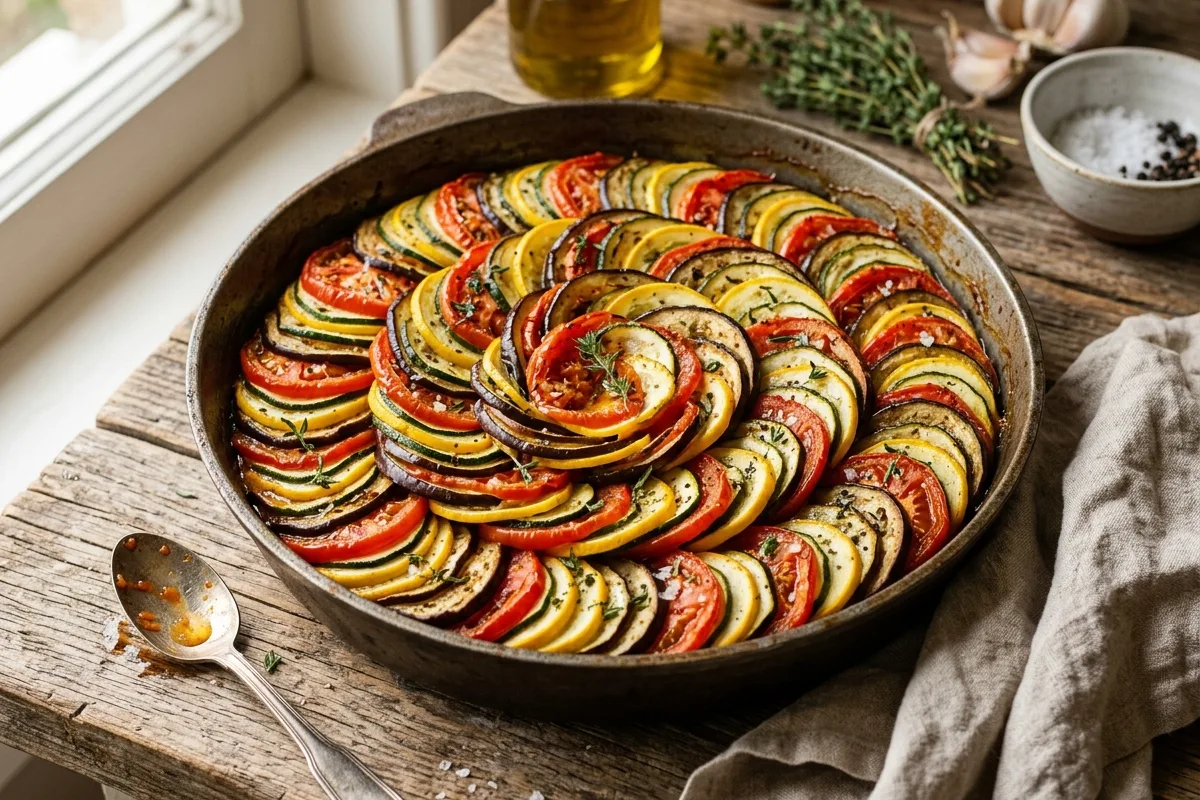
Modern culinary geometry applied to classic ratatouille: precision mandoline calibration, piperade foundation moisture balance, and slow parchment-covered steam baking.
Instructions
Traditional rustic ratatouille frequently suffers from a fatal culinary defect: watery, mushy vegetable stewing where distinctive flavors dissolve into indistinct grey cellulose. Confit Byaldi (invented by chef Michel Guérard and refined by Thomas Keller) solves this through thermal layering geometry and controlled evaporative moisture balance.
The Physics of Thin-Layer Vegetable Confit
Summer vegetables—eggplant, zucchini, squash, and tomatoes—contain between 92% and 95% cellular water. In a traditional stewpot, trapped moisture cannot escape, causing cell walls composed of pectin and cellulose to collapse in an uncontrolled water bath. The result is soggy, overcooked mush.
Confit Byaldi re-engineers this thermodynamic profile by combining three distinct physical mechanisms:
- High Surface-Area-to-Volume Ratio: By slicing every vegetable to an exact thickness of 1.5 millimeters, heat penetrates the tissue rapidly and evenly. Moisture evaporates at a consistent, predictable rate across all four vegetable varieties despite their differing cell densities.
- Piperade Dehydration Pad: The roasted bell pepper and reduced tomato piperade at the base of the skillet acts as an absorbent flavor sponge. As moisture drips downward from the shingled vegetables, the concentrated piperade absorbs it, using the liquid to continue slow caramelization rather than pooling.
- The Parchment Cartouche Microclimate: A circular disc of parchment paper with a center steam vent creates a semi-sealed microclimate. The trapped steam breaks down tough protopectin into soluble pectin at 85°C (185°F), keeping the vegetables tender without direct radiant scorching.
The Caramelization Phase: Fructose & Pectin Setting
During the initial 50-minute cartouche bake at 150°C (300°F), the vegetables reach structural equilibrium: the cellulose softens, but the overlapping shingle architecture prevents them from sinking. When the parchment paper is removed and the oven heat climbs to 190°C (375°F), direct dry convection takes over.
Water continues to vaporize from the exposed edges of the overlapping discs. As water activity drops, natural sugars (fructose and glucose in zucchini and tomatoes) exceed 160°C (320°F), triggering pyrolysis and caramelization. The rims curl and brown delicately, developing complex roasted sweetness that contrasts with the savory, garlicky vegetable interior.
Precision Oven-to-Table Cooking with Alva
Confit Byaldi requires flawless heat distribution across the entire pan diameter. Alva multi-clad stainless steel and enameled skillets transition seamlessly from stovetop reduction to gentle oven baking.
Explore Alva Cookware Range →Lipid Transport: Extra-Virgin Olive Oil Chemistry
Vegetable carotenoids (such as lycopene in tomatoes and lutein in squash) are fat-soluble molecules bound inside plant chromoplasts. Raw or boiled in plain water, these nutrients remain trapped and biologically inaccessible.
High-polyphenol extra-virgin olive oil acts as an essential lipophilic transport solvent. As the oil coats the vegetables during the bake, heat dissolves the carotenoid pigments, carrying them uniformly through the dish and intensifying the rich color while improving nutrient bioavailability.
Critical Failure Modes & Chemistry Risks to Avoid
- Uneven Slicing Thickness: Slicing by hand with a knife yields irregular discs: thick slices remain crunchy and raw while thin slices dry into parchment. Always use a calibrated mandoline set to 1.5 mm.
- Watery Piperade Foundation: If the base tomato-pepper mixture is not reduced until thick and pasty before assembling the shingles, excess liquid will pool at the bottom, boiling the vegetables from beneath.
- Skipping the Parchment Cartouche: Baking uncovered from the start burns the delicate edges of the zucchini long before the eggplant interior softens. The cartouche is mandatory.
- Over-Salting Before Assembly: Salt draws water out by osmosis. Salting heavily before arranging causes premature water weeping that makes shingling messy. Salt lightly just prior to baking.
Nutritional & Biochemical Profile
One serving (approx. 260 g vegetable confit) delivers 185 kcal with exceptional antioxidant density:
| Macronutrient | Quantity per Serving | Energy Contribution (%) | Biological Role |
|---|---|---|---|
| Protein | 4 g | 9% | Plant-based peptides from concentrated nightshade vegetables and squash |
| Fat | 11 g | 54% | Heart-healthy monounsaturated oleic acid and polyphenols from extra-virgin olive oil |
| Carbohydrates | 18 g | 37% | Natural plant sugars combined with slow-digesting dietary fiber |
| Dietary Fiber | 6.2 g | — | High soluble pectin and insoluble cellulose supporting gut microbiome integrity |
| Lycopene & Beta-Carotene | 8.4 mg | — | Potent lipid-dissolved antioxidants extracted during slow oven confit |
Frequently Asked Questions
Can I prepare Confit Byaldi in advance?
Yes. The piperade base can be prepared up to 48 hours in advance and stored in the refrigerator. Assemble the vegetable shingles on the day of cooking for maximum textural precision.
Do I need to salt and purge the eggplants first?
With modern Japanese or fairy tale eggplants, bitter alkaloid compounds have been largely bred out, so salting is unnecessary when sliced at 1.5 mm. If using large globe eggplants, salt slices on paper towels for 20 minutes to draw out excess moisture before arranging.
Is this dish served hot, warm, or room temperature?
While delicious warm from the oven, Confit Byaldi reaches peak flavor balance at room temperature (around 20°C to 22°C / 68°F–72°F). As the olive oil and vegetable juices cool slightly, their natural sweetness and aromatic herb notes become significantly more pronounced.
Editorial Transparency & Affiliate Disclosure: FoxyChef evaluates culinary gear independently. Some links on this page route through verified partner programs such as /go/alva-cookware/ which may earn our kitchen lab a modest commission at zero additional cost to you.