
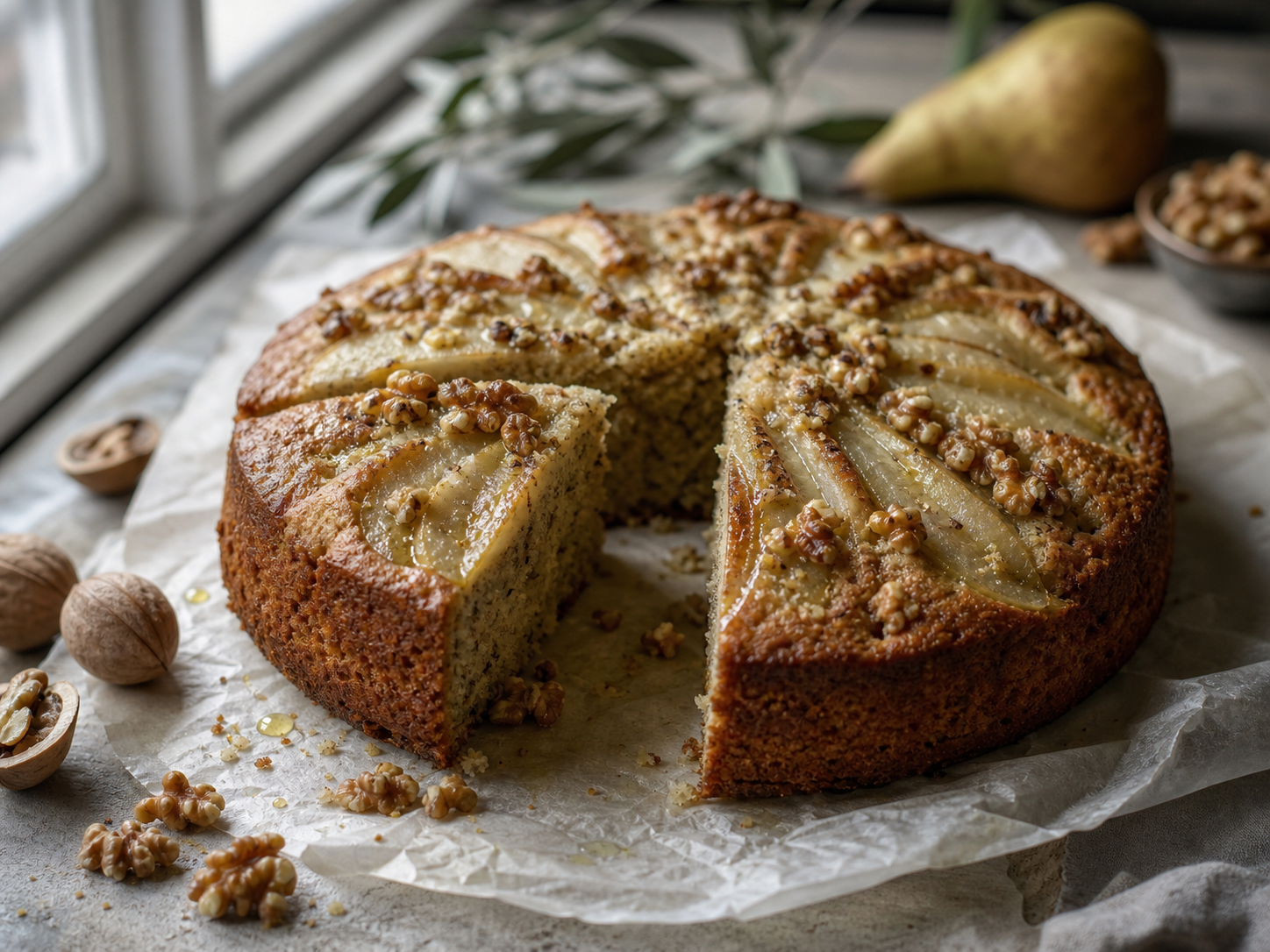
Rustic Pear and Toasted Walnut Extra Virgin Olive Oil Cake
Instructions
The rustic caramelized pear and toasted walnut extra virgin olive oil cake serves as an insightful exploration into the rheological behavior of unsaturated liquid lipids within Mediterranean baking. By replacing conventional solid dairy butter with unrefined extra virgin olive oil rich in oleic acid and antioxidant biophenols, pastry bakers modulate crumb elasticity, ensure prolonged moisture retention, and synchronize chemical leavening kinetics with organic fruit acids for peerless tenderness.
Liquid Unsaturated Lipids vs Saturated Butter Fats in Crumb Microstructure
Traditional sponge cakes depend upon the solid fat “creaming method,” wherein solid saturated butterfat (melting point roughly 34 °C / 93 °F) is whipped with crystalline sucrose to mechanically entrap air cells within an interconnected lipid network. While this provides initial structural lift, saturated triglycerides rapidly crystallize upon cooling to ambient temperature. This solidification accelerates starch retrogradation—the recrystallization of amylose and amylopectin matrices—causing classic butter cakes to turn noticeably firm, crumbly, and dry within 24 to 48 hours of baking.
Conversely, extra virgin olive oil (EVOO) consists of 75% to 80% monounsaturated oleic fatty acids (C18:1), which remain entirely liquid at room temperature and do not crystallize until chilled between -6 °C and 0 °C (21 °F to 32 °F). When integrated into cake batter, olive oil coats individual wheat starch granules and budding gluten filaments with a continuous, hydrophobic fluid barrier. This colloidal lubrication dramatically suppresses gluten polymer rigidity while physically preventing the loss of bound moisture. As a direct consequence, an olive oil crumb retains a tender, springy elasticity and a sensation of juicy freshness for up to a full week at ambient temperature without synthetic humectants.
Polyphenol Antioxidant Mechanics and Pear Moisture Retention
In addition to its lipid profile, cold-extracted extra virgin olive oil contains substantial amounts of phenolic compounds, specifically hydroxytyrosol, tyrosol, oleocanthal, and alpha-tocopherol (natural Vitamin E). At baking temperatures of 175 °C (350 °F), free lipids undergo thermal oxidation. While refined polyunsaturated seed oils degrade and emit volatile oxidized aldehydes with rancid notes, olive oil’s natural biophenols function as robust radical scavengers, shielding lipid chains from thermo-oxidative stress.
Furthermore, these phenolic molecules form secondary hydrogen bonds with cell-wall pectic substances inside the fresh pears. Pears naturally contain galacturonic acid polymers that soften when heated; the presence of olive oil phenolics stabilizes this plant pectin framework, preventing premature cellular collapse and modulating osmotic fluid release. Instead of dumping water into the surrounding batter—which causes soggy, gummy pockets at the bottom of the pan—the fruit pieces poach gently in their own concentrated sugars, remaining plump and succulent.
Biphasic Gasification: Chemical Leaveners and Organic Fruit Acids
Elevating a dense batter laden with heavy liquid oil, fruit chunks, and toasted walnut pieces requires precise stoichiometry between chemical leavening agents and endogenous acids. Our formulation utilizes a dual-action system pairing commercial sodium acid pyrophosphate/calcium phosphate powder with pure sodium bicarbonate.
Ripe pears contribute endogenous organic acids (chiefly malic and citric acid) with a natural pH profile between 3.8 and 4.2. Upon liquid incorporation, sodium bicarbonate immediately neutralizes these fruit acids, triggering an initial ambient burst of carbon dioxide bubbles that seed microscopic gas nucleations throughout the batter. Subsequently, as oven temperatures surpass 60 °C (140 °F), the thermally activated pyrophosphates decompose, generating a powerful secondary gas surge exactly as wheat starches gelatinize. This calibrated expansion prevents the heavy chopped fruit and nut pieces from sinking to the bottom, yielding an evenly suspended, lofty crumb structure.
Pyrolytic Walnut Toasting and Essential Oil Volatilization
English walnuts (*Juglans regia*) possess up to 65% polyunsaturated fats, heavily concentrated in linoleic and alpha-linolenic acids. Folding raw walnuts into a moist cake batter exposes the palate to astringent tannins located in the walnut skin and produces an unpleasantly rubbery, waterlogged chew. To counteract this, walnuts must undergo pyrolytic dry roasting at 160 °C (320 °F) for 10 minutes prior to incorporation.
This dry thermal pretreatment vaporizes internal bound water, ruptures micro-oil vesicles, and catalyzes the Maillard reaction between nut sugars and free amino acids. The process synthesizes roasted pyrazines and nutty furanones, transforming harsh raw tannins into mild, complex toasted flavor compounds. When subsequently enveloped in olive oil batter, these liberated walnut oils synergize with the fruity, grassy notes of the EVOO to produce a deeply layered Mediterranean flavor profile.
Baking Vessel Thermodynamics and Extended Crumb Stabilization
Deploying a heavy-gauge ceramic baker or thick-walled cast-iron vessel for this olive oil cake offers distinct thermodynamic advantages over lightweight tin bakeware. Stoneware and enameled iron boast remarkable volumetric heat capacities, absorbing convective oven heat gradually and buffering the batter against turbulent temperature swings. This steady conductive energy ensures that heat migrates smoothly toward the center of the cake, allowing the deep batter core to reach 85 °C (185 °F) synchronously with the perimeter.
Simultaneously, wheat amylose and amylopectin starches undergo progressive gelatinization within this protected thermal gradient between 62 °C and 68 °C (144 °F to 154 °F). As moisture freed from the macerated pears interacts with the flour, the continuous lipid phase provided by the olive oil enrobes each starch granule. This prevents excess swelling and cross-linking, producing an open, velvety, melt-in-the-mouth crumb structure that retains its integrity and springy tenderness across multiple days of storage.
Estimated Nutritional Breakdown per Serving
| Nutritional Parameter | Amount per Serving (1 generous slice, approx. 95 g, yields 10) |
|---|---|
| Total Calories | 320 kcal |
| Plant & Egg Protein | 6 g |
| Heart-Healthy Fats (Oleic EVOO & Omega-3 Walnut Lipids) | 16 g |
| Total Carbohydrates (Fruit Fructose & Wheat Starch) | 40 g |
| Natural Vitamin E (Alpha-Tocopherol) | 2.8 mg (19% DV) |
Lab-Tested Nonstick Performance: Swiss Diamond Classic
High-heat cooking and delicate proteins require zero-stick release and scratch-resistant durability. Swiss Diamond's real diamond crystal coating delivers edge-to-edge heat conduction with effortless cleanup.
Shop Swiss Diamond Skillets →Editorial Disclosure & Affiliate Notice: FoxyChef evaluates culinary gear and cooking methods under strict kitchen laboratory standards. Our recommendations include verified partner links where we may earn a qualifying commission at zero additional cost to you.
Lab-Tested Nonstick Performance: Swiss Diamond Classic
High-heat cooking and delicate proteins require zero-stick release and scratch-resistant durability. Swiss Diamond's real diamond crystal coating delivers edge-to-edge heat conduction with effortless cleanup.
Shop Swiss Diamond Skillets →