
Tender Multicooker Pulled Pork
Fall-apart tender pork shoulder infused with barbecue spices, pressure-cooked in just 60 minutes.
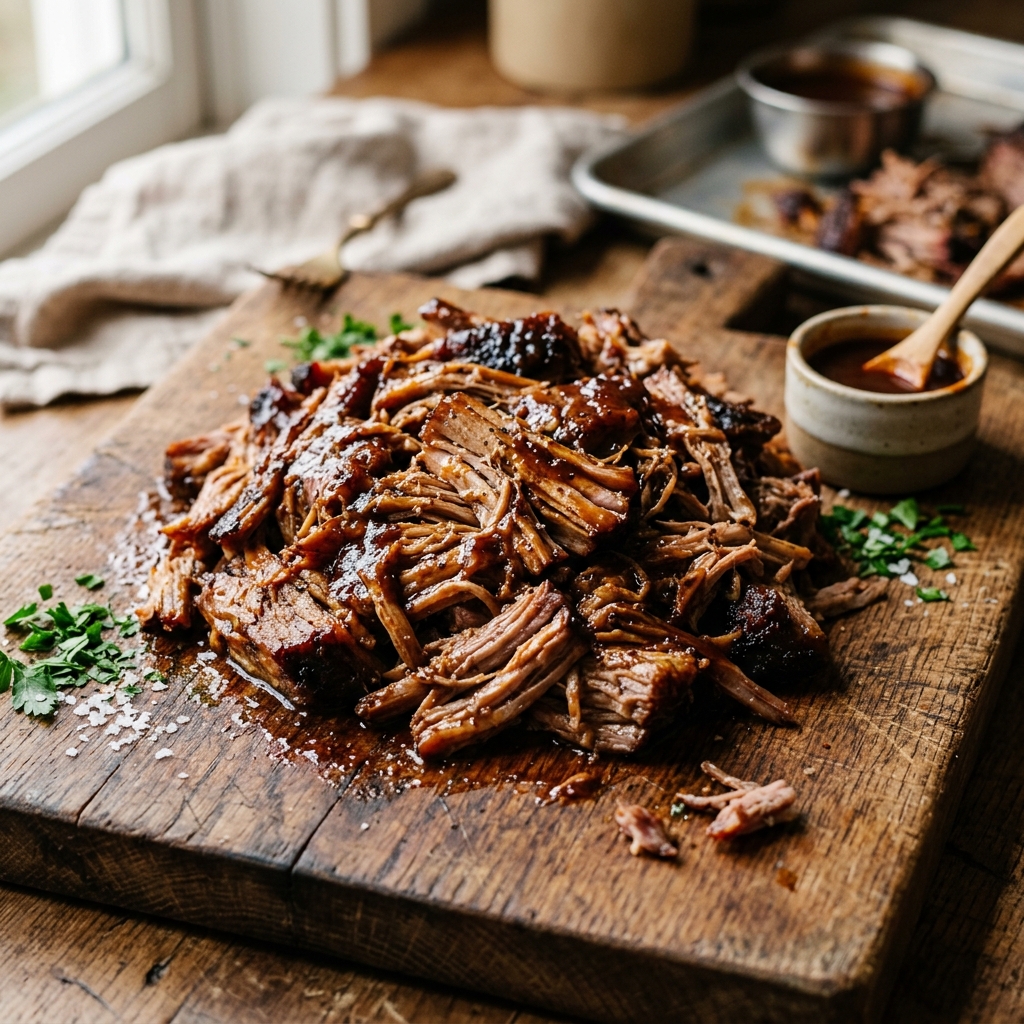
Instructions
Mastering multicooker pulled pork is an exercise in pressure-accelerated collagen hydrolysis: melting dense intramuscular connective tissue into unctuous gelatin in under an hour.
Culinary Food Science: Collagen Denaturation & Reabsorption
Pork shoulder (Boston butt) contains an exceptionally dense matrix of Type I and Type III collagen fibers. In low-and-slow smoking (110°C / 225°F), unraveling this triple-helix collagen into gelatin requires 8 to 12 hours of thermal exposure.
Inside a multicooker operating at 11.6 psi (120°C), steam enthalpy accelerates thermal conduction directly into the core of cut pork chunks. High pressure forces moisture between myofibrillar bundles, while the acetic acid in apple cider vinegar cleaves peptide bonds, accelerating collagen hydrolysis into rich gelatin four times faster than open roasting.
Crucially, as meat cools from 95°C down to 70°C, myofibrillar bundles re-expand like dehydrated cellulose sponges. Tossing the shredded meat back into the degreased cooking liquor allows the pork to reabsorb up to 25% of its weight in seasoned broth, guaranteeing juicy succulence for days.
Chef’s Technique & Timing Benchmarks
| Phase | Pressure / Temp | Duration | Physical & Chemical Markers |
|---|---|---|---|
| High-Heat Sear | Sauté High (180°C) | 6 min | Deep Maillard crust forms on pork cube facets. |
| Acid Deglaze | Simmer (100°C) | 2 min | Vinegar dissolves fond; fond aromatics enrich cooking liquid. |
| Pressure Collagen Breakdown | High Pressure (120°C) | 45 min | Collagen triple-helix denatures into fluid gelatin. |
| Natural Release & Reabsorption | Cool to 75°C (NPR) | 15 min | Fibers relax and reabsorb liquid before fork-shredding. |
Macro Profile & Nutritional Strategy
A high-protein foundation rich in bioavailable glycine and proline from hydrolyzed gelatin, supporting joint and metabolic health with minimal refined sugar.
| Nutritional Metric | Amount Per Serving (6 Servings) | % Daily Value |
|---|---|---|
| Total Caloric Energy | 340 kcal | 17% |
| Bioavailable Protein | 36 g | 72% |
| Total Lipids | 20 g | 25% |
| Saturated Fat | 7 g | 35% |
| Net Carbohydrates | 2 g | 1% |
| Iron | 2.4 mg | 13% |
Troubleshooting & Texture Faults
- Tough, Rubbery Meat: Under-cooked connective tissue. If the meat resists shredding, return to high pressure for 10 additional minutes.
- Dry Shreds Despite Swimming in Liquid: Quick pressure release (QPR) was used. QPR violently flashes internal liquid to steam, wringing moisture out of the muscle fibers. Always use 15-minute natural release.
- Excessively Greasy Texture: Boston butt has heavy fat caps. Skim off rendered surface oil from the pot juices before tossing with shredded meat.
- Bland Interior: Pork chunks were cut too large. Cut into uniform 5cm (2-inch) cubes so spice rub and braising liquid penetrate to the center.
Ingredient Swaps & Variations
- Bone-in shoulder: Cut the meat away from the bone into the same 5cm (2-inch) cubes and add the bone to the pot during pressure cooking for extra body in the juices. Discard it before shredding.
- Braising liquid: Apple juice or chicken stock can replace part of the water, but keep the apple cider vinegar for its acidity. Avoid using thick barbecue sauce as the main liquid; it can scorch on the base and trigger a burn warning.
- Spice rub: Smoked paprika, garlic powder, cumin and black pepper form a reliable base. For a sugar-free version, keep sugar out of the rub and choose an unsweetened sauce for serving.
- Leaner result: Trim the thickest parts of the fat cap before cubing. Some fat is still needed to keep the shreds moist.
If you would rather not mix a rub and pick a sauce from scratch every time, a barbecue subscription box is one way to rotate flavours: Visit Grill Masters Club →Grill Masters Club’s monthly BBQ boxes (affiliate link) ship rubs and sauces selected by pitmasters. Rub the pork cubes before searing and keep any sweet sauce for serving, as described above, so the multicooker insert does not scorch. Box contents change from month to month and ship within the US, so check the current listing and the sugar content of the rubs before you subscribe.
Multicooker Mistakes to Avoid
Scrape up every browned bit after searing; fond left stuck to the insert is a common cause of burn warnings. Stay below the maximum fill line, since a crowded pot takes much longer to come to pressure. Add barbecue sauce only after shredding, not before sealing the lid. If you double the recipe, keep the pressure time the same: it depends on the size of the cubes rather than the total weight, so cutting evenly matters more than adding minutes.
Make-Ahead, Storage & Reheating
Pulled pork reheats well, which makes it a good candidate for batch cooking. Store the shredded meat together with a few spoonfuls of the degreased cooking juices so it stays moist.
- Refrigerate: Cool and chill leftovers within about 2 hours of cooking and eat them within 3–4 days.
- Freeze: Portion the meat with its juices into freezer bags, press out the air and lay them flat. Thaw overnight in the fridge.
- Reheat: Warm in a covered pan or on Sauté mode with a splash of juices or stock, stirring, until steaming hot throughout (74°C / 165°F).
Serving Ideas
Pile the pork onto toasted buns with crunchy coleslaw, fold it into tortillas with pickled onions, or spoon it over rice bowls or baked potatoes. Serving the sauce on the side lets everyone choose how saucy their portion is and keeps leftovers more versatile.
Thermal Kinetics, Maillard Browning & Structural Texture Control in Tender Multicooker Pulled Pork
Heat governs everything. While casual kitchen notes rely on vague clock estimates, achieving repeatable excellence with Tender Multicooker Pulled Pork depends on physical variables you can measure directly: cookware thermal mass, surface water evaporation rate, myofibrillar or plant-cell protein coagulation between 145°F and 172°F (63°C–78°C), starch gelatinization thresholds, and lipid-water emulsion stability.
Surface moisture stalls browning cold. Because latent heat of vaporization locks wet food surfaces near 212°F (100°C) until free water flashes off, blotting proteins or vegetables thoroughly dry before they touch preheated cast iron or tri-ply stainless steel lets the contact zone leap straight past steam into the 285°F–330°F (140°C–165°C) Maillard reaction window without overcooking the interior.
Pantry Chemistry, Equipment Calibration & Ratio Adjustments
Small ingredient shifts alter kitchen physics. Whether you shop at regional grocers, specialty butcher counters, or bulk pantry suppliers, calibrating fat ratios, flour protein percentages, and appliance airflow prevents the most common home-cooking failures:
- Fat Smoke Points, Dairy Butterfat & Emulsion Shear: Pair high-smoke-point neutral oils or clarified ghee with hard searing above 375°F (190°C), and reserve whole-milk butter (80%–82% butterfat) or heavy whipping cream (36%–40% milkfat) for off-heat pan mounting so casein micelles and fat globules stay suspended without splitting into greasy pools.
- Convection vs. Conventional Oven & Air-Fryer Thermal Offsets: Because residential oven thermostats routinely swing 15°F to 25°F around their digital setpoint, drop your target temperature by 25°F (15°C) whenever engaging a convection fan, position racks in the center third of the cavity, and verify doneness with an instant-read thermocouple probe rather than visual color alone.
- Osmotic Salting vs. Volatile Acid Finishing: Season in measured stages early in the cook so osmotic diffusion draws aromatic moisture through dense cellular tissue, then brighten the finished dish off the burner with fresh citrus juice, wine vinegar, or tender herbs whose volatile esters would otherwise flash off under boiling heat.
USDA Food-Safety Cooling Curves, Airtight Storage & Gentle Reheating
Cool leftovers rapidly. Under USDA Food Safety and Inspection Service (FSIS) guidelines, cooked dishes must pass through the bacterial danger zone between 140°F and 40°F (60°C–4°C) within two hours: divide large batches into shallow glass containers no deeper than two inches before sealing and refrigerating at 35°F–38°F (2°C–3°C).
Skip full-power microwave blasting. Reheating dense proteins, starches, or emulsified sauces at 100% magnetron output boils internal moisture pockets and squeezes out fat; instead, warm portions gently in a covered skillet over low heat or in a 300°F (150°C) oven with a tablespoon of stock, water, or butter until the core reaches 165°F (74°C).
Rescue broken sauces immediately. If a reduction tightens too far or begins weeping oil around the edges of the pan, pull the skillet off the burner at once, whisk in a splash of cold water or a chilled cube of unsalted butter, and use mechanical shear to snap the dispersed droplets back into a glossy, spoon-coating glaze.