
Ultimate Fudgy Dark Chocolate Espresso Brownies: Sugar Dissolution & Shiny Crust Chemistry
Instructions
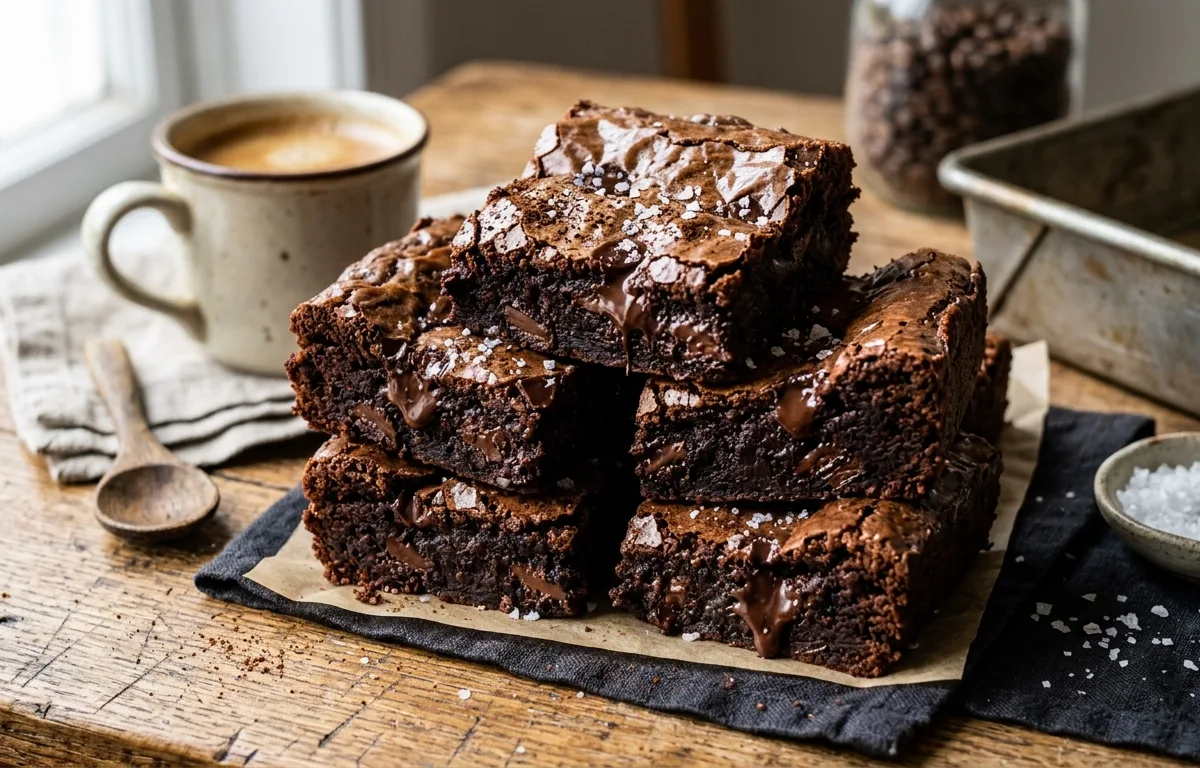
Baking the ultimate fudgy dark chocolate espresso brownie boasting an ultra-glossy, paper-thin crinkled meringue crust is an exercise in applied thermodynamics and colloid emulsion chemistry. By engineering complete sucrose dissolution within a warmed 45 °C egg ribbon matrix, manipulating cocoa butter polymorphic lipid crystallization, and purposefully restricting gluten web formation, bakers can transcend conventional cakey textures to deliver a velvety, truffle-dense interior with pinpoint precision.
The Chemistry of the Crinkle Crust: Sugar Dissolution Kinetics and Egg Microfoam
The prized wafer-thin, tissue-paper crinkle crust that crowns a world-class brownie is not an accidental culinary artifact or the product of chemical leaveners. Biochemically, this lustrous crust represents a micro-thin layer of baked meringue formed by denatured egg albumins bonded with fully dissolved sucrose. When granulated sugar is added cold or dumped in with dry flour, sugar crystals fail to dissolve within the available aqueous phase. Unsolubilized sugar granules stay suspended within the batter, caramelizing irregularly and leaving a dull, matte, textured surface devoid of shine.
To trigger the spontaneous formation of this reflective top skin, whole eggs and an extra yolk must be whipped alongside refined white sugar and moisture-rich brown sugar at an elevated temperature of 45 °C to 50 °C (113 °F to 122 °F) for 5 to 7 minutes until reaching a voluptuous ribbon stage. At 45 °C, sucrose solubility in the free water of egg whites surges dramatically, exceeding 240 grams per 100 grams of water. Vigorous aeration mechanically denatures ovalbumin and ovotransferrin proteins, encapsulating microscopic air cells stabilized by yolk-derived amphiphilic lecithin.
During the initial phase of baking at 170 °C (338 °F), this low-density sugar-protein foam floats to the surface via buoyant convective displacement. As surface water vaporizes, the concentrated dissolved sugar reaches supersaturation, flash-drying into an ultra-thin, glassy amorphous shell. Upon cooling, thermal contraction fractures this brittle crystalline sheet into a labyrinth of elegant gossamer micro-crevices.
Thermodynamics of Cocoa Butter and Polymorphic Phase Transitions
A true fudgy brownie relies upon an exceptionally high lipid-to-flour ratio. Our laboratory formulation pairs 70% dark couverture chocolate with unsalted dairy butter in a commanding 2.5:1 fat-to-flour proportion. Cocoa butter is a complex triacylglycerol matrix dominated by oleic, palmitic, and stearic fatty acids displaying six distinct polymorphic crystalline configurations (designated Form I through Form VI).
Melting the bittersweet chocolate and dairy butter between 50 °C and 55 °C (122 °F to 131 °F) completely melts away prior unstable crystalline polymorphs, yielding a silky, single-phase liquid lipid suspension. During oven baking, this liquid fat envelopes the starch granules of the minimal flour payload, acting as a hydrophobic barrier that curtails excessive water absorption and starch gelatinization. As the brownies cool slowly to ambient room temperature and subsequently chill, the fats settle into a semi-crystalline state that softens immediately upon oral contact at human body temperature (37 °C / 98.6 °F), imparting an unctuous, melt-in-the-mouth sensory profile.
Deliberate Gluten Inhibition Mechanics
In artisan bread baking, gluten strength is the ultimate pursuit; in fudgy brownie pastry science, gluten development is strictly forbidden. Any structural elasticity introduces unwanted springiness, converting an unctuous confection into a dry chocolate sponge cake. Gluten formation requires two fundamental precursors: bioavailable free water and sustained mechanical shear. We eliminate both pathways.
First, we deploy low-protein pastry flour (8% to 9% protein content, low in glutenin polymers). Second, the enormous concentration of dissolved sucrose exerts intense osmotic pressure, binding free polar water molecules and starving glutenin and gliadin of the hydration required to cross-link. Third, the hydrophobic fat coats the flour particles, physically hindering contact with any moisture (a classic shortening effect). Finally, dry ingredients are introduced solely via gentle manual folding using a flexible silicone spatula for fewer than 45 seconds, terminating the motion the split-second the last pocket of cocoa flour disappears.
Espresso Synergism in Polyphenol and Flavanol Perception
The addition of a concentrated shot of hot espresso (or micro-ground freeze-dried espresso powder) does not convert the brownie into a coffee dessert; rather, it functions as a molecular flavor catalyst. Fermented cacao beans and roasted coffee cherries share upwards of 120 identical volatile aromatic compounds, including alkylpyrazines, methylpyrazines, and furanones born of intense roasting pyrolysis.
Chlorogenic acids and caffeine alkaloids present in brewed espresso engage lingual TAS2R bitter-taste receptors, modulating palate sensitivity. This biochemical interaction attenuates the one-dimensional cloying sweetness of sucrose while amplifying the deeper earthy, tobacco, and fruity floral notes native to premium dark cacao. Furthermore, the mild acidity of the espresso (pH 5.0) stabilizes the emulsion structure as the butterfat integrates into the egg-sugar base.
Baking Vessel Thermodynamics and Starch Gelatinization Thresholds
Baking brownies in an uneven or overly thin tin leads to scorched perimeter edges and a soup-like raw center. To achieve uniform thermal conductivity, professional bakers utilize heavy-gauge ceramic stoneware or multi-clad metal baking pans. The high heat capacity of these materials ensures gradual, stable heat penetration without sharp thermal spikes that prematurely cook egg albumins before the center can equilibrate.
In standard cake batters with high hydration, wheat starch granules gelatinize rapidly between 60 °C and 65 °C (140 °F to 149 °F). In this fudgy formulation, however, the overwhelming concentration of dissolved sucrose binds free water molecules, elevating the starch gelatinization threshold to nearly 82 °C (180 °F). Consequently, the interior matrix remains in a viscous, semi-fluid state throughout most of the baking cycle. Terminating the bake when the core reaches 88 °C (190 °F) guarantees that the starches partially set without drying out the moisture-retaining lipid suspension.
Estimated Nutritional Breakdown per Serving
| Nutritional Parameter | Amount per Serving (1 brownie square, approx. 65 g, yields 16) |
|---|---|
| Total Calories | 360 kcal |
| Complete High-BV Protein | 5 g |
| Total Fat (Cocoa Butter & Dairy Butterfat) | 22 g |
| Total Carbohydrates (Simple Sugars & Cocoa Starch) | 38 g |
| Bioavailable Magnesium | 64 mg (16% DV) |
Lab-Tested Nonstick Performance: Swiss Diamond Classic
High-heat cooking and delicate proteins require zero-stick release and scratch-resistant durability. Swiss Diamond's real diamond crystal coating delivers edge-to-edge heat conduction with effortless cleanup.
Shop Swiss Diamond Skillets →Editorial Disclosure & Affiliate Notice: FoxyChef evaluates culinary gear and cooking methods under strict kitchen laboratory standards. Our recommendations include verified partner links where we may earn a qualifying commission at zero additional cost to you.
Lab-Tested Nonstick Performance: Swiss Diamond Classic
High-heat cooking and delicate proteins require zero-stick release and scratch-resistant durability. Swiss Diamond's real diamond crystal coating delivers edge-to-edge heat conduction with effortless cleanup.
Shop Swiss Diamond Skillets →