
Beef Cuts Compared: Ribeye vs Sirloin vs Tenderloin
Culinary Advantages & Lab Performance
- Continuous multi-layer tri-ply aluminum core guarantees rapid thermal response and eliminates scorching hot spots.
- High-grade 18/10 stainless cooking surface resists corrosion from acidic tomato and wine deglazing liquids.
- Hollow stay-cool cast stainless handles provide secure ergonomic balance when maneuvering hot pans.
Cons & Kitchen Limitations
- Substantial heavy commercial body weight requires two hands when lifting full braising vessels.
- Requires proper oil seasoning and heat modulation technique to prevent protein sticking during searing.
Cookware Cladding & Thermal Response Matrix
| Specification | Alva Tri-Ply (Top Pick) | Standard Disc-Bottom | Ceramic Coated Non-Stick |
|---|---|---|---|
| Thermal Conductivity | Edge-to-Edge 3-Ply Core | Base Plate Only | Moderate Single-Layer |
| Fond Development | Superior (18/10 Stainless) | Inconsistent (Hotspots) | Zero Fond (Coated) |
| Oven Safe Limit | Up to 500°F (260°C) | Up to 400°F | Up to 350°F |
Understanding Beef Primal Cuts: Biomechanics, Connective Tissue & Tenderness
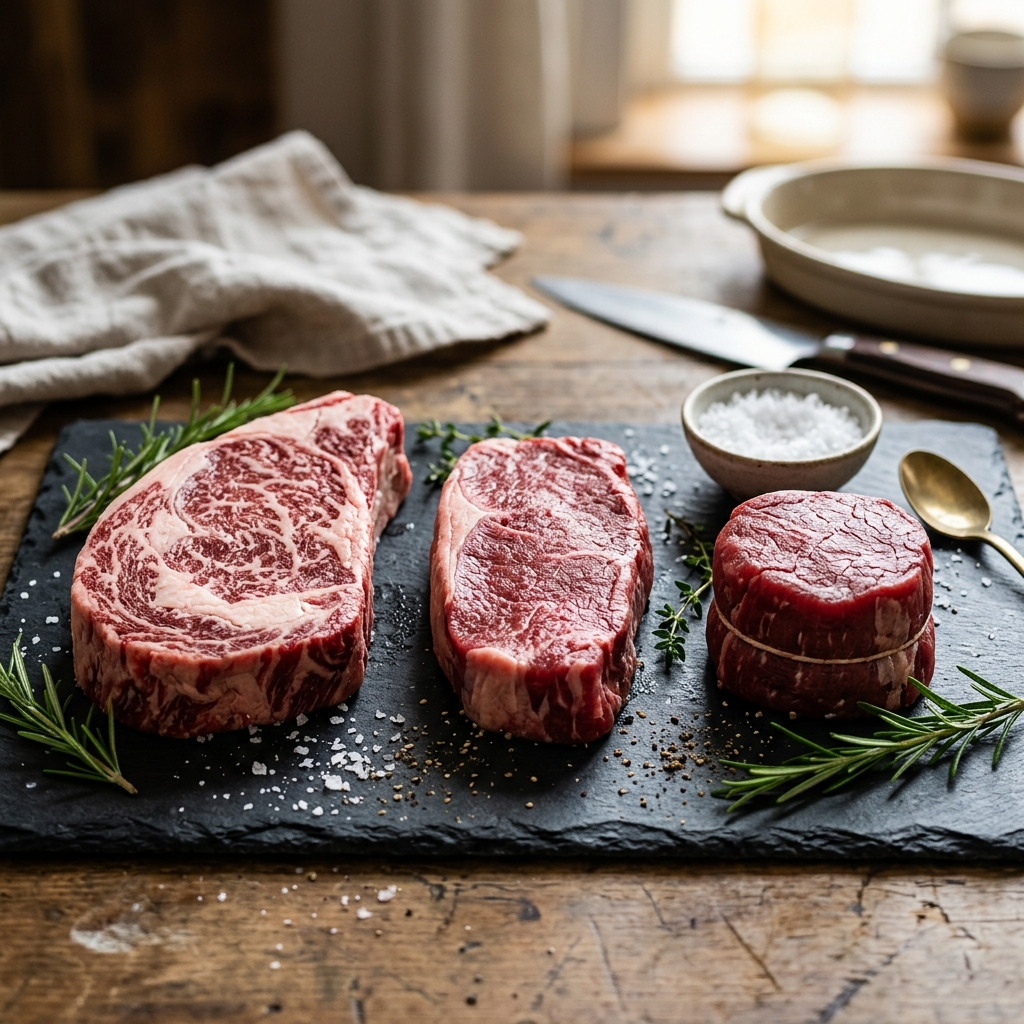
When selecting and preparing premium beef steaks, understanding bovine muscle anatomy is the foundation of culinary precision. The price, texture, moisture retention, and flavor intensity of any cut are direct functions of the biomechanical workload performed by that muscle during the animal’s life. Muscles tasked with constant locomotion and postural stability—such as the brisket, chuck, and shank—possess dense muscle fiber fascicles wrapped in heavy sheets of collagenous perimysium connective tissue. Conversely, suspension muscles shielded from heavy physical work along the upper spine and lumbar region—such as the ribeye and tenderloin—feature fine muscle grain with minimal connective tissue cross-linking.
In the culinary laboratory, tenderness is defined by the shear force required to slice through cooked muscle fibers. When heat is applied, muscle proteins undergo distinct structural changes: myosin denatures and contracts between 104°F and 122°F (40°C and 50°C), while actin contracts tightly between 150°F and 163°F (66°C and 73°C), expelling intracellular moisture. Concurrently, native collagen begins to dissolve into gelatin at temperatures above 140°F (60°C). Balancing these competing thermal dynamics dictates how each primal cut must be butchered, cooked, and sliced.
Properly fabricating and carving distinct beef primal cuts requires extreme edge retention, where an artisan high-carbon blade like the Adept Knives High-Carbon Chef Knife glides through dense intramuscular fat without tearing tender muscle fibers.
Detailed Comparison: Ribeye vs. Tenderloin vs. Sirloin
1. Ribeye (Spinalis Dorsi & Longissimus Dorsi)
Cut from the dorsal rib primal (specifically ribs 6 through 12), the ribeye is composed primarily of two distinct muscle groups: the central Longissimus dorsi eye and the outer capping muscle, the Spinalis dorsi (ribeye cap). The Spinalis dorsi is widely regarded by professional chefs as the single most flavorful muscle on the entire steer, boasting ultra-fine muscle grain and extraordinary marbling.
Intramuscular fat (marbling) in the ribeye consists of monounsaturated fatty acids with a low melting threshold (approximately 95°F to 105°F / 35°C to 40°C). As the steak cooks to medium-rare (130°F–135°F / 54°C–57°C), this internal fat liquefies, self-basting the surrounding muscle fibers and imparting rich, savory succulence. The ribeye is ideal for high-heat skillet searing, charcoal grilling, or two-stage reverse-sear cooking.
2. Tenderloin (Psoas Major / Filet Mignon)
Situated deep along the sublumbar spine beneath the short loin, the Psoas major is completely non-weight-bearing. Because it performs zero mechanical lifting or propulsion, it features the thinnest collagen sheaths and smallest muscle fiber diameters in bovine anatomy. A diner can effortlessly cut a properly prepared filet mignon with a dull fork.
However, extreme tenderness comes with an important culinary trade-off: the tenderloin is exceptionally lean, containing virtually no intramuscular marbling. Without fat to render into savory fatty acids, its flavor profile is mild and subtle. Because it lacks protective fat, cooking tenderloin past 130°F (54°C) causes rapid moisture expulsion, rendering the meat dry and metallic. It thrives with brief, high-heat flash searing, sous-vide precision baths, or service alongside rich butter sauces such as béarnaise or red wine demi-glace.
3. Top Sirloin (Gluteus Medius)
Harvested from the pelvic hip region, the sirloin represents the versatile middle ground of steakhouse cuts. The primary muscle, the Gluteus medius, is an active locomotive muscle that supports the steer’s hindquarters. As a result, its muscle fibers are thicker and its connective tissue density is moderately higher than that of ribeye or tenderloin.
What the sirloin gives up in tenderness, it repays with robust, mineral-dense beef flavor. Because it is relatively lean yet reasonably tender when sliced properly across the grain, top sirloin delivers outstanding culinary utility for high-heat wok stir-fries, steak salads, churrasco skewers, and everyday pan roasts.
The Physics of Butchery and Slicing Geometry
How a finished steak is carved with cutlery directly determines how tender it feels on the human palate. Muscle fibers run parallel to one another in distinct grain directions. If a steak is carved parallel to the grain, the diner’s teeth must grind through long, intact muscle bundles, making even a prime cut feel fibrous and chewy.
By slicing strictly perpendicular (across) the grain at a 90-degree angle, the knife blade mechanically severs muscle bundles into short, stubby segments. When chewed, these short fibers separate effortlessly. Furthermore, knife blade geometry plays an essential role in preserving juiciness. Standard Western cutlery typically features a wide 20-to-22-degree wedge angle that crushes delicate cell walls as it passes through the meat, squeezing pressurized myoglobin and intracellular juices out onto the carving board.
A precision high-carbon chef knife sharpened to an acute 15-degree edge angle slices cleanly through fat and muscle fascicles without cellular compression. This surgical cut seals the microscopic juice chambers within each individual slice, preserving maximum juiciness in every bite.
The Reverse-Sear Protocol for Thick-Cut Steaks
- Dry Brining: Season steaks with 1.2% kosher salt by weight on all surfaces. Place uncovered on a stainless wire rack in the refrigerator for 12 to 24 hours to dehydrate surface moisture and allow sodium ions to diffuse into the muscle interior.
- Low-Temperature Convective Roasting: Place the dry-brined steak into an oven or indirect smoker set to 225°F (107°C). Cook gently until an internal digital thermometer registers 115°F (46°C) for medium-rare. This slow rise enables natural calpain and cathepsin enzymes to tenderize the meat while evaporating surface moisture.
- High-Temperature Flash Sear: Transfer the steak immediately to a screaming-hot heavy cast-iron skillet or charcoal grate preheated to 500°F+ (260°C). Sear for exactly 60 seconds per side with a dollop of beef tallow. Because the surface is already parched, Maillard crust formation occurs instantaneously without boiling or creating an unappealing grey overcooked band.
- Brief Rest and Cross-Grain Carving: Rest the steak for 5 minutes to allow internal hydrostatic pressure to stabilize, then slice across the grain into 1/3-inch thick ribbons using a razor-sharp high-carbon blade.
Chef’s Verified Verdict
Chef’s Verified Verdict: Adept Knives
When portioning high-dollar steaks or carving cooked meat, Adept Knives delivers the razor sharpness and balance required to prevent cell crushing and preserve flavorful juices.
- Long-Lasting Keen Edge: High carbon steel maintains sharpness through repetitive butchery tasks.
- Agile Blade Geometry: Ultra-thin spine geometry prevents wedging in dense cuts.
- Moisture-Sealed Handle: Ergonomic pakkawood grip provides secure traction even with wet hands.
* FoxyChef maintains strict independent culinary testing standards. Purchases through verified links may earn an affiliate commission at no extra cost to you.
Frequently Asked Questions on Beef Cuts
Which cut is best for dry-aging at home?
Subprimal bone-in rib roasts (prime rib) are the gold standard for home dry-aging bags or chambers. The thick external fat cap and protective rib bones shield the tender Longissimus dorsi muscle from excessive trimming waste as natural enzymes concentrate flavor over 30 to 45 days.
Can you cook sirloin with the same technique as ribeye?
Sirloin requires more delicate heat management because it has significantly less intramuscular fat. Pull sirloin from heat 5°F earlier than ribeye (at roughly 125°F / 52°C internal temperature), and always slice it into thin strips across the grain before serving to maximize perceived tenderness.
Related equipment: Adept Knives. FoxyChef may earn a commission on qualifying purchases.