
Baking Powder Substitutes: The Exact Acid-Base Chemistry and Ratios for Home Bakers
Master the chemical ratios of baking powder substitutes. Learn the exact cream of tartar to baking soda balance, single-acting reaction kinetics, and liquid acid swaps.
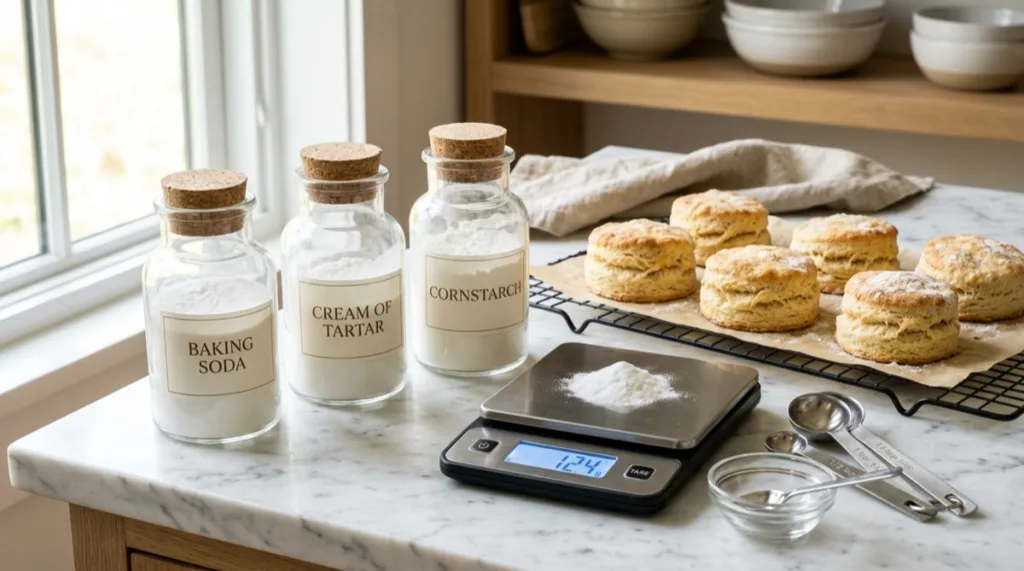
Baking powder is not a single chemical element; it is a precisely calculated chemical leavening compound engineered to release carbon dioxide gas at two distinct thermal stages. When a recipe calls for baking powder and you find an empty tin in your pantry, substituting pure baking soda (sodium bicarbonate) on a 1:1 basis will ruin your bake, resulting in a flat crumb, a yellow-tinged batter, and an unpleasant, bitter metallic aftertaste. Crafting an effective baking powder substitute requires understanding stoichiometric neutralization between alkaline carbonates and food-grade acid salts.
The Chemistry of Commercial Double-Acting Baking Powder
Modern commercial baking powders are almost universally “double-acting.” This means they contain one base and two distinct acid salts with staggered dissolution kinetics:
- The Alkaline Base: Sodium bicarbonate (NaHCO3), which supplies the carbon dioxide gas.
- Low-Temperature Fast-Acting Acid: Monocalcium phosphate monohydrate (Ca(H2PO4)2·H2O). It dissolves in room-temperature water during mixing, neutralizing approximately 30% of the available bicarbonate and generating initial microscopic air cells in the batter.
- High-Temperature Heat-Triggered Acid: Sodium acid pyrophosphate (SAPP) or sodium aluminum sulfate (SAS). These acid salts remain dormant at room temperature and only dissolve and react when batter temperature exceeds 122°F to 140°F (50°C to 60°C) in the oven, providing the essential “oven spring” expansion before starch sets.
- Inert Starch Buffer (28% to 32% by weight): Food-grade cornstarch, which absorbs atmospheric moisture inside the tin to prevent premature acid-base reactions and standardizes volumetric dosing for domestic recipes.
The Master Ratio: Homemade Single-Acting Baking Powder
When compounding baking powder from pantry staples, the most chemically stable substitute uses cream of tartar (potassium bitartrate, KC4H5O6), a dry, purified acid salt byproduct of winemaking.
| Component | Mass (Grams) | Volume Equivalent | Chemical Role |
|---|---|---|---|
| Potassium Bitartrate (Cream of Tartar) | 2.4 g | 1/2 teaspoon | Fast-acting dry acidulant (pH ~3.6) |
| Sodium Bicarbonate (Baking Soda) | 1.2 g | 1/4 teaspoon | Alkaline CO2 source |
| Cornstarch (Optional, for storage) | 1.2 g | 1/4 teaspoon | Moisture desiccant & dilution buffer |
Immediate Substitution Rule: To replace 1 teaspoon (4.8 grams) of commercial baking powder, mix 1/2 teaspoon cream of tartar + 1/4 teaspoon baking soda. If you are baking immediately, omit the cornstarch. Sift the powders together through a fine mesh strainer to ensure uniform neutralization.
Crucial Timing Difference: The Single-Acting Window
Because potassium bitartrate is water-soluble at room temperature, this homemade mixture behaves as a single-acting leavener. Over 85% of its total carbon dioxide volume is generated within 2 minutes of hydration:
KHC4H4O6 + NaHCO3 → KNaC4H4O6 + H2O + CO2↑
Unlike commercial double-acting baking powder, which tolerates resting on the counter, batters prepared with cream of tartar must enter the preheated oven immediately. Letting the batter sit causes carbon dioxide gas to escape into the room, reducing final bake volume by up to 40%.
Alternative Liquid Acid Substitutions for Baking Powder
If you lack cream of tartar, you can utilize liquid food acids already present in your kitchen. However, this approach requires balancing both acidity and hydration ratios across the recipe.
1. Buttermilk or Cultured Yogurt (Lactic Acid Neutralization)
Cultured buttermilk has a titratable acidity of 0.8% to 0.9% and a pH of 4.4 to 4.8 due to bacterial lactic acid production. To replace 1 teaspoon of baking powder:
- Add 1/4 teaspoon (1.2 grams) of baking soda to your dry ingredients.
- Add 1/2 cup (120 grams) of real cultured buttermilk to the wet ingredients.
- Reduce the recipe’s other primary liquids (milk or water) by 1/2 cup (120 grams) to maintain identical flour hydration.
2. Distilled White Vinegar or Lemon Juice (Citric/Acetic Acid)
When making quick bread, pancakes, or chocolate layer cakes, distilled white vinegar (5% acetic acid) or strained fresh lemon juice (6% citric acid) neutralizes baking soda cleanly without leaving residual off-flavors:
- Add 1/4 teaspoon (1.2 grams) of baking soda to the dry flour.
- Add 1/2 teaspoon (2.5 grams) of vinegar or lemon juice to the wet liquids.
- No liquid reduction is necessary for quantities under 1 teaspoon.
Allergen Safety, Corn Sensitivity, and Dietary Considerations
Commercial baking powders contain commercial cornstarch to stabilize shelf life. In households with severe corn allergies or those following strict grain-free Paleo diets, commercial leaveners can trigger adverse reactions:
- Corn-Free Formulation: When making homemade baking powder, replace cornstarch with an identical mass of potato starch, arrowroot starch, or tapioca starch. These alternative starches absorb moisture without altering the neutralization threshold.
- Sodium-Restricted Diets: Traditional baking powder adds approximately 340 to 480 mg of sodium per tablespoon. Potassium-based commercial baking powders substitute potassium bicarbonate for sodium bicarbonate, delivering equivalent leavening lift without elevating dietary sodium.
Precision Thermal Induction in High-Rise Biscuits
Single-acting homemade leaveners require rapid, uniform bottom heat transfer to trigger expansion before bubbles escape. Heavy-gauge multi-ply cookware and cast-iron alternatives ensure immediate thermal conduction.
* FoxyChef maintains strict independent culinary testing standards. Purchases through verified links may earn an affiliate commission at no extra cost to you.
Frequently Asked Questions on Baking Powder Substitutes
Can I use baking soda instead of baking powder without an acid?
No. Baking soda requires an acid to generate carbon dioxide gas. Without an acidic reactant, unreacted sodium bicarbonate decomposes thermally into sodium carbonate, water, and gas only at high temperatures, leaving a yellowish tint, a soapy pH (>8.5), and an acrid bitter flavor.
Can I prepare homemade baking powder in large batches and store it?
Yes, provided you include the 1/4 teaspoon of cornstarch per teaspoon of mixture. Store in an airtight glass jar with a rubber gasket in a dark, cool cupboard at 60°F–68°F (15°C–20°C). Under dry conditions, it remains potent for up to 6 months.
How can I test if my old baking powder is still active?
Add 1/2 teaspoon of baking powder to 1/4 cup (60 ml) of warm water (105°F / 40°C). If it fizzes vigorously immediately, the acid and base components are active and ready for baking.