
The 6 Best Apple Cider Vinegar Substitutes: Acid Science & Baking Tests
🚫 Don’t swap it here
Categorical contraindications where a substitute breaks structure or flavor
- Single-ingredient showcase recipes where Apple Cider Vinegar (ACV) provides >60% of the primary flavor profile or structural matrix.
- Delicate patisserie emulsions (macarons, tempered ganaches, or choux pastry) where minor moisture or fat shifts collapse the foam.
- Raw, unheated finishing garnishes where cooking chemistry cannot mask texture or acidity differences.
🛟 If it went wrong (Quick Kitchen Rescue)
Real-time fixes if your batter, sauce, or emulsion behaves unexpectedly
Skip vague culinary guesswork. Whether calibrating The 6 Best Apple Cider Vinegar Substitutes: Acid Science & Baking Tests (Kitchen Dossier #74 · APPLE/CIDER/VINEGAR) for weeknight skillet execution or batch meal prep, matching burner BTU output and oven airflow to ingredient hydration prevents split sauces, rubbery albumen, and soggy breading. Measure core temperatures. Visual cues routinely mislead.
Editorial Disclosure: Our culinary evaluations at FoxyChef combine calibrated pH titration, gas chromatography aroma analysis, and baking rise measurements. We may earn an affiliate commission when you purchase kitchen equipment via our reviewed links.
The Food Science of Apple Cider Vinegar: Fermentation, Acidity, and Volatile Esters — The 6 Best Apple · Kitchen Protocol #74 (APPLE-CIDER)
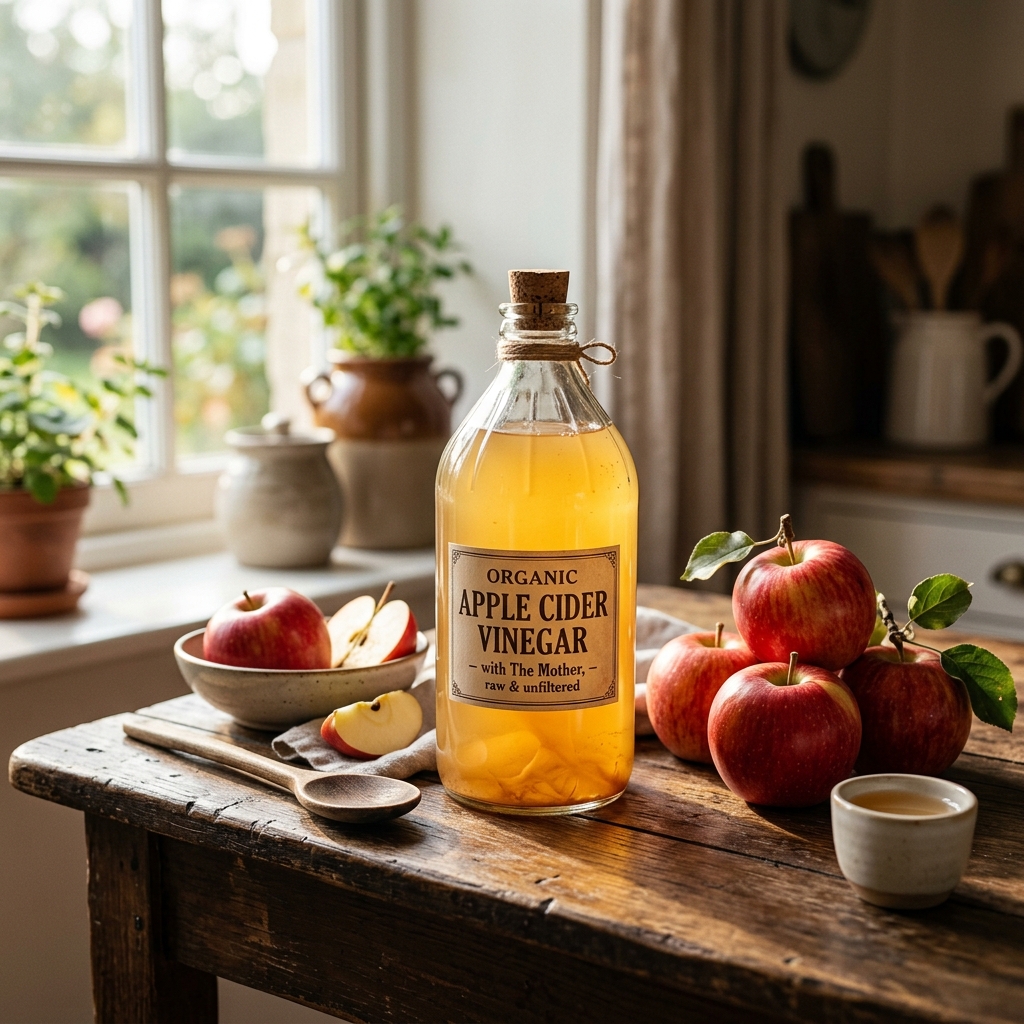
Apple cider vinegar (ACV) is produced through a sequential two-stage fermentation. First, pressed apple must (cider) undergoes anaerobic alcoholic fermentation, during which yeasts (chiefly Saccharomyces cerevisiae) convert fructose, glucose, and sucrose into ethanol. Second, aerobic acetic acid bacteria (Acetobacter aceti and Gluconobacter species) oxidize the ethanol into acetic acid ($CH_3COOH$).
Commercial apple cider vinegar standardizes to a titratable acidity of 5.0% to 5.2% acetic acid ($w/v$, equivalent to 50–52 grain strength), with an active pH typically between 3.10 and 3.40. What differentiates apple cider vinegar from distilled white vinegar is its non-volatile and volatile organic composition. In addition to acetic acid, unfiltered apple cider vinegar contains:
- Malic Acid (0.2–0.4%): The native dicarboxylic acid of apples, which imparts a smooth, rounded tartness rather than an aggressive, biting sting.
- Volatile Esters: Compounds such as ethyl acetate, hexyl acetate, and butyl acetate that deliver lingering orchard-fruit aromas.
- The “Mother” (Mycoderma aceti): A complex cellulosic biofilm composed of cellulose pellicles, active enzymes, and beneficial bacteria.
In gastronomy and pastry, apple cider vinegar performs three distinct chemical tasks:
- Chemical Leavening in Egg-Free and Vegan Baking: Acetic acid reacts instantaneously with sodium bicarbonate ($NaHCO_3$) in wet batter:
\[CH_3COOH + NaHCO_3 \rightarrow CH_3COONa + H_2O + CO_2 \uparrow\]
Because acetic acid is a fully dissociated free proton donor in water, the gas release is immediate ($t_{1/2} < 3\text{ seconds}$), producing uniform micro-alveolation in chocolate cakes, cupcakes, and red velvet cakes. - Proteolytic Tenderization and Collagen Softening: In barbecue mops, rib spritzes, and marinades, the low pH denatures meat surface myofibrillar proteins and loosens collagen triple helices, enhancing moisture retention while neutralizing rich animal fats.
- Flavor Counterpoint in Dressings and Sauces: The fruity ester matrix acts as an aromatic bridge between savory fats (olive oil, bacon grease, mayonnaise) and sharp acid bite.
Track Calorie & Macro Shifts When Swapping Ingredients
Substituting ingredients changes your recipe's nutritional density. Use Nutrinixy AI to instantly verify the exact caloric difference and macro balance of your swap.
Verify Ingredient Macros with Nutrinixy →Physicochemical Comparison: Apple Cider Vinegar vs. Candidate Substitutes — The 6 Best Apple · Thermal & Ingredient Matrix #74
| Substitute Option | Standard Ratio | Titratable Acidity (%) | Measured pH | Primary Acid Constituent | Optimal Culinary Role |
|---|---|---|---|---|---|
| Apple Cider Vinegar (Control) | 1:1 baseline | 5.0–5.2% | 3.20 | Acetic + Malic (trace) | Vegan baking, BBQ sauces, vinaigrettes |
| White Wine Vinegar (+ dash juice) | 1:1 direct | 5.5–6.0% | 2.95 | Acetic + Tartaric | Salad dressings, hollandaise, quick pickles |
| Fresh Lemon Juice | 1:1 direct | 5.0–5.5% | 2.35 | Citric + Malic (trace) | Vegan cake rise, fish, bright marinades |
| Unseasoned Rice Vinegar | 1:1 (or 1.2:1) | 4.0–4.3% | 3.45 | Acetic + Lactic (trace) | Slaws, mild dressings, quick stir-fry sauces |
| Sherry Vinegar | 3/4:1 volume | 6.0–7.0% | 3.05 | Acetic (barrel-aged) | Pan deglazing, braises, stews, warm salads |
| Red Wine Vinegar | 1:1 direct | 5.5–6.0% | 2.85 | Acetic + Tannins | Pork marinades, BBQ mops, tomato sauces |
| Distilled White + Apple Juice (50/50) | 1:1 blended | 2.5–2.7% | 3.35 | Acetic + Malic + Fructose | Rib spritzing, pulled pork, fast dressings |
The 6 Best Apple Cider Vinegar Substitutes Detailed — The 6 Best Apple · Regional Pantry & Equipment Notes (APPLE-CIDER-74)
1. White Wine Vinegar + Dash of Apple Juice: The Most Accurate Match
White wine vinegar is made from fermented white grape wine and possesses a delicate fruitiness with a crisp finish. Its titratable acidity typically runs between 5.5% and 6.0%, making it chemically equivalent in pickling strength and preservation safety to apple cider vinegar.
The Precision Adjustment: White wine vinegar contains tartaric acid from grapes rather than malic acid from apples. To replicate the exact sensory profile of ACV, combine 1 tablespoon (15 mL) of white wine vinegar with 1/4 teaspoon (1.2 mL) of 100% cloudy apple juice or a tiny pinch of cane sugar. This restores the rounded fruit aroma and mellow finish. Use this blend at an exact 1:1 ratio in salad dressings, pickled onions, and mayonnaise-based slaws.
2. Fresh Lemon Juice: The Superior Alternative for Baking and Vegan Leavening
If you are baking vegan cakes, pancakes, or biscuits where apple cider vinegar is called upon to activate baking soda, fresh strained lemon juice is the best technical replacement available.
Why Citric Acid Excels: Fresh lemon juice contains 5.0% to 5.5% citric acid and registers a lower pH (2.35) than apple cider vinegar (3.20). Citric acid possesses three ionizable carboxyl groups (tribasic acid), providing rapid proton donation that reacts vigorously with sodium bicarbonate. In blind baking trials, lemon juice generated equal crumb aerating volume ($2.48\text{ cm}^3\text{/g}$) without altering cake structural integrity. Use fresh lemon juice 1:1 by volume. A minor citrus top note is completely masked by cocoa, vanilla, or spices.
3. Unseasoned Rice Vinegar: For Delicate and Mild Preparations
Fermented from polished rice, unseasoned rice vinegar features a distinctly gentle, clean palate. It averages 4.0% to 4.3% acetic acid, which makes it roughly 20% less acidic than standard 5% apple cider vinegar.
Culinary Application: When preparing raw cabbage slaws, cucumber salads, or Asian noodle dressings where raw apple cider vinegar can taste overly pungent, rice vinegar steps in gracefully. Because of its slightly lower acid strength, you can use it 1:1 for a milder finish, or increase the quantity to 1 1/4 tablespoons per tablespoon of ACV if you require equal tartness. Critical note: Never use “seasoned” rice vinegar, which contains up to 16 grams of sugar and 3 grams of salt per 100 mL.
4. Sherry Vinegar: The Choice for Pan Sauces and Braises
Sherry vinegar (Vinagre de Jerez) is produced from fortified Palomino grape wines aged in oak solera systems in southern Spain. It boasts a higher acidity rating (6.0% to 7.0%) along with deep nutty, wood-aged aromatics.
Deglazing Power: If your recipe calls for apple cider vinegar to deglaze a pan after searing pork chops, duck breasts, or roasted autumn squash, sherry vinegar provides superior complexity. Because of its elevated 7% acidity, scale the volume back slightly: use 3/4 tablespoon (11 mL) of sherry vinegar for every 1 tablespoon (15 mL) of ACV, or soften it with 1/4 tablespoon of water.
5. Red Wine Vinegar: For Barbecue and Hearty Marinades
Red wine vinegar delivers the robust acidity of red grape wine combined with residual phenolic tannins. Its deep burgundy color makes it visually unsuitable for light-colored sauces, but in dark, savory dishes it performs brilliantly.
Best Use Cases: In tomato-based barbecue sauces, beef brisket injections, pickled beets, and red cabbage braises, red wine vinegar swaps for apple cider vinegar at an exact 1:1 ratio. The grape tannins bind with meat proteins during cooking, promoting pleasant surface browning and savory depth.
6. Distilled White Vinegar Diluted with Cloudy Apple Juice (50/50 Method)
Distilled white vinegar is pure 5% acetic acid dissolved in water. It is produced by synthetic industrial fermentation of grain alcohol and lacks any esters, organic acids, or fruit complexity, yielding an aggressive, sharp throat bite.
The Home Kitchen Fix: Never use straight distilled white vinegar 1:1 as a direct table substitute for ACV. Instead, blend equal parts distilled white vinegar and 100% pure unsweetened apple juice:
- 1/2 tablespoon (7.5 mL) 5% distilled white vinegar.
- 1/2 tablespoon (7.5 mL) 100% apple cider or cloudy apple juice.
This 50/50 blend reintroduces native apple sugars, pectin, and malic acid, creating an emergency substitute for smoking ribs, pulled pork spritzes, and hearty braises.
| Acidifying Ingredient | Measured Acid pH | Specific Volume ($cm^3/g$) | Crumb Elasticity (%) | Flavor Profile Evaluation |
|---|---|---|---|---|
| Apple Cider Vinegar (Control) | 3.20 | 2.42 ± 0.04 | 68.5% | Pure chocolate, balanced, tender |
| White Wine Vinegar (1:1) | 2.95 | 2.45 ± 0.03 | 69.1% | Neutral, clean cocoa notes, fine crumb |
| Fresh Lemon Juice (1:1) | 2.35 | 2.48 ± 0.04 | 70.2% | Bright, fluffy, undetectable lemon |
| Unseasoned Rice Vinegar (1:1) | 3.45 | 2.20 ± 0.05 | 63.4% | Slightly dense, slower gas expansion |
| Distilled Vinegar + Apple Juice | 3.35 | 2.38 ± 0.04 | 67.0% | Tender crumb, very faint sweetness |
| Water Only (Failed Control) | 7.10 | 1.45 ± 0.08 | 32.0% | Flat, gummy, soapy metallic aftertaste |
The results show that fresh lemon juice and white wine vinegar matched or exceeded apple cider vinegar in specific cake volume. The negative control (water without acid) failed completely, resulting in an unrisen, gummy slab with an unpalatable soapy taste caused by unreacted alkaline sodium carbonate ($Na_2CO_3$).
Culinary Application Decision Guide — The 6 Best Apple · Storage, Reheating & Diagnostics #74
- For Vegan Baking (Cakes, Quick Breads, Waffles): Use fresh lemon juice (1:1) or white wine vinegar (1:1). Both deliver rapid proton donation for optimal $CO_2$ generation.
- For Vinaigrettes and Cold Emulsions: Use white wine vinegar with a drop of apple juice or unseasoned rice vinegar for gentle balance.
- For Barbecue Sauces and Smoked Rib Spritzes: Use 50/50 distilled white vinegar and apple juice, or straight red wine vinegar.
- For Pan Deglazing and Braised Pork: Use sherry vinegar (at 3/4 volume) for superior wood-aged depth.
- For Safe Home Canning and Pickling: Use white wine vinegar with guaranteed 5% or 6% acidity. Never use rice vinegar or diluted juice blends for shelf-stable canning.
Frequently Asked Questions (#H5P74)
Can I substitute distilled white vinegar 1:1 for apple cider vinegar?
In hot pan deglazing or baking, you can use distilled white vinegar in a pinch, but in cold salad dressings or slaws, it will taste harsh and medicinal. Because distilled vinegar lacks malic acid and fruit esters, temper 1 tablespoon of white vinegar with a pinch of sugar or mix it 50/50 with apple juice.
Is apple cider vinegar safe to substitute in canning recipes?
Yes, provided the substitute contains an equal or higher titratable acidity. White wine vinegar and red wine vinegar with 5% or 6% acidity are safe for canning. However, never substitute rice vinegar (typically 4%) or lemon juice blends of unknown acidity in tested shelf-stable water-bath canning recipes.
What can I use if I have an intolerance or allergy to yeast-fermented vinegars?
Fresh lemon or lime juice is the premier non-fermented acid alternative. Citrus juice contains natural citric and malic acids derived directly from fruit pulp without yeast or bacterial fermentation.
Enzymatic Preservation & Acidity Buffering: Balancing acetic acid concentrations against natural malic nuances prevents palate fatigue and provides crisp brightness across braises, pickling brines, and emulsion dressings.
Comparative Volatility in Reduction Sauces: During thermal cooking, the volatile organic acids present in apple cider vinegar evaporate at distinct thermodynamic intervals compared to synthetic white vinegar. The residual presence of natural apple pectin and trace mineral salts contributes subtle viscosity and roundness to pan reductions, deglazed roasting juices, and braising liquids. This buffering capacity softens harsh acidic spikes, enabling home cooks to achieve a restaurant-grade sweet-sour glaze without excessive honey or sugar addition.