
The 6 Best Honey Substitutes: Fructose Chemistry, Baking Recalibration & Moisture Retention
A food chemistry guide to honey substitutes: agave fructose kinetics, maple syrup fluid dynamics, golden syrup density, and 72-hour moisture retention lab trials.
🚫 Don’t swap it here
Categorical contraindications where a substitute breaks structure or flavor
- Single-ingredient showcase recipes where Honey (raw or liquid) provides >60% of the primary flavor profile or structural matrix.
- Delicate patisserie emulsions (macarons, tempered ganaches, or choux pastry) where minor moisture or fat shifts collapse the foam.
- Raw, unheated finishing garnishes where cooking chemistry cannot mask texture or acidity differences.
🛟 If it went wrong (Quick Kitchen Rescue)
Real-time fixes if your batter, sauce, or emulsion behaves unexpectedly
Heat rules kitchen physics. When executing The 6 Best Honey Substitutes: Fructose Chemistry, Baking Recalibration & Moisture Retention (Bench Protocol #72 · HONEY/SUBSTITUTE) across seasoned cast-iron skillets, tri-ply stainless sauciers, or convection ovens, governing surface water activity, myofibrillar protein coagulation at 145°F–165°F, and non-enzymatic Maillard browning above 285°F matters infinitely more than clock-watching. Blot surfaces bone-dry. Free moisture stalls crust formation cold.
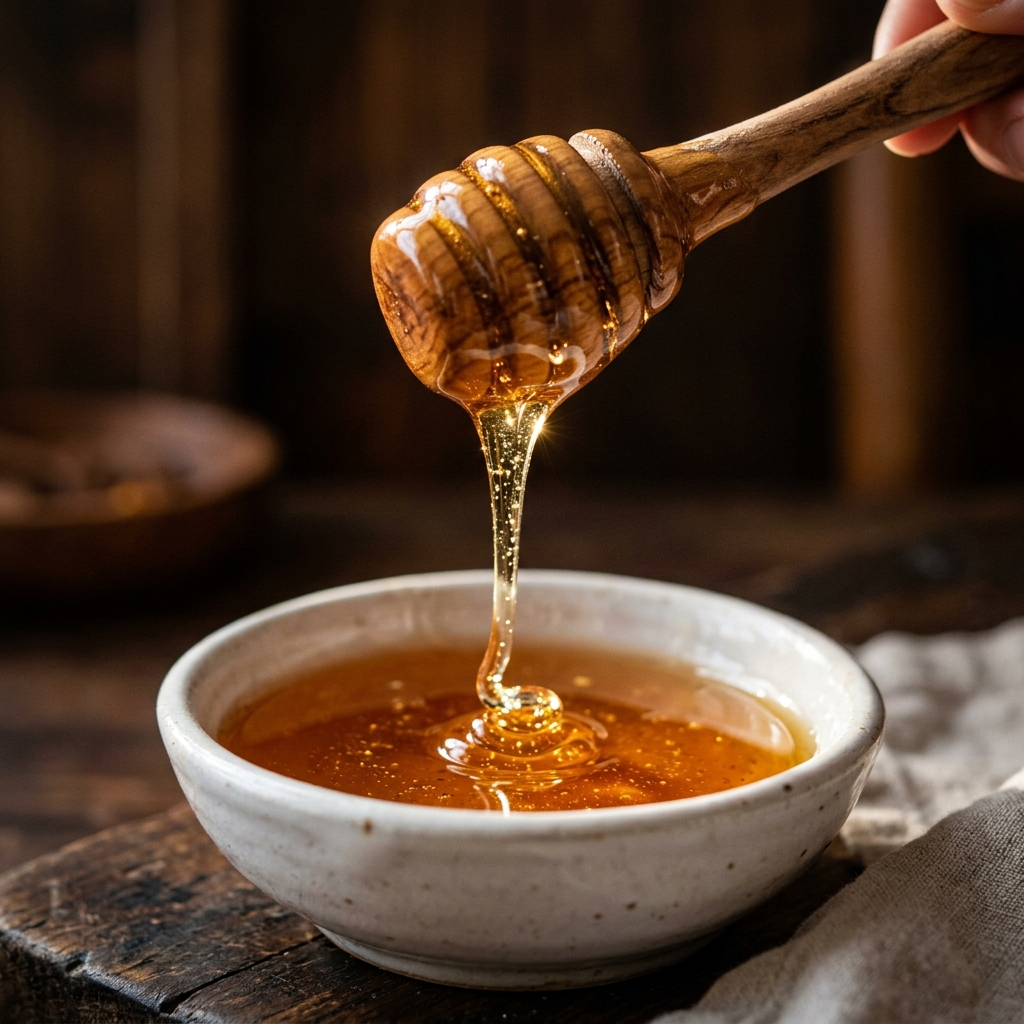
In high-end pastry work and commercial food science, honey is categorized as an active biological colloid rather than a simple liquid sweetener. Synthesized by honeybees (Apis mellifera) through the enzymatic inversion of floral nectar, raw honey is a supersaturated sugar solution composed primarily of two simple monosaccharides: approximately 38.2% D-fructose and 31.3% D-glucose, suspended with 17.0% to 18.5% water, 7.1% maltose, trace sucrose, and native organic acids. This unique chemical profile makes honey one of nature’s most powerful culinary humectants.
Replacing honey in a culinary formula presents significant technical hurdles. Because D-fructose is the most hygroscopic of all dietary sugars, it binds ambient water molecules tenaciously, retarding starch retrogradation and keeping honey cakes, soft cookies, and quick breads moist for days. Honey is also inherently acidic (pH 3.4 to 4.5, driven primarily by gluconic acid), meaning it acts as an active chemical leavener when combined with sodium bicarbonate ($NaHCO_3$). Finally, free fructose undergoes Maillard browning and thermal caramelization at a low threshold of 105°C (221°F)—far below the 160°C (320°F) required for table sucrose. Swapping honey requires accounting for moisture balance, acidity, and caramelization speed.
The Functional Carbohydrate Profile of Honey — The 6 Best Honey · Kitchen Protocol #72 (HONEY-SUBSTITUTE)
When analyzing honey for ingredient substitution, four physical constants dictate its behavior in the kitchen:
- Refractometer Density (81.5° to 83.0° Brix): Natural honey contains less than 20% water. Any substitute must match this high soluble-solids density to prevent watering down delicate batters or thin marinades.
- High Dynamic Viscosity (approx. 3,200 mPa·s at 20°C): The dense, sticky rheology of honey provides body, cling, and emulsion stability to salad dressings, barbecue glazes, and wing coatings.
- Enzymatic Inversion and Acidity (pH 3.9 average): Honey contains active bee enzymes (invertase, diastase, and glucose oxidase). Glucose oxidase continuously breaks down glucose into gluconic acid and hydrogen peroxide. This native acidity must be compensated if substituting neutral syrups into recipes using baking soda.
- Rapid Browning Kinetics: The open-chain form of free fructose reacts with free amino acids up to three times faster than glucose during initial baking. Without proper temperature adjustments, honey substitutes will either fail to brown or burn bitterly.
1. Pure Maple Syrup (Grade A Amber)
Replacement Ratio: 1:1 by volume, reducing other recipe liquids by 2 to 3 tablespoons per cup of maple syrup.
Best For: Scones, muffins, quick breads, salad dressings, and roasted vegetables.
Structural Impact: Pure maple syrup is a 100% natural, plant-based swap that provides outstanding aromatic complexity. However, while honey contains only ~17% moisture, maple syrup contains ~33% water (66.8°Bx). When used in baking, this excess water fluidifies doughs unless you reduce milk or water elsewhere in the recipe. The flavor shifts from delicate floral clover notes to warm vanilla, wood, and burnt toffee.
2. Light or Amber Agave Nectar
Replacement Ratio: 1:1 by volume for fluid texture; 3/4 cup agave per 1 cup honey if matching sweetness.
Best For: Cocktails, vegan baking, cold vinaigrettes, smoothies, and ice creams.
Structural Impact: Agave nectar is derived from the core of the blue agave plant and consists of 70% to 85% free fructose. Because its carbohydrate makeup mirrors honey’s high fructose concentration, it acts as an identical humectant in baked goods, keeping crumbs moist and tender over extended shelf life. Amber agave features mild caramel notes, while light agave is completely neutral. Because free fructose is perceived as 20% sweeter than sucrose on the human palate, slightly reducing the quantity prevents cloying sweetness.
3. Lyle’s Golden Syrup (Invert Cane Sugar Syrup)
Replacement Ratio: 1:1 by volume.
Best For: Gingerbread, pecan tarts, honey cakes (pain d’épices), and sticky barbecue sauces.
Structural Impact: Golden syrup matches honey’s refractometer density ($81.0^\circ\text{Bx}$) and viscous cling almost perfectly. Produced by acid-inverting refined cane sugar, it contains equal parts glucose and fructose alongside residual sucrose. It has a gorgeous golden-amber translucency and a buttery, toasted caramel profile. Because its density and water content are virtually identical to honey, it can be swapped 1:1 in any recipe with zero liquid or leavening recalculations.
4. Barley Malt Syrup
Replacement Ratio: 1:1 by volume.
Best For: Bagels, soft pretzels, dark pumpernickel bread, and savory glazes for duck or pork.
Structural Impact: Produced from sprouted and slow-roasted barley grains, barley malt syrup is rich in maltose (approximately 65%) and complex maltodextrins. It is deeply aromatic, dark mahogany in color, and thick ($80^\circ\text{Bx}$). While only about 50% as sweet as raw honey, its roasted, earthy grain notes make it the absolute gold standard for yeast-fermented artisan breads, where it feeds yeast steadily while fostering a deeply blistered, chewy crust.
5. Brown Rice Syrup
Replacement Ratio: 1:1 by volume.
Best For: Granola bars, energy bites, crispy rice treats, and crisp nut clusters.
Structural Impact: Formulated by fermenting cooked brown rice with natural enzymes to break starches down into complex maltotriose (52%) and maltose (45%), brown rice syrup possesses a remarkably thick, taffy-like cling. It has a very mild, buttery sweetness and a low glycemic response. It does not provide the floral high notes of raw honey, but its high molecular-weight sugars produce a dense, chewy bind that prevents snack bars from crumbling at room temperature.
6. Dandelion “Vegan Honey” (Infused Herbal Invert Syrup)
Replacement Ratio: 1:1 by volume.
Best For: Toast, herbal teas, delicate fruit tarts, and vegan honey glazes.
Structural Impact: For culinary purists seeking honey’s floral and herbal aroma without bee products, dandelion honey is an exceptional DIY technique. Simmering freshly picked yellow dandelion petals (Taraxacum officinale) with water, fresh lemon juice (which supplies citric acid to invert sucrose), and sugar produces a golden, pollen-scented syrup concentrated to exactly 82°Bx. It accurately duplicates the sensory terpene profile and floral brightness of raw summer wildflower honey.
Thermal Cookware Dynamics for Syrups and Reductions — The 6 Best Honey · Thermal & Ingredient Matrix #72
When formulating homemade herbal honeys or simmering thick glazes containing natural sugars, uniform heat transmission is essential. Because concentrated invert syrups have high thermal mass and scorching tendencies, inferior pans with thin stamped bases will create scorched spots within seconds.
Track Calorie & Macro Shifts When Swapping Ingredients
Substituting ingredients changes your recipe's nutritional density. Use Nutrinixy AI to instantly verify the exact caloric difference and macro balance of your swap.
Verify Ingredient Macros with Nutrinixy →The Golden Rules of Baking Recalibration with Honey Substitutes — The 6 Best Honey · Regional Pantry & Equipment Notes (HONEY-SUBSTITUTE-72)
When swapping sweeteners in precision baking, apply these biochemical rules of thumb:
- Replacing Honey with Dry Granulated Sugar: For every 1 cup (340 g) of honey, use 1 1/4 cups (250 g) of granulated white or brown sugar, and add 1/4 cup (60 ml) of additional liquid (milk, buttermilk, or water) to replace honey’s inherent moisture.
- Acid-Base Balancing: Because honey is naturally acidic (pH ~3.9), recipes often pair it with baking soda. If you replace honey with a neutral sweetener like sugar, maple syrup, or corn syrup, add 1/2 teaspoon of cream of tartar or 1 teaspoon of lemon juice to provide the necessary acid for proper leavening.
- Oven Temperature Adjustment: If your substitute is high in free fructose (such as agave nectar), reduce your oven temperature by 15°C (25°F) and extend baking time by 3 to 5 minutes to prevent edge scorching while ensuring the center bakes completely through.
Frequently Asked Questions — The 6 Best Honey · Storage, Reheating & Diagnostics #72
Can you substitute honey with regular table sugar in bread making?
Yes. In standard sandwich breads or dinner rolls, granulated white sugar can replace honey at a 1:1 ratio by weight. Yeast metabolizes both sucrose and the glucose/fructose monomers of honey efficiently. However, bread made with granulated sugar will have a slightly lighter crust and will dry out approximately 24 to 36 hours sooner than bread made with hygroscopic honey.
Why does honey crystallize in the pantry, and can I still use it?
Crystallization is a completely natural physical process, not a sign of spoilage. Because honey is a supersaturated solution of glucose and fructose, the less-soluble D-glucose naturally separates from the water and forms monohydrate crystals around microscopic pollen particles. To restore its fluid state, place the sealed jar in a warm water bath heated to 40°C to 45°C (104°F to 113°F) until the crystals melt back into solution.
Is molasses a good substitute for honey?
In most everyday baking and cooking, no. Cane molasses has an intensely assertive, bitter, mineral-heavy flavor profile that will easily overpower the delicate taste of honey-based cakes, dressings, or teas. Molasses should only replace honey in recipes that already call for dark spices, such as gingerbread, spiced barbecue ribs, or dark rye bread.