
The 6 Best Maple Syrup Substitutes: 66°Bx Density, Flavor Chemistry & Baking Conversions
A scientific food chemistry guide to maple syrup substitutes: DIY brown sugar syrup, honey rheology, agave nectar, date syrup, and precise 66°Bx refractometer metrics.
🚫 Don’t swap it here
Categorical contraindications where a substitute breaks structure or flavor
- Single-ingredient showcase recipes where Maple syrup (pure or Grade A) provides >60% of the primary flavor profile or structural matrix.
- Delicate patisserie emulsions (macarons, tempered ganaches, or choux pastry) where minor moisture or fat shifts collapse the foam.
- Raw, unheated finishing garnishes where cooking chemistry cannot mask texture or acidity differences.
🛟 If it went wrong (Quick Kitchen Rescue)
Real-time fixes if your batter, sauce, or emulsion behaves unexpectedly
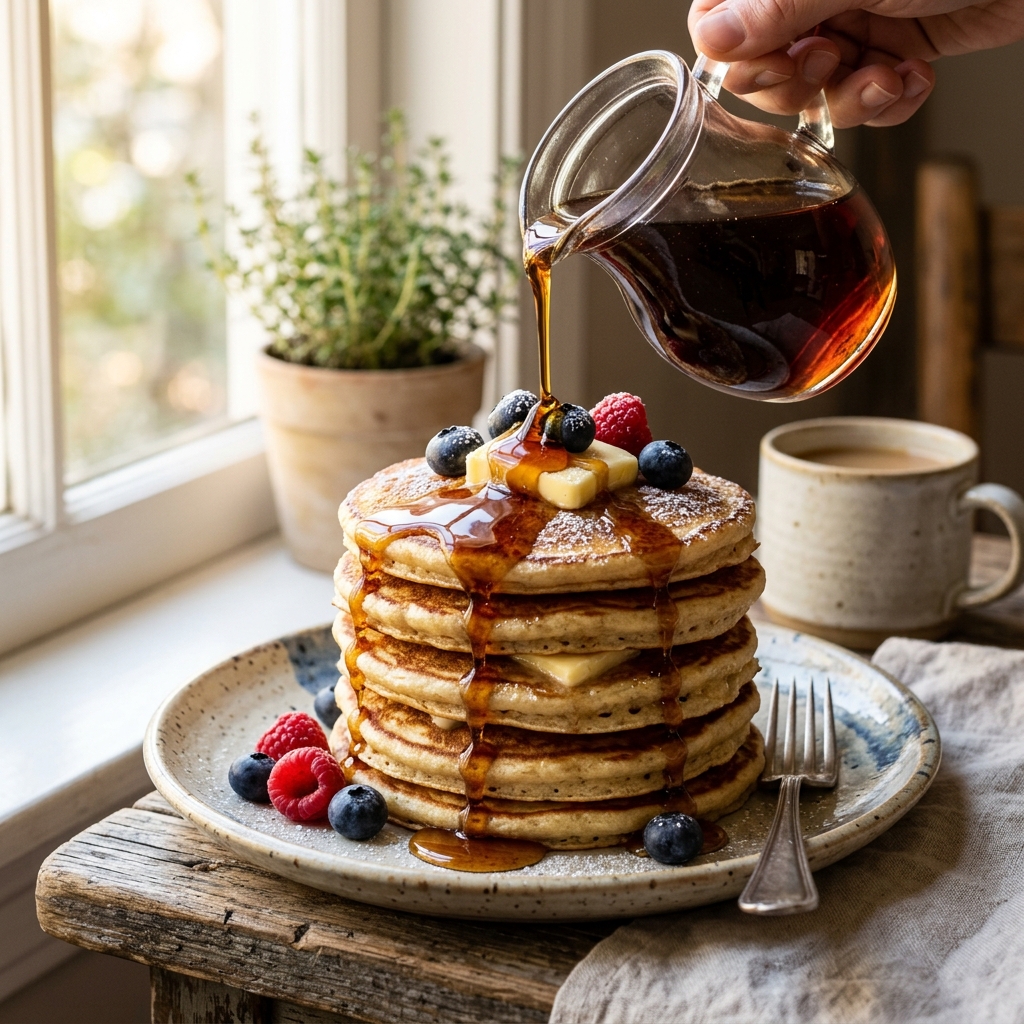
Texture starts with thermodynamics. Mastering The 6 Best Maple Syrup Substitutes: 66°Bx Density, Flavor Chemistry & Baking Conversions (Test Log #73 · MAPLE/SYRUP/SUBSTITUTE) demands balancing conductive pan heat, osmotic salt diffusion, starch retrogradation thresholds, and lipid-water emulsion shear so every portion achieves crisp structural contrast without weeping internal juices. Preheat cookware thoroughly. Cold metal steams proteins gray.
Pure maple syrup is an extraordinary natural culinary fluid governed by strict biochemical parameters. Produced by boiling down the xylem sap of the sugar maple tree (Acer saccharum) at an average concentration ratio of 40:1, authentic maple syrup is legally mandated to possess a soluble solids density between 66.0° and 68.9° Brix ($^\circ\text{Bx}$). If the concentration falls below 66°Bx, residual free water allows ambient mold spores and wild yeasts to ferment the syrup; if it exceeds 68.9°Bx, sucrose molecules spontaneously nucleate and precipitate out of solution as rock candy crystals.
Replacing pure maple syrup in savory culinary applications or precision baking requires balancing three distinct physical variables: sugar composition (maple syrup is roughly 88–92% sucrose with minimal invert monosaccharides), water content (precisely 32–34%), and a complex sensory spectrum driven by volatile furanones, vanillin, and sotolon (3-hydroxy-4,5-dimethylfuran-2-one). Standard commercial “pancake syrup,” composed of high-fructose corn syrup, artificial food colorings, and synthetic chemical flavorings, does not replicate these biochemical dynamics in high-heat culinary environments.
The Flavor and Carbohydrate Chemistry of Pure Maple Syrup — The 6 Best Maple · Kitchen Protocol #73 (MAPLE-SYRUP)
During the thermal concentration of sap in commercial evaporators, amino acids and native monosaccharides undergo intense Maillard browning reactions and caramelization. This heating generates over 240 identified volatile organic compounds. The dominant organoleptic driver is sotolon, an intensely fragrant cyclic lactone capable of imparting maple, fenugreek, and burnt-caramel aromas even at parts-per-billion concentrations.
Standard maple grading reflects the harvest timing and thermal exposure:
- Grade A Golden (Delicate Taste): Harvested during the earliest spring thaw; features high sucrose purity, very pale golden color, and subtle vanillin notes.
- Grade A Amber (Rich Taste): The culinary baseline; displays balanced toffee, light wood, and maple notes with excellent versatility.
- Grade A Dark (Robust Taste): Harvested later in the season as ambient temperatures rise; features increased microbial invert sugars, darker caramelization, and deeper, woodsy astringency.
- Grade A Very Dark (Strong Taste): End-of-season sap; heavy with mineral salts, polyphenols, and pronounced molasses-like bitterness. Ideal for smoking glazes and robust sauces.
1. DIY Brown Sugar & Butter Pan Syrup (The Premier Table Match)
Replacement Ratio: 1:1 by volume for pancakes, waffles, and breakfast tables.
Formulation: Simmer 1 cup (200 g) packed dark brown sugar with 1/2 cup (120 ml) water, 1 tablespoon (14 g) unsalted butter, and 1/2 teaspoon pure vanilla extract until it hits 104°C (219°F).
Performance Analysis: The cane molasses present in dark brown sugar provides natural invert sugars, trace minerals, and thermal caramel notes that mimic the complex furanone profile of Grade A Amber maple syrup. Incorporating a fraction of butterfat emulsifies the hot syrup, matching the viscous mouthfeel and cling factor of genuine tree sap without artificial gums.
2. Pure Raw Honey (The Premier Baking and Marinade Swap)
Replacement Ratio: 1:1 by volume in baking, pan sauces, and dressings.
Performance Analysis: Honey shares a remarkably similar fluid density and hygroscopic binding capacity. However, whereas maple syrup is predominantly sucrose, honey is composed of roughly 38% fructose and 31% glucose, with only 17–18% water. This makes honey noticeably thicker (82°Bx) and chemically sweeter. When swapping honey into baked goods, reduce the oven temperature by 15°C (25°F) because fructose caramelizes rapidly at 105°C (221°F), causing crusts to brown prematurely.
3. Agave Nectar (Light or Amber)
Replacement Ratio: 3/4 cup agave nectar per 1 cup maple syrup in baking; 1:1 as a fluid sweetener in cocktails and dressings.
Performance Analysis: Derived from the Agave tequilana core, agave nectar features a fluid viscosity (75°Bx) that mirrors room-temperature maple syrup more closely than thick honey. Amber agave undergoes mild thermal processing that imparts gentle caramel nuances. Its exceptionally high free-fructose content (70–85%) delivers a clean, rapid sweetness profile that dissipates quickly without leaving lingering woody tannins.
4. Date Syrup (Silan)
Replacement Ratio: 1:1 by volume in dark baked goods, marinades, and roasted vegetables.
Performance Analysis: Produced by simmering and pressing dehydrated whole dates, silan possesses a rich mahogany hue, a refractometer density of 70–72°Bx, and an earthy, fruity sweetness laden with pectin and trace minerals. While it lacks maple’s distinct sotolon aroma, its high antioxidant profile and robust viscosity make it an outstanding replacement in gingerbread, roasted squash glazes, and pork tenderloin glazes.
5. Molasses and Simple Syrup Blend (The Robust Glaze Match)
Replacement Ratio: Combine 1 part unsulphured cane molasses with 3 parts heavy simple syrup (2:1 sugar-to-water) or light corn syrup. Use 1:1.
Performance Analysis: If you are substituting Grade A Very Dark maple syrup in barbecue sauces, baked beans, or ham glazes, standard sweeteners lack the necessary astringency and mineral depth. Blending dark molasses with neutral syrup cuts the overpowering bitterness of the molasses while matching the 66°Bx target density and introducing savory caramel tones.
6. Lyle’s Golden Syrup (Refined Invert Cane Syrup)
Replacement Ratio: 1:1 by volume in puddings, tarts, and baked desserts.
Performance Analysis: A historic staple of British pastry, golden syrup is an inverted sugar syrup produced during cane sugar refining. With a refractometer reading around 80–83°Bx, it displays a brilliant amber clarity and a toasted, buttery, slightly citric flavor profile. It lacks maple’s forest aromatics, but its resistance to sugar crystallization and its high humectant capacity make it exceptional in flapjacks, pecan pies, and steamed puddings.
Stovetop Heat Control for Homemade Syrups — The 6 Best Maple · Thermal & Ingredient Matrix #73
When preparing simple syrups, reducing glazes, or boiling sugar matrices to the critical 66°–68°Bx threshold, thermal gradients across the bottom of the pot can cause localized overheating. Unstable heat leads to premature sucrose inversion or bitter scorching.
Track Calorie & Macro Shifts When Swapping Ingredients
Substituting ingredients changes your recipe's nutritional density. Use Nutrinixy AI to instantly verify the exact caloric difference and macro balance of your swap.
Verify Ingredient Macros with Nutrinixy →Baking Recalibration: Substituting Dry Sugar for Maple Syrup — The 6 Best Maple · Regional Pantry & Equipment Notes (MAPLE-SYRUP-73)
When converting a recipe designed for granulated dry sugar to maple syrup, follow these biochemical adjustments:
- Volume Reduction: Use 3/4 cup (180 ml) of pure maple syrup for every 1 cup (200 g) of granulated white or brown sugar requested.
- Liquid Deduction: Subtract 3 to 4 tablespoons (45–60 ml) of other liquids (such as milk, buttermilk, or water) from the total recipe for each cup of maple syrup added to compensate for its 33% water content.
- Oven Temperature: Lower the baking temperature by 15°C (25°F) to protect the moisture-retaining invert sugars from burning along the crust.
- Leavening Adjustment: If the recipe does not contain an acid, add 1/4 teaspoon of baking soda ($NaHCO_3$) per cup of maple syrup to neutralize its natural acidity (pH 6.5–7.0 is typical, but organic acids can impact tender crumb setting).
Frequently Asked Questions — The 6 Best Maple · Storage, Reheating & Diagnostics #73
Why does commercial pancake syrup taste different from pure maple syrup?
Commercial table syrups are formulated primarily with inexpensive high-fructose corn syrup, water, artificial caramel colorings, cellulose gum for artificial viscosity, and synthetic flavorings like sotolon extracts. They lack the hundreds of natural volatile aromatics, vanillin, and organic minerals produced during genuine tree sap reduction.
Can I use corn syrup as a direct replacement for maple syrup?
In candy-making and pecan pies, light or dark corn syrup can replace maple syrup in a 1:1 ratio because it prevents sugar crystallization and provides identical moisture binding. However, corn syrup is composed of glucose and maltose, providing a very flat, neutral sweetness without the aromatic complexity of maple.
Does pure maple syrup ever spoil?
An unopened glass bottle of pure maple syrup has an indefinite shelf life at room temperature. Once opened, however, exposure to ambient air can allow xerophilic molds to grow on the surface if the syrup’s density is under 66°Bx. Always store opened maple syrup in the refrigerator to prevent surface spore germination.