
The 6 Best Molasses Substitutes: Sugar Chemistry, Leavening Physics & Baking Science
A comprehensive food chemistry guide to molasses substitutes: DIY dark brown sugar syrup, dark corn syrup rheology, black treacle, sorghum, and lab baking tests.
🚫 Don’t swap it here
Categorical contraindications where a substitute breaks structure or flavor
- Single-ingredient showcase recipes where Molasses (dark or baking) provides >60% of the primary flavor profile or structural matrix.
- Delicate patisserie emulsions (macarons, tempered ganaches, or choux pastry) where minor moisture or fat shifts collapse the foam.
- Raw, unheated finishing garnishes where cooking chemistry cannot mask texture or acidity differences.
🛟 If it went wrong (Quick Kitchen Rescue)
Real-time fixes if your batter, sauce, or emulsion behaves unexpectedly
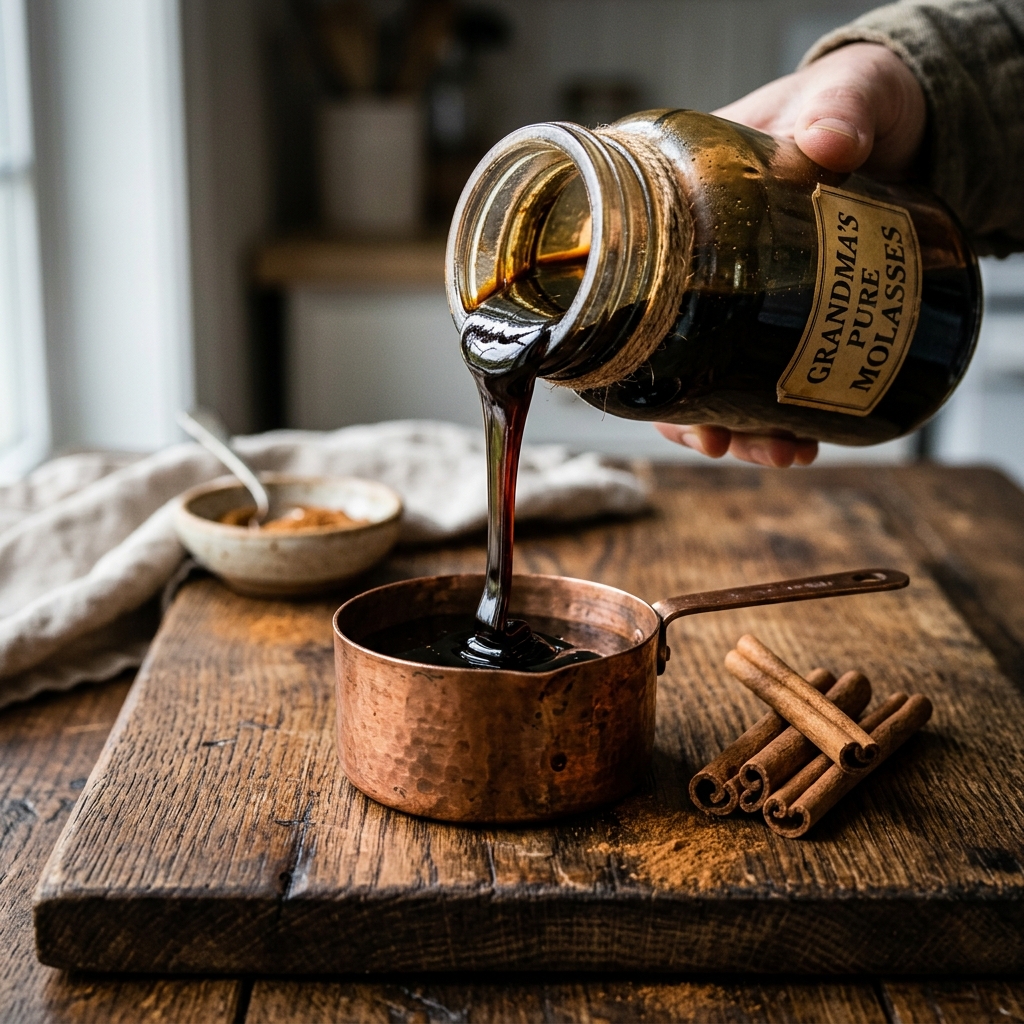
Ten degrees changes everything. While preparing The 6 Best Molasses Substitutes: Sugar Chemistry, Leavening Physics & Baking Science (Thermal Audit #150 · MOLASSES/SUBSTITUTE), a narrow shift in skillet contact temperature or convection damper velocity dictates whether sugars caramelize cleanly into nutty lactones or scorch into acrid carbon before the center sets. Rest cooked batches. Carryover heat equalizes gradients.
In classical baking science, molasses is far more than an intensely dark viscous sweetener; it is an active biochemical cocktail of concentrated mineral ash, organic carboxylic acids, and uncrystallized invert sugars. Molasses represents the viscous byproduct yielded during the industrial crystallization of sugar cane (Saccharum officinarum) juice. As sucrose crystals are repeatedly centrifugally separated, the remaining mother liquor concentrates native minerals (potassium, calcium, magnesium, iron), polyphenolic pigments, and volatile pyrazines.
Replacing molasses in recipes such as traditional gingerbread, gingersnaps, pumpernickel bread, or slow-baked Boston beans requires an understanding of its dual functionality: acidity and hygroscopicity. Because standard baking molasses exhibits a naturally low pH between 5.0 and 5.5, it serves as the essential acidulant that reacts with sodium bicarbonate (baking soda, $NaHCO_3$) to release carbon dioxide ($CO_2$) gas for initial oven spring. Its non-sugar solids and high proportion of reducing sugars also inhibit sucrose crystallization, giving gingerbread cookies their signature chewy, bendable interior. Omitting molasses without chemical compensation produces pale, crumbly, and flat baked goods.
The Sugar Refining Hierarchy: Light, Dark, and Blackstrap Molasses — The 6 Best Molasses · Kitchen Protocol #150 (MOLASSES-SUBSTITUTE)
Before selecting a culinary substitute, it is critical to distinguish between the three distinct extraction grades of molasses:
- First Molasses (Light or Mild): Produced from the initial boiling of cane syrup. It contains the highest total sugar concentration (roughly 65% sucrose and invert sugars) and the lowest mineral ash (2% to 3%). It is golden-brown, sweet, and mild, frequently used as a table pancake syrup.
- Second Molasses (Dark or Robust): The standard commercial “baking molasses.” Obtained after a second boiling and crystallization cycle, it contains roughly 50% to 55% sugars and 5% to 6% mineral ash. It displays a deep mahogany hue, a robust bittersweet flavor profile, and the requisite acidity for leavening baked doughs.
- Third Molasses (Blackstrap): The dense, tar-like residue remaining after the third and final extraction. It is drastically reduced in fermentable sugars (35% to 40%) but highly concentrated in mineral ash (8% to 12%), iron, and calcium. Blackstrap has a bitter, salty, sulfurous bite with a low pH (4.5 to 5.0). In pastry baking, blackstrap will easily overpower delicate flavors and should not be used as a 1:1 substitute for standard dark molasses unless specifically formulated.
1. Dark Brown Sugar + Hot Water Simple Syrup (The Exact Molecular Flavor Match)
Replacement Ratio: 3/4 cup (165 g) packed dark brown sugar dissolved in 1/4 cup (60 ml) boiling water to replace 1 cup (340 g) of molasses.
Best For: Gingerbread men, spiced cookies, spice cakes, and baked beans.
Performance Analysis: Because commercial brown sugar is manufactured by re-coating refined white sucrose with authentic cane molasses, this DIY liquid blend provides a nearly identical flavor and acid profile. Dissolving the sugar in hot water replicates the 22% to 25% moisture content of liquid molasses, ensuring that dough hydration remains mathematically in balance. It provides the characteristic toffee-mineral undertones and leavens properly with baking soda.
2. Dark Corn Syrup (The Best Rheology and Chewiness Match)
Replacement Ratio: 1:1 by volume.
Best For: Soft gingersnap cookies, pecan pies, barbecue sauces, and candy making.
Performance Analysis: Dark corn syrup is formulated with refined glucose, maltose, and caramel coloring. With a high soluble-solids density ($80^\circ\text{Bx}$) and thick viscosity, it mirrors the flow rate and moisture-binding capacity of molasses. Cookies baked with dark corn syrup achieve the exact spread and chewy center of molasses-based recipes. However, because it lacks the assertive bitterness and organic acids of cane molasses, we recommend adding 1/4 teaspoon of ground allspice or cloves and a tiny drop of apple cider vinegar per cup used.
3. British Black Treacle
Replacement Ratio: 1:1 by volume.
Best For: Traditional fruitcakes, English sticky toffee pudding, ginger cakes, and rich stews.
Performance Analysis: Black treacle is a quintessential British baking ingredient composed of a proprietary blend of cane molasses and partially inverted sugar syrup. It sits biochemically halfway between standard dark molasses and blackstrap, possessing a deeply smoky, slightly bitter, caramelized profile with a refractometer density around 82°Bx. It can be substituted directly into any molasses recipe without altering flour or liquid ratios.
4. Sorghum Syrup (Sweet Sorghum)
Replacement Ratio: 1:1 by volume.
Best For: Southern skillet cornbread, biscuits, glazes for roasted pork, and barbecue glazes.
Performance Analysis: Extracted from the crushed stalks of sweet sorghum grass (Sorghum bicolor) rather than sugar cane, sorghum syrup is a historic staple of the American South. It possesses an amber-to-copper color, a lighter viscosity than blackstrap, and a bright, tangy, slightly grassy sweetness. Because sorghum syrup naturally shares molasses’s acidic pH (around 5.0), it activates baking soda with equal efficiency, delivering light, well-aerated baked goods.
5. Pure Maple Syrup (Grade A Dark or Very Dark)
Replacement Ratio: 1:1 by volume, reducing other liquids in the recipe by 2 tablespoons per cup.
Best For: Marinades, salad dressings, morning pancakes, and light gingerbread cakes.
Performance Analysis: Dark or Very Dark maple syrup provides warm woodsy notes, vanillin, and furanones that approximate the depth of mild molasses. However, maple syrup contains roughly 33% water compared to molasses’s 20–22%, making it noticeably thinner. It is also significantly sweeter and less bitter. When swapping maple syrup for molasses in baked goods, anticipate a lighter color and a sweeter, more delicate flavor profile reminiscent of maple-spice rather than dark gingerbread.
6. Date Syrup (Silan)
Replacement Ratio: 1:1 by volume.
Best For: Dark rye sourdough, pumpernickel bread, fruitcakes, and roasted vegetable glazes.
Performance Analysis: Silan is made by simmering, pressing, and concentrating whole dates into a deep mahogany syrup ($71^\circ\text{Bx}$). It contains natural fruit pectins, fructose, glucose, and trace minerals. While it lacks the distinct sulfurous tang of cane molasses, its rich, dried-plum sweetness and heavy viscosity give dark artisan breads exceptional crust color and extended crumb freshness.
Stovetop Heat Control for Sugar Reductions and Syrups — The 6 Best Molasses · Thermal & Ingredient Matrix #150
When dissolving dark brown sugar to create DIY molasses syrup or reducing fruit purées to high solids density, even thermal transmission is paramount. Because unrefined syrups concentrate calcium salts and caramelizing sugars, uneven heating leads to immediate scorched spots and acrid bitterness.
Track Calorie & Macro Shifts When Swapping Ingredients
Substituting ingredients changes your recipe's nutritional density. Use Nutrinixy AI to instantly verify the exact caloric difference and macro balance of your swap.
Verify Ingredient Macros with Nutrinixy →Baking Recalibration Rules for Molasses Substitutions — The 6 Best Molasses · Regional Pantry & Equipment Notes (MOLASSES-SUBSTITUTE-150)
When swapping molasses in classic recipes, adhere to these chemical guidelines:
- Leavening Neutralization: If using a neutral substitute like honey, maple syrup, or corn syrup in a recipe that relies on baking soda ($NaHCO_3$), add 1/2 teaspoon of cream of tartar or 1 teaspoon of lemon juice per cup of syrup to supply the acid necessary for carbon dioxide release.
- Hydration Compensation: When replacing molasses with dry brown sugar without making a syrup, increase the recipe’s liquid ingredients (milk, coffee, or water) by 3 to 4 tablespoons per cup of sugar to maintain correct batter viscosity.
- Spice Amplification: Lighter substitutes (corn syrup, maple, honey) lack the heavy, sulfurous, bitter backbone of cane molasses. Increase ground ginger, cinnamon, cloves, and nutmeg by 15% to 20% to restore the intended depth of flavor in holiday baking.
Frequently Asked Questions — The 6 Best Molasses · Storage, Reheating & Diagnostics #150
Can I substitute blackstrap molasses for regular baking molasses?
Generally, no. Blackstrap molasses has had almost all of its sucrose extracted, leaving an intensely bitter, salty, mineral-concentrated syrup. If substituted 1:1 in gingerbread or cookies, it will impart an acrid, overwhelming medicinal flavor. If blackstrap is your only option, blend 1 part blackstrap with 3 parts light corn syrup or honey to balance the bitterness.
Is molasses sweet or bitter?
Molasses is both sweet and bitter. Light molasses is pleasantly sweet with a hint of caramel, standard dark baking molasses is bittersweet with rich mineral tones, and blackstrap molasses is predominantly bitter, robust, and salty with very little perceptible sweetness.
Can I use honey instead of molasses?
Yes, honey can replace molasses at a 1:1 ratio in marinades, glazes, and quick breads. However, honey is composed of fructose and glucose and is noticeably sweeter and more floral. Your finished dish will have a significantly lighter color and will lack the deep, earthy caramel bite that molasses provides.