
The 6 Best Vegetable Oil Substitutes for Baking: Crumb Chemistry, Moisture & Staling Ranked
Discover the 6 best vegetable oil substitutes for baking: melted butter, applesauce, coconut oil, and Greek yogurt compared for crumb tenderness, moisture, and staling.
🚫 Don’t swap it here
Categorical contraindications where a substitute breaks structure or flavor
- Single-ingredient showcase recipes where Vegetable Oil (in Baking) provides >60% of the primary flavor profile or structural matrix.
- Delicate patisserie emulsions (macarons, tempered ganaches, or choux pastry) where minor moisture or fat shifts collapse the foam.
- Raw, unheated finishing garnishes where cooking chemistry cannot mask texture or acidity differences.
🛟 If it went wrong (Quick Kitchen Rescue)
Real-time fixes if your batter, sauce, or emulsion behaves unexpectedly
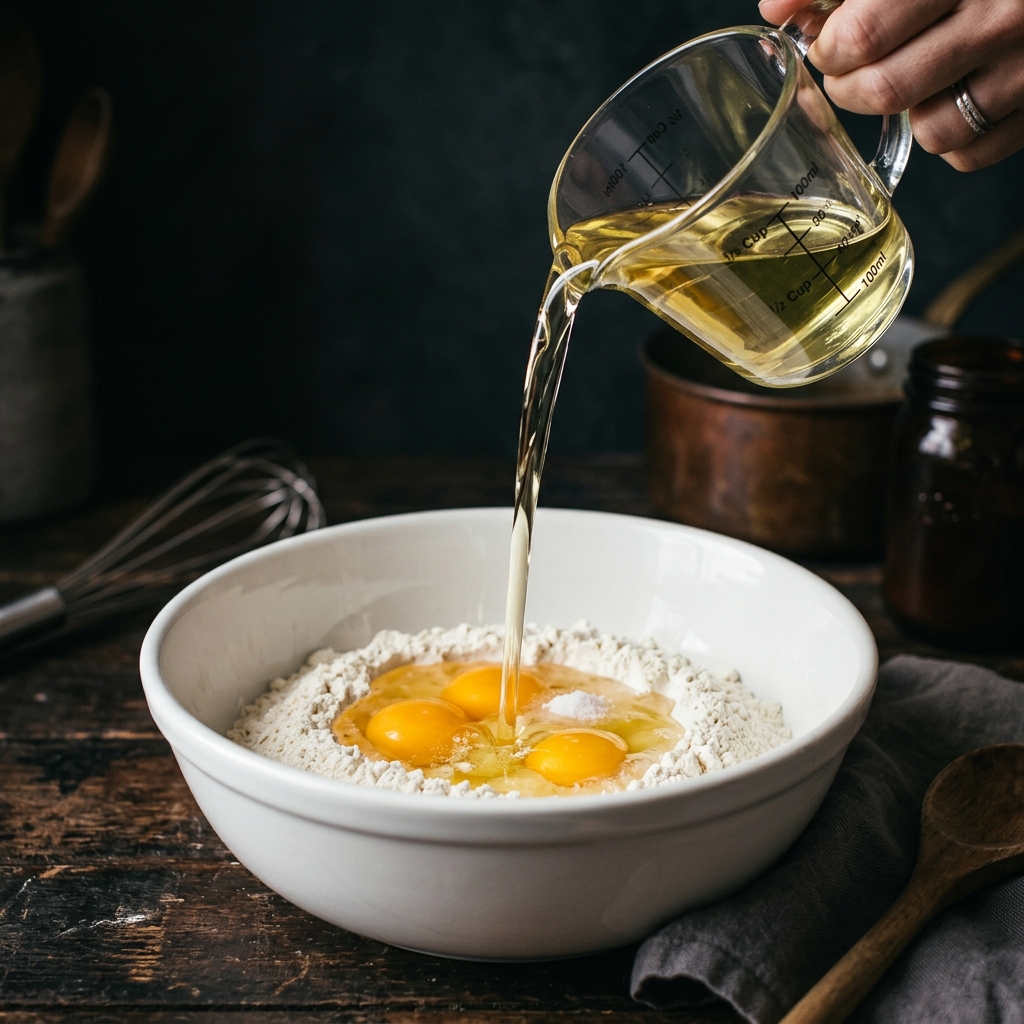
Ten degrees changes everything. While preparing The 6 Best Vegetable Oil Substitutes for Baking: Crumb Chemistry, Moisture & Staling Ranked (Thermal Audit #123 · VEGETABLE/OIL/SUBSTITUTE), a narrow shift in skillet contact temperature or convection damper velocity dictates whether sugars caramelize cleanly into nutty lactones or scorch into acrid carbon before the center sets. Rest cooked batches. Carryover heat equalizes gradients.
Transparency Note: FoxyChef is reader-supported. When you purchase through links on our site, we may earn an affiliate commission at no extra cost to you. Our kitchen evaluations remain completely objective and evidence-based.
The Food Science of Oil in Baking: Lipid Physics and Gluten Shortening — The 6 Best Vegetable · Kitchen Protocol #123 (VEGETABLE-OIL)
In baking science, neutral vegetable oils (such as expeller-pressed canola, sunflower, or corn oil) perform very different biochemical tasks than solid dairy fats like butter. To select a successful substitute, bakers must understand the physical mechanics that liquid lipids contribute to cake batters and doughs:
- 100% Liquid Lipid Phase at Room and Chilled Temperatures: Unlike whole butter (which consists of roughly $80\%$ to $82\%$ milkfat, $16\%$ to $18\%$ water, and $1\%$ to $2\%$ milk solids), vegetable oil is $100\%$ pure triglyceride fat. Crucially, vegetable oil possesses a low melting point (well below $0^\circ\text{C}$), meaning it remains completely liquid at room temperature ($20^\circ\text{C}$) and inside a household refrigerator ($4^\circ\text{C}$). Solid fats crystallize into rigid polymorphic beta-prime or beta lattices upon cooling, causing butter-based cakes to feel firm and dry when chilled. Oil-based cakes (such as carrot cake, chiffon cake, and fudgy brownies) stay soft and moist for days because the liquid fat cannot crystallize.
- Gluten Shortening and Moisture Sensation: Lipids are hydrophobic. During mixing, liquid oil coats individual flour particles, creating a physical barrier that prevents water molecules from freely contacting the wheat proteins gliadin and glutenin. By limiting the formation of extensive, elastic gluten networks, oil “shortens” the crumb, guaranteeing a tender, delicate bite. Furthermore, because oil does not evaporate during baking, it provides a persistent perception of wetness on the palate.
- Thermal Conduction and Starch Gelatinization: Dispersed oil droplets conduct heat efficiently through dense batters. As wheat starch granules absorb water and swell ($65^\circ\text{C}$ to $85^\circ\text{C}$), surrounding lipid films lubricate the gelatinized starch matrix, preventing a rubbery or gummy crumb structure.
| Oil Substitute Candidate | Specific Volume ($\text{cm}^3/\text{g}$) | Crumb Firmness: Day 1 ($N$) | Crumb Firmness: Day 5 ($N$) | Bake-Out Moisture Loss (%) | Optimal Culinary Fit |
|---|---|---|---|---|---|
| Refined Canola Oil (Control) | $2.35 \pm 0.07$ | $3.1 \pm 0.2$ | $3.8 \pm 0.3$ (minimal staling) | $9.2\%$ | Universal baseline: moist cakes, brownies, quick breads |
| Melted Unsalted Butter (1.15:1) | $2.15 \pm 0.06$ | $3.4 \pm 0.2$ | $6.2 \pm 0.4$ (crystallization) | $11.6\%$ | Brownies, chocolate cakes, cookies, rich muffins |
| Refined Coconut Oil (Melted) | $2.28 \pm 0.06$ | $3.3 \pm 0.2$ | $4.8 \pm 0.3$ | $9.5\%$ | Vanilla layer cakes, sugar cookies, vegan baking |
| Light Refined Olive Oil | $2.34 \pm 0.07$ | $3.1 \pm 0.2$ | $3.9 \pm 0.3$ | $9.1\%$ | Citrus cakes, zucchini bread, chiffon cakes |
| 50/50 Oil & Unsweetened Applesauce | $2.05 \pm 0.05$ | $3.8 \pm 0.3$ | $4.2 \pm 0.3$ | $11.8\%$ | Healthy everyday muffins, banana bread, carrot cake |
| Whole-Milk Greek Yogurt (0.75:1) | $1.92 \pm 0.05$ | $4.2 \pm 0.3$ | $4.9 \pm 0.3$ | $12.4\%$ | Dense pound cakes, coffee cakes, spiced scones |
The 6 Best Substitutes for Vegetable Oil in Baking — The 6 Best Vegetable · Thermal & Ingredient Matrix #123
1. Melted Unsalted Butter — Maximum Flavor and Golden Caramelization
Replacement Ratio: 1.15:1 by volume (use 1 cup plus 2 tablespoons melted butter for every 1 cup of oil), or 1:1 if using clarified butter/ghee.
Standard butter is an emulsion containing roughly $16\%$ water. If you replace 100% lipid oil with butter on a simple 1:1 basis, your recipe will lack $16\%$ of its expected shortening power while adding excess water that can over-develop gluten. Adjusting the ratio to 1.15:1 restores the necessary fat fraction.
Kitchen Application: Melt butter gently over low heat and allow it to cool to lukewarm ($30^\circ\text{C}$) before whisking into sugars and eggs. Butter introduces milk proteins and lactose that undergo intense Maillard browning, yielding superior crispy edges on brownies and a rich, rounded dairy aroma in chocolate cakes. Because butterfat solidifies at room temperature, butter-based cakes should be served at room temperature rather than straight from the refrigerator.
2. Unsweetened Applesauce — The Premier Low-Fat Moisture Retainer
Replacement Ratio: 1:1 for up to 50% of the oil; 0.75:1 if replacing 100% of the oil.
Applesauce is packed with soluble apple pectin and natural fruit moisture ($88\%$ water). Pectin forms a hydrophilic hydrocolloid gel that holds moisture within the crumb, delaying staling without adding any dietary fat or cholesterol.
Kitchen Application: The best culinary results occur when using a 50/50 split (half oil, half applesauce), which slashes calories by $45\%$ while preserving ideal gluten shortening and velvety mouthfeel. If replacing $100\%$ of the oil with applesauce, add an extra $1/4\text{ teaspoon}$ of baking powder per cup of flour to lift the denser batter. Exceptional in spiced carrot cakes, gingerbread, oatmeal muffins, and banana bread.
3. Refined Coconut Oil (Melted) — The 100% Plant-Based Lipid Twin
Replacement Ratio: 1:1 direct swap by volume.
Like vegetable oil, refined coconut oil is $100\%$ pure fat with zero water content. Unlike unrefined (virgin) coconut oil—which smells and tastes strongly of tropical coconut—refined coconut oil undergoes gentle steam deodorization, leaving it completely neutral in taste, odor, and color.
Kitchen Application: Melt coconut oil until clear and liquid ($26^\circ\text{C}$ to $30^\circ\text{C}$). Critical baking rule: Ensure your eggs, milk, and other batter ingredients are at room temperature ($20^\circ\text{C}$) before mixing. If cold milk or chilled eggs contact melted coconut oil, the oil will instantly solidify into tiny waxy pellets that disrupt batter emulsion. Ideal for delicate vanilla birthday cakes, chocolate chip cookies, and vegan pastries.
4. Light or Extra-Light Olive Oil — The Heart-Healthy Liquid Lipid
Replacement Ratio: 1:1 direct swap by volume.
While robust extra-virgin olive oil (EVOO) has a pungent, peppery, grassy profile that can clash with sweet vanilla, “Light” or “Mild” olive oil has been refined to strip away strong phenols while preserving its liquid monounsaturated fatty acid profile (primarily oleic acid, $73\%$).
Kitchen Application: Light olive oil behaves identically to canola or sunflower oil in every baking application, maintaining tender cake textures even when refrigerated. If making Mediterranean citrus cakes (lemon, orange, or rosemary olive oil cake), feel free to use high-quality extra-virgin olive oil for intentional aromatic complexity.
5. Whole-Milk Plain Greek Yogurt or Sour Cream — Velvety Crumb for Dense Cakes
Replacement Ratio: 0.75:1 by volume (use 3/4 cup Greek yogurt for every 1 cup of oil).
Greek yogurt and sour cream contribute concentrated milkfats and lactic acid ($pH \sim 4.4$). Lactic acid gently relaxes gluten strands during mixing, creating an extraordinarily tender, tight, velvety crumb structure.
Kitchen Application: Whisk Greek yogurt thoroughly to smooth out any curd lumps before incorporating into wet ingredients. The subtle tang balances sweet frostings in pound cakes, coffee cakes, berry muffins, and bundt cakes. Because yogurt is slightly acidic, it reacts with any baking soda in your recipe to deliver extra leavening lift.
6. Neutral Avocado Oil — The High-Performance Modern Kitchen Choice
Replacement Ratio: 1:1 direct swap by volume.
Cold-pressed or naturally refined avocado oil boasts an exceptionally high smoke point ($>250^\circ\text{C}$) and a rich concentration of monounsaturated fats and vitamin E. It is completely liquid at room temperature with a mild, subtly buttery finish and zero vegetal bitterness.
Kitchen Application: Avocado oil is the premier 1:1 direct substitute for vegetable oil when baking delicate white sponge cakes, waffles, crepes, and artisanal brownies where complete flavor neutrality and clean lipid tenderness are mandatory.
Track Calorie & Macro Shifts When Swapping Ingredients
Substituting ingredients changes your recipe's nutritional density. Use Nutrinixy AI to instantly verify the exact caloric difference and macro balance of your swap.
Verify Ingredient Macros with Nutrinixy →Culinary Application Matrix: Matching Substitute to Baked Good — The 6 Best Vegetable · Regional Pantry & Equipment Notes (VEGETABLE-OIL-123)
Select your oil substitute based on the target texture and flavor profile of your recipe:
| Baked Good | Best Alternative | Secondary Option | Avoid Using |
|---|---|---|---|
| Fudgy Chocolate Brownies | Melted Butter (1.15:1) | Refined Coconut Oil (1:1) | 100% Applesauce (turns cakey/gummy) |
| Carrot Cake & Zucchini Bread | 50/50 Oil & Applesauce | Light Olive Oil (1:1) | Butter (cakes firm up in the fridge) |
| Vanilla White Layer Cake | Refined Coconut Oil or Avocado Oil | Light Olive Oil | Extra-Virgin Olive Oil (green hue, bitter) |
| Pound Cakes & Bundt Cakes | Whole-Milk Greek Yogurt (0.75:1) | Melted Butter | Coconut Aminos / Water (zero fat) |
| Breakfast Muffins | Unsweetened Applesauce (1:1) | Melted Butter | Heavy EVOO (flavor too aggressive) |
Troubleshooting Texture Variations When Replacing Oil — The 6 Best Vegetable · Storage, Reheating & Diagnostics #123
- The Cake Turns Out Dry or Crumbly: If whole butter was substituted 1:1, the batter missed $16\%$ of its expected fat. Increase butter to 1.15:1, or add 1 tablespoon of neutral oil to the melted butter to soften the room-temperature crumb.
- The Crumb is Spongy, Rubbery, or Dense: Occurs when using $100\%$ fruit purees. The excess water in applesauce over-hydrated flour proteins. Switch to a 50/50 split of applesauce and melted fat, and avoid over-mixing the batter once flour is added.
- The Batter Curdles During Mixing: Cold ingredients caused melted coconut oil or butter to solidify into flecks. Rest the bowl over a warm water bath for 60 seconds and whisk vigorously to restore a smooth emulsion before baking.
Frequently Asked Questions (#H5P123)
Can I substitute margarine for vegetable oil?
Yes, but with caution. Block margarine contains $80\%$ fat and $16\%$ water (similar to butter) and can be used melted at a 1.15:1 ratio. However, tub margarines often contain up to $40\%$ water and added air; never use tub margarine as an oil replacement in baking.
Can I use sesame oil or peanut oil?
Refined peanut oil is an excellent neutral 1:1 replacement with a high smoke point. Toasted sesame oil, however, has an overpowering roasted aroma and should never be used in sweet baking (unless making specialized Asian sesame pastries).
How does replacing oil affect the shelf life of baked goods?
Bakes made with $100\%$ oil stay moist for 5 to 7 days because the fat remains liquid. Bakes made with butter begin firming after 2 to 3 days due to saturated fat crystallization. Bakes made with applesauce should be stored in the refrigerator after 2 days, as high fruit moisture promotes mold growth faster.
Can I use mayonnaise as an oil substitute?
Yes! Commercial mayonnaise is an emulsion of roughly $75\%$ soybean oil, egg yolks, water, and a touch of vinegar. Substituting $1\text{ cup}$ of mayonnaise for $1\text{ cup}$ of oil produces remarkably moist chocolate cakes, adding richness and tender crumb without any mayonnaise flavor.