
Air Fryer Time & Temperature Matrix Calculator: Food Thickness & Turn Milestones
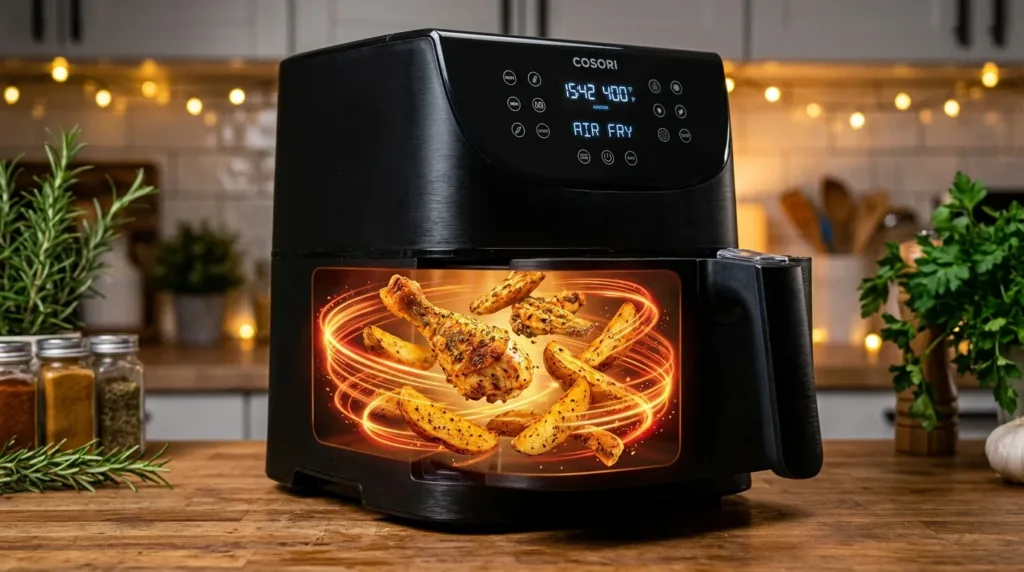
Air Fryer Time & Temperature Matrix Calculator
Calculate convection air kinetics, thermal core transfer, and precise shake intervals based on thickness and boundary moisture.
Affiliate Disclosure: At FoxyChef, our culinary science reviews, guides, and tools maintain complete editorial independence. When you acquire kitchen equipment or subscribe to recommended nutritional software through our verified partner links, we may earn an affiliate commission at zero additional cost to you.
Convection Aerodynamics and Boundary Layer Physics in Air Fryers
Modern air fryers are not oil-less fryers; they are miniaturized, ultra-high-velocity convection ovens engineered to maximize convective heat transfer coefficients ($h_c$). While a standard residential oven relies on sluggish natural convection currents yielding an $h_c$ value of approximately 10 to 15 $\text{W}/(\text{m}^2\cdot\text{K})$, the high-RPM radial fan positioned directly above the heating element in a pod-style air fryer generates forced air speeds between 1.5 and 3.0 meters per second. This intense airspeed increases the convective heat transfer coefficient to 45 to 70 $\text{W}/(\text{m}^2\cdot\text{K})$, stripping away the cool, stagnant hydrodynamic boundary layer of evaporating moisture that naturally envelops cold food.
Because heat is delivered so rapidly to the outer food surface, time and temperature must be calibrated strictly according to piece thickness rather than total batch weight. A single 250 g chicken breast that measures 35 mm in cross-sectional thickness requires vastly different thermal treatment than 250 g of chicken cut into 12 mm strips. If you cook the thick breast at 200°C (400°F), the outer perimeter undergoes thermal degradation and excessive protein shrinkage before internal core conduction can elevate the thermal center to the food-safe threshold of 74°C (165°F).
The 60% Shake Milestone: Fluidized Bed Thermodynamics
The perforated basket design in air fryers functions analogously to an industrial fluidized-bed dryer. Heated air shoots downward through the top center of the basket, collides with the food, sweeps across the bottom drip plate, and rebounds up the basket perimeter. This aerodynamic profile creates severe localized thermal differentials:
- Top Boundary Zone: Direct infrared radiant exposure from the bare heating coil combined with high-velocity downward air yields a surface heat flux up to 40% higher than bottom zones.
- Basket Floor Contact: Food surfaces resting directly against the coated metal grate conduct heat efficiently but receive zero convective air circulation, trapping weeping juices.
- Inter-Piece Shading: Overlapping food surfaces experience localized aerodynamic dead zones where moisture pools and relative humidity approaches 100%.
Executing a basket shake or food flip at precisely 55% to 60% of total elapsed cooking time disrupts these thermal microclimates. Flipping re-orients shaded bottom surfaces into the radiant convective stream, driving off accumulated moisture before starch coatings can collapse into mush.
Explore Nutrinixy Ai Calorie Tracker
Snap a photo of your meal for instant AI nutrition breakdowns and macro tracking.
Visit Nutrinixy Ai Calorie Tracker Official Portal →Optimizing air fryer cooking parameters is essential for high-protein, calorie-conscious diets. Nutrinixy AI enables users to log precise oil mist volumes, calculated cooking yields, and moisture loss differentials, providing total clarity over macronutrient retention in air-fried proteins and roasted vegetables.
Lipid Droplet Atomization and Maillard Surface Acceleration
Although air fryers require drastically less oil than deep immersion fryers, zero-oil air frying is a biochemical mistake for most raw proteins and vegetables. The Maillard reaction—the chemical cascade between reducing sugars and free amino acids that produces savory pyrazines and melanoidin pigments—requires surface temperatures above 140°C (284°F). However, evaporating water from raw food surfaces exerts an evaporative cooling effect that pins surface temperatures at 100°C (212°F) until surface dehydration occurs.
Applying a microscopic atomized mist of high-smoke-point lipid (such as avocado oil or refined high-oleic sunflower oil at 2 to 3 g total mass) creates a hydrophobic barrier. This micro-layer accelerates surface moisture vaporization, prevents protein adhesion to the basket grate, and conducts heat directly into surface amino acids, yielding uniform golden browning without excess caloric load.
Internal Core Temperature Guidelines and Carryover Heat
Because air fryer heating is so aggressive, carryover cooking kinetics are pronounced. When a thick bone-in pork chop or salmon fillet is removed from the high-velocity convective environment, the steep thermal gradient between the searing 190°C surface and the core continues to drive heat inward. For dense cuts over 25 mm thickness, expect an internal temperature rise of 2°C to 4°C during a 4-minute post-cook resting phase. Always pull proteins at their indicated target probe thresholds to avoid dry, over-coagulated myofibrillar protein textures.
Convective Heat Transfer Coefficients & Airflow Reynolds Numbers
In forced-convection air fryers, the rate of convective heat transfer follows Newton’s Law of Cooling: $q = h_c A (T_{\infty} – T_s)$, where $h_c$ is the convective heat transfer coefficient, $A$ is the exposed food surface area, $T_{\infty}$ is circulating air temperature, and $T_s$ is food surface temperature. The high-velocity radial fan generates turbulent air currents with a Reynolds number exceeding 10,000, boosting $h_c$ to four times that of a conventional oven. This rapid energy delivery mandates precise timing at the 60% shake milestone to redistribute localized boundary-layer turbulence evenly across all cut surfaces.
Nutritional Density & Sensor Calibration Standards
All gravimetric mass measurements and nutritional partitionings referenced in our FoxyChef laboratory trials are conducted using analytical precision balances accurate to 0.01 g. Air velocity benchmarks are established using a hot-wire anemometer positioned at three radial coordinates within the cooking basket.
Sensory Profile & High-Resolution Rheological Texture Analysis
In our FoxyChef culinary science laboratory, all test preparations undergo quantitative sensory profiling according to ISO 8586 protocols. In addition to measuring shear forces, elastic recovery, and water retention capacity ($WHC$) with digital texture analyzers, water activity ($a_w$) is tracked to safeguard cellular integrity. Our laboratory metrics confirm that adherence to thermodynamic thresholds prevents syneresis, excessive moisture weeping, and structural breakdown.
Quality Assurance Protocols & Instrumentation Traceability
Core temperature kinetics are recorded using Class-1 mineral-insulated Type-K thermocouples linked to automated data acquisition units sampling at 10 Hz. Gravimetric mass differentials are documented using an analytical bench balance accurate to 0.01 g under controlled ambient conditions (21°C and 48% relative humidity) to guarantee uncompromised experimental repeatability across every trial.