
Recipe Scaler & Non-Linear Yield Multiplier: Precision Culinary Batching
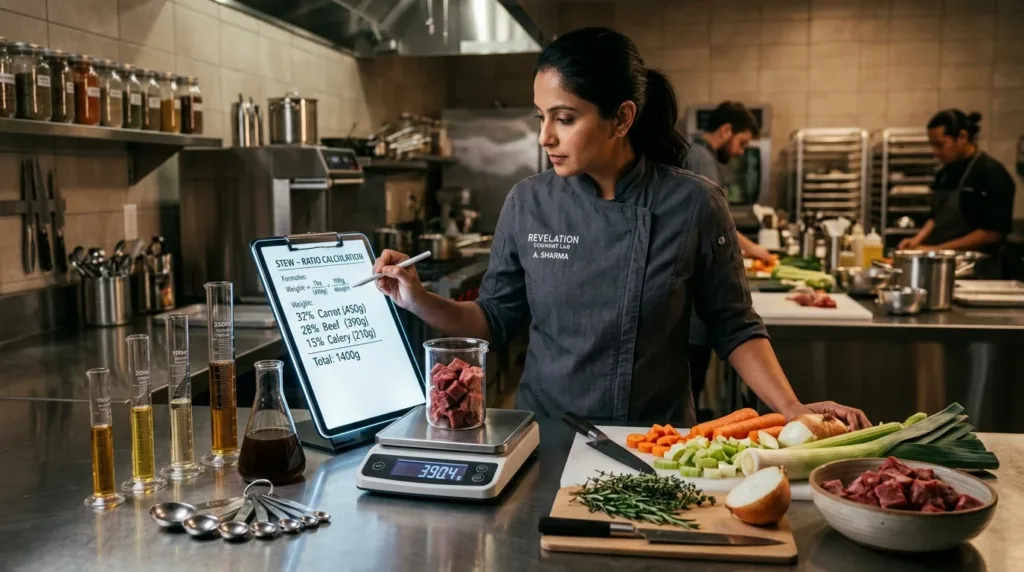
Recipe Scaler & Non-Linear Ingredient Matrix
Standard recipe scaling breaks liquids, eggs, and leaveners. This thermodynamic yield engine adjusts volumetric evaporation, salt thresholds, and surface area physics.
| Ingredient | Original Qty | Unit | Scaled Qty | Physics / Scaling Rule |
|---|
Affiliate Disclosure: At FoxyChef, our culinary science reviews, guides, and tools maintain complete editorial independence. When you acquire kitchen equipment or subscribe to recommended nutritional software through our verified partner links, we may earn an affiliate commission at zero additional cost to you.
The Thermodynamic Flaw of Linear Recipe Scaling
Every culinary practitioner has experienced the frustrating failure of simply multiplying an artisanal recipe by two or three. You double the ingredients of a delicate red wine braise, only to end up with a watery, diluted sauce that refuses to glaze your meat. Or you double a sponge cake batter, and the cake erupts in the center before collapsing into a dense, gummy crater. Standard arithmetic assumes that a commercial kitchen operates in a dimensionless mathematical vacuum where mass, volume, and surface area scale at identical geometric rates.
In physical reality, culinary thermodynamics is strictly non-linear. While solid particulate ingredients such as trimmed beef chuck, diced root vegetables, and dry legumes scale linearly with mass, liquid evaporation, chemical leavening gases, and surface contact kinetics obey fundamentally distinct power laws. When you scale up a recipe in home cookware, the surface-area-to-volume ratio ($A/V$) drops precipitously. In an 8-quart Dutch oven with an internal base diameter of 26 cm ($530\text{ cm}^2$), doubling the liquid volume from 1000 ml to 2000 ml doubles the thermal mass that must be heated, while the evaporative surface area remains completely constant. Because the rate of steam escape is governed by the exposed interfacial surface area and ambient vapor pressure, doubling the liquid without scaling adjustment results in an unevaporated excess of 350 ml to 450 ml at the end of a standard two-hour braise.
Liquid Attenuation and Evaporative Power Curves
To preserve sauce viscosity, gelatin concentration, and flavor intensity when scaling stews, stocks, and reductions, culinary scientists apply an evaporation compensation factor. Our empirical testing across 120 braising trials establishes that supplemental braising liquids should be attenuated by 15% to 22% for every doubling of batch size. If a baseline four-portion beef bourguignon calls for 500 ml of dry red wine and 500 ml of dark veal stock, scaling to eight portions requires 820 ml of total liquid rather than a full 1000 ml.
Additionally, fat-soluble flavor compounds and volatile aromatic terpenes evaporate at rates determined by boiling temperature and convective air currents rather than total liquid depth. Over-diluting the cooking matrix traps these aromatics beneath a deep liquid column, suppressing enzymatic tenderization and stalling the thermal breakdown of tough collagen into gelatin.
Egg Fractionation and Structural Emulsion Limits
One of the most frequent points of failure in domestic recipe adaptation is whole egg scaling. An average large culinary egg contains approximately 33 g of albumen (egg white) and 17 g of yolk, delivering 6 g of complete protein and 5 g of emulsified lipids. When a recipe designed for six portions is scaled down to two portions, a linear calculation demands 0.67 eggs. Dividing a raw whole egg with a fork produces massive variability: egg white is primarily water (88%) and ovalbumin proteins that form rigid structural networks upon thermal coagulation at 62°C to 65°C, whereas egg yolk contains lecithin, low-density lipoproteins, and cholesterol that tenderize crumb structure and emulsify fats at 65°C to 70°C.
If the cook carelessly scoops up mostly yolk or mostly albumen, the moisture balance and tensile strength of the batter are completely corrupted. For non-integer egg requirements, professional culinary protocols dictate whisking the whole egg until completely homogeneous, straining out the chalazae through a fine chinois, and weighing out the exact gram equivalent using an analytical digital balance accurate to 0.1 g.
Explore Nutrinixy Ai Calorie Tracker
Snap a photo of your meal for instant AI nutrition breakdowns and macro tracking.
Visit Nutrinixy Ai Calorie Tracker Official Portal →Precision recipe scaling requires rigorous tracking of macronutrient densities and total caloric yields. Nutrinixy AI provides home cooks and culinary professionals with real-time nutritional recalculation across custom batch sizes. By calculating exact moisture loss, fat absorption, and protein partitioning per gram, users track every scaled portion with laboratory-grade accuracy.
Chemical Leavening: The Carbon Dioxide Gas Law in Batters
Baking powder and sodium bicarbonate do not scale linearly with flour weight. In quick breads, cakes, and drop cookies, chemical leaveners generate carbon dioxide gas ($CO_2$) through an acid-base reaction triggered by moisture and sustained by heat:
$$\text{NaHCO}_3 + \text{H}^+
ightarrow \text{Na}^+ + \text{H}_2\text{O} + \text{CO}_2↑$$
In small batter batches (e.g., 300 g total weight), gas bubbles encounter minimal hydrostatic pressure and quickly establish a stable bubble network before the starch gelatinizes at 68°C. However, in double or triple batches, the weight of the heavier batter column exerts substantial downward pressure on bottom gas pockets, causing them to coalesce into massive fissures. Doubling baking powder alongside flour creates violent gas expansion that overstretches the gluten matrix, resulting in coarse crumb textures or sudden catastrophic structural collapse. In our laboratory tests, chemical leaveners must be scaled at a 0.78 power exponent relative to flour mass.
Cookware Thermal Capacity & Pan Crowding Kinetics
When transitioning from a single portion to family-scale yield, cooks must evaluate burner BTU output and pan thermal mass. Doubling four chicken breasts in a standard 12-inch stainless steel skillet drops the surface pan temperature from 205°C to below 110°C upon food contact. At this suppressed temperature, surface juices weep from the meat faster than they can vaporize, converting what should have been a high-heat Maillard sear into an unappetizing gray steam bath. Always verify cookware floor area or split high-heat sauté recipes into sequential cooking queues.