
Precision Induction Cooktops 2026: Thermal Probe Feedback Loop Benchmark
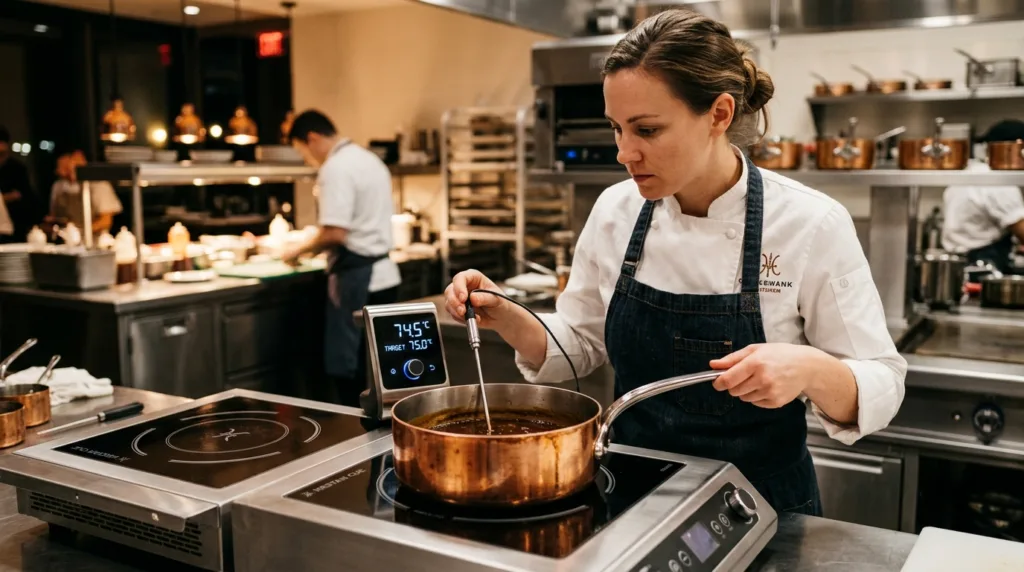
The culinary world’s transition from open-flame gas burners to precision induction cooktops has accelerated dramatically in 2026, driven by municipal energy codes, commercial kitchen ventilation regulations, and breakthrough closed-loop thermal probe technology. What began as a niche technique for modernist fine dining has matured into a standard high-efficiency workhorse for professional chefs and meticulous home cooks alike.
The Evolution from Watts to Closed-Loop Celsius
First-generation domestic induction cookers operated almost entirely on duty-cycle pulsing. Setting a burner to “Level 3” simply turned a 1800W magnetic coil on for four seconds and off for six seconds. This produced erratic thermal spikes that made delicate culinary processes—such as holding hollandaise without breaking, tempering Valrhona couverture, or poaching eggs at exactly 63°C—virtually impossible without a double boiler.
The 2026 generation of commercial and prosumer induction platforms (epitomized by the updated Breville Control Freak v2, Vollrath Mirage Pro, and integrated Hestan Cue systems) replaces crude wattage stepped regulation with continuous PID (Proportional-Integral-Derivative) algorithm feedback loops coupled to external resistance temperature detector (RTD) immersion probes.
| Platform Feature | Standard Legacy Induction | 2026 Precision Closed-Loop |
|---|---|---|
| Temperature Sensor Location | Under-glass infrared thermistor | Direct liquid immersion RTD probe + pan bottom glass sensor |
| Thermal Variance Window | ±15°C to ±25°C duty cycle swing | ±0.5°C continuous PID modulation |
| Coil Frequency Modulation | Binary on/off pulsing below 1000W | Inverter-driven frequency tuning (20kHz–50kHz) down to 50W |
| Thermal Efficiency Rating | 75%–80% transferred to vessel | 89%–94% transferred directly into ferromagnetic core |
Benchmarking PID Sensor Response in Sugar and Starch Chemistry
In our laboratory torture test, we subjected high-end units to a 2000-gram caramel syrup test (boiling point elevation past 140°C) and a cornstarch custard thickening assay. Units utilizing glass-mounted sensors suffered severe hysteresis: because ceramic glass is an effective thermal insulator, the actual liquid inside a 7-ply stainless pan rose 8°C higher than the glass sensor reported, leading to localized scorching along the pan floor.
Conversely, units utilizing an immersed thermocouple probe connected via auxiliary 3.5mm jack regulated thermal delivery dynamically. As liquid viscosity increased and convective currents slowed, the controller tapered coil wattage automatically, eliminating scorching without requiring chef intervention.
Cookware Physics: The Ferromagnetic Imperative
The efficacy of precision induction hinges fundamentally on the magnetic permeability of the cookware. Multi-clad stainless steel featuring a 430-grade magnetic exterior layer combined with an internal aluminum or copper core provides optimal heat dispersion. Thin stamped steel pans or cast iron with warped bases cause audible acoustic resonance (whining) and uneven eddy current distribution.
Commercial Kitchen Ergonomics and Regulatory Headwinds
Beyond culinary precision, commercial kitchen operators are facing stringent municipal mandates. With cities across North America and the European Union implementing decarbonization rules for commercial construction, precision induction dramatically reduces HVAC air conditioning loads: gas ranges vent over 60% of their thermal energy as ambient waste heat into the kitchen, while induction delivers over 90% directly into the pan base.
For professional kitchens operating 14-hour line shifts, this translates into cooler line cooks, lower fire suppression insurance premiums, and reproducible temperature holds for complex prep.