
Cast Iron vs Non-Stick vs Stainless Steel: The Definitive Cookware Comparison Guide
Compare cast iron, diamond non-stick, and stainless steel by heat retention, searing power, longevity, and toxic-free safety.
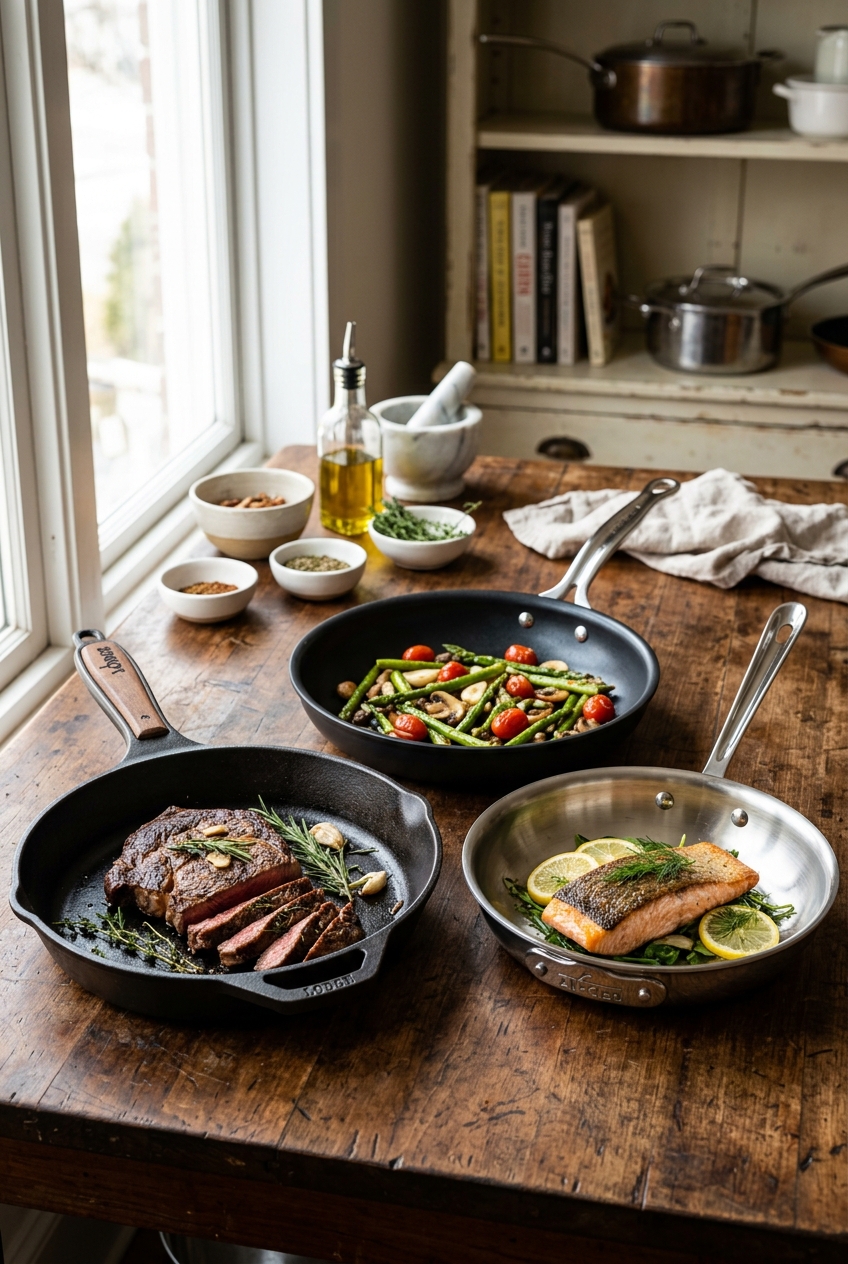
Quick Decision: The 3 Skillets Every Home Kitchen Actually Needs
Most home cooks accumulate 8 to 12 mismatched pans over time, yet professional test kitchens consistently rely on just three distinct materials. Each material solves a fundamentally different thermodynamic problem: heat retention, frictionless release, and deglazing reactivity.
If you want to streamline your kitchen, here is the golden trio:
- Cast Iron: For searing steaks, chops, burger smash patties, and oven-to-table bakes where raw thermal mass is king.
- Diamond-Reinforced Non-Stick: For delicate proteins (farm eggs, omelets, Dover sole, crepes) that tear on raw metal.
- Heavy-Gauge Stainless Steel / Pressure Cooker: For high-acid tomato reductions, pan deglazing with wine, rapid broths, and braises.
The Science of Thermal Mass: Why Cast Iron Searing Cannot Be Faked
When a cold 16-ounce ribeye hits a lightweight aluminum pan, the surface temperature of the metal instantly plunges by 100°F to 150°F. Instead of searing through the Maillard reaction (which requires sustained surface temperatures above 300°F / 150°C), the meat begins to steam in its own rendered moisture, leaving a grey, rubbery exterior.
A heavyweight American-crafted cast iron skillet like Stargazer possesses immense thermal mass. Its dense iron lattice stores thermal energy like a battery, transferring heat continuously into the meat fibers without temperature drop. The result is a glass-crisp, mahogany crust with a perfectly pink, juicy interior.
Non-Toxic Non-Stick: Why Diamond Reinforcement Beats Cheap Coatings
Traditional budget non-stick cookware relies on thin fluoropolymer layers sprayed onto stamped aluminum. Within 12 to 18 months of regular heat cycles, these coatings micro-flake, scratch, and degrade. Furthermore, overheating empty non-stick pans past 500°F can release noxious fumes.
Modern luxury manufacturers have solved this with diamond composite technology. Swiss Diamond integrates real industrial diamond crystals directly into the coating substrate. Because diamonds conduct thermal energy faster than copper, the pan heats exceptionally evenly, eliminating the hot spots that scorch butter, while providing virtually frictionless food release without added cooking oils.
German Stainless Engineering: Precision Pressure & Deglazing
For dishes requiring acidic balance—such as braised beef short ribs with Chianti, coq au vin, or lemon piccata—cast iron cannot be used because acid strips the seasoning layer and imparts an off-metallic taste. Stainless steel is completely inert, non-reactive, and chemically impervious to acids.
German manufacturer Fissler represents the pinnacle of multi-ply encapsulated stainless cookware. Their CookStar all-stove base ensures flat thermal contact on induction, gas, and electric ranges. In addition, their precision pressure cookers (such as the Vitaquick and Vitavit series) cut braising times from 3.5 hours down to 40 minutes while preserving 90% of water-soluble vitamins and locking in deep collagen gelatinization.
The Artisan Pizza Secret: Baking Steels Over Ceramic Stones
If you bake homemade artisan pizza or sourdough in a conventional home oven (which tops out around 500°F–550°F), traditional cordierite ceramic pizza stones take 60+ minutes to heat and often crack under thermal shock. High-carbon cooking steels from Cookingsteels.com solve this with 18x higher thermal conductivity, instantly flash-searing the pizza base for charred, airy crusts reminiscent of a 900°F wood-fired oven.
Summary Recommendation
Do not waste money on 15-piece low-grade department store box sets. Invest in one heirloom cast iron skillet (Stargazer), one diamond non-stick pan for eggs (Swiss Diamond), and one high-capacity stainless stockpot or pressure cooker (Fissler). That three-piece foundation will elevate 99% of your cooking forever.