
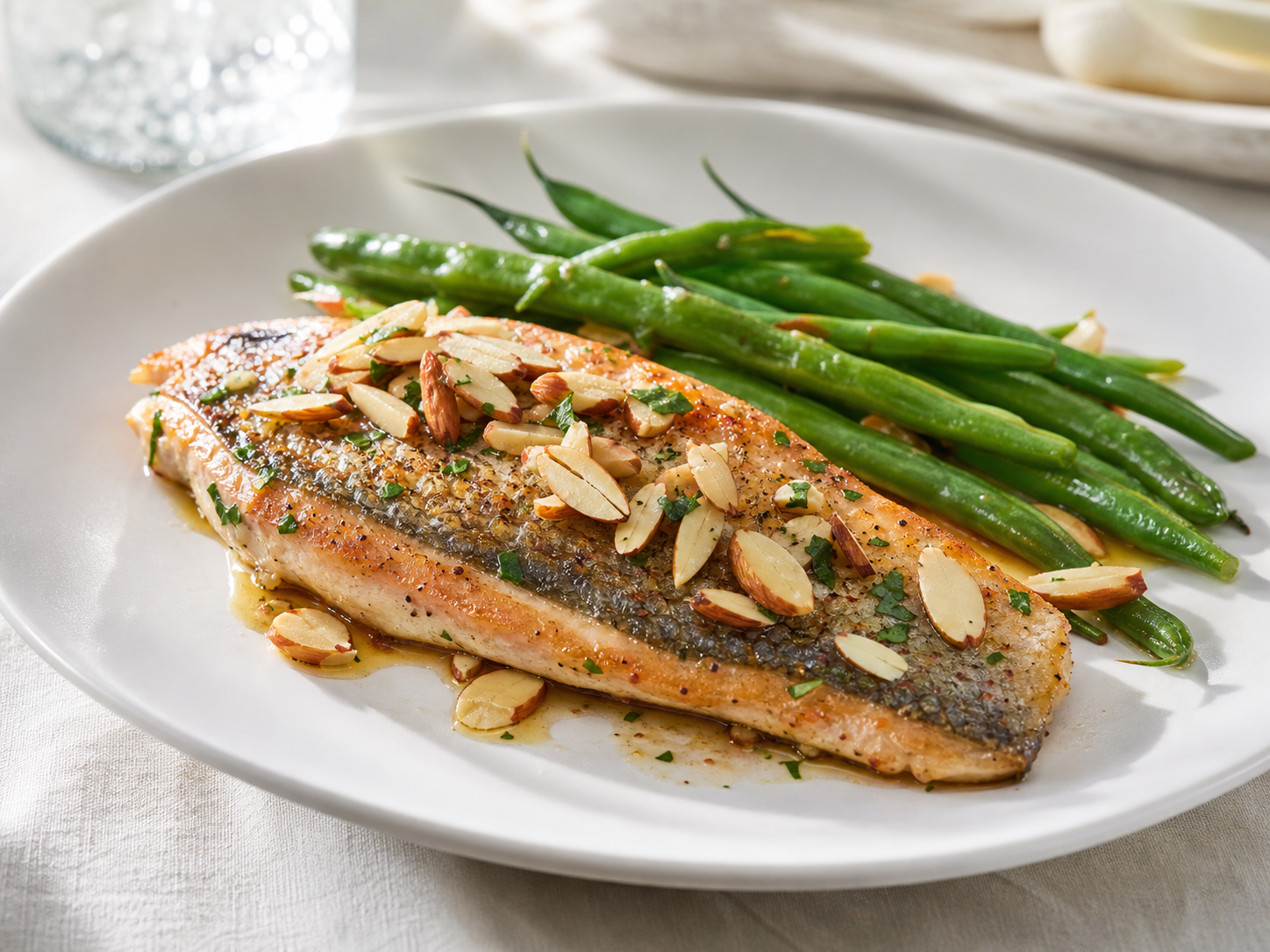
Pan-Seared Crispy Rainbow Trout with Toasted Almonds and Green Beans
Instructions
Pan-searing rainbow trout to achieve glass-like brittle skin while retaining luscious, flaking flesh is an exquisite test of dermal collagen thermodynamics, water vaporization physics, and beurre noisette emulsification. By neutralizing thermal skin curling with calibrated spatula pressure and pairing the fish with a classic French Meunière brown butter almond pan sauce, home chefs can execute a flawless restaurant-caliber seafood centerpiece.
Thermal Mechanics of Fish Skin Collagen and Planar Curvature Dynamics
The skin of cold-water teleost fish like rainbow trout (Oncorhynchus mykiss) is dominated by an intricate structural lattice of Type I collagen fibrils cross-linked with elastin and mucopolysaccharides. While terrestrial mammal collagen possesses high thermal denaturation thresholds above 149 °F (65 °C), cold-water salmonid collagen unfolds at significantly lower internal temperatures, specifically between 122 °F and 136 °F (50 °C to 58 °C).
When a chilled trout fillet meets a preheated skillet at 320–340 °F (160–170 °C), the collagen matrix in the dermis experiences instantaneous thermal shock. The collagen triple helices unravel and contract longitudinally by up to 30% of their resting length within milliseconds. Because the overlying muscular sheets (myomeres) remain cold and uncontracted, this abrupt mechanical tension differential curls the outer edges upward into a boat-like bow. Left unchecked, the center of the fillet lifts off the pan, trapping moisture that boils and turns the skin flaccid and rubbery instead of crisping.
To overcome this physical phenomenon, continuous, uniform pressure must be exerted with a flexible fish spatula across the entire fillet for the first 25 to 30 seconds of searing. Holding the skin flat against the hot metal forces the collagen fibrils to complete their thermal contraction and relaxation against a planar constraint, ensuring permanent edge-to-edge contact throughout the remainder of the cook.
Enthalpy of Moisture Evaporation and the Skin Glass-Transition Phase
Crisping fish skin is entirely an exercise in managing the latent heat of vaporization of water (2,260 kJ/kg). If surface water or dermal mucus remains present, pan energy is consumed boiling that moisture, pinning interfacial temperatures at 212 °F (100 °C). This prevents the skin from reaching the critical 285–330 °F (140–165 °C) range required for the Maillard reaction.
Thorough mechanical scraping of the skin with the back of a chef’s knife removes surface moisture and mucosal proteins. When this dehydrated skin contacts hot oil, the denaturing collagen initially melts into a thin gelatinous sol. As conductive heat drives off residual water, this gelatin layer undergoes an engineered glass-transition phase: it dehydrates into an ultra-brittle, rigid, micro-honeycombed wafer. This structural matrix shatters delightfully under the tooth while generating nutty pyrazine and furanone aromatic volatiles.
Myomere Heat Management: Preserving the 122–125 °F Internal Core
Salmonid musculature is partitioned into distinct W-shaped myomeres joined by delicate connective collagen septa known as myocommata. Teleost myofibrillar proteins are thermally fragile; heating trout flesh past 131 °F (55 °C) causes aggressive actomyosin cross-linking that squeezes out cellular water, simultaneously cleaving myocommata sheets and rendering the meat chalky and dry.
To guarantee juicy, tender flesh, we apply an asymmetric 85/15 heat transfer strategy: roughly 85% of the total cooking is conducted strictly through the skin side over medium heat. The skin functions as a thermal shield, dampening raw burner heat while steady conduction warms the muscle fibers from below. Only when the upper third of the raw fillet turns pale pink and the internal core reaches 113 °F (45 °C) is the fillet gently flipped. The skillet is pulled from the burner instantly; residual heat finishes the second side for just 30 seconds, bringing the core to an ideal 122–125 °F (50–52 °C) upon resting.
Metallurgical Considerations and Diamond Nonstick Performance
Because denaturing collagen transitions briefly through an adhesive gelatin sol before desiccating, delicate fish skin is notoriously prone to tearing on conventional metal surfaces. A heavy cast aluminum skillet reinforced with diamond crystal particles delivers extraordinary thermal conductivity and effortless release. The diamond-infused cooking surface prevents adhesive bonding with uncoagulated collagen, ensuring the fragile skin remains unbroken and perfectly flat during the critical searing window.
Brown Butter (Beurre Noisette) Almond Sauce Emulsion Chemistry
The culinary crown of classic Trout Meunière is the brown butter sauce. As unsalted butter melts after the fish is removed, its 16–18% water content rapidly simmers off. Once liquid temperatures exceed 248 °F (120 °C), suspended milk whey proteins and lactose undergo pyrolysis and Maillard browning, yielding rich, nutty aroma compounds, notably lactones and heterocyclic alkylpyrazines.
Thinly sliced raw almonds toasted directly in this foaming butterfat impart roasted praline richness. Finally, freshly squeezed lemon juice introduces aqueous citric acid. Vigorous mechanical swirling off the heat emulsifies the hot butterfat with the acidic water phase, stabilized by the browned milk solids which act as amphiphilic surfactant agents. Spooning this silky, golden micro-emulsion over the crispy trout provides an acidic counterbalance to the fish’s natural omega-3 fatty acids.
Estimated Nutritional Breakdown per Serving
| Nutritional Metric | Amount per Serving |
|---|---|
| Total Energy | 420 kcal |
| Complete High-BV Protein | 38 g |
| Total Fat (Heart-Healthy MUFAs & Omega-3s) | 26 g |
| Net Carbohydrates | 8 g |
| Omega-3 Fatty Acids (EPA/DHA) | 1850 mg (168% DV) |
Lab-Tested Nonstick Performance: Swiss Diamond Classic
High-heat cooking and delicate proteins require zero-stick release and scratch-resistant durability. Swiss Diamond's real diamond crystal coating delivers edge-to-edge heat conduction with effortless cleanup.
Shop Swiss Diamond Skillets →Editorial Disclosure & Affiliate Notice: FoxyChef evaluates culinary gear and cooking methods under strict kitchen laboratory standards. Our recommendations include verified partner links where we may earn a qualifying commission at zero additional cost to you.
Lab-Tested Nonstick Performance: Swiss Diamond Classic
High-heat cooking and delicate proteins require zero-stick release and scratch-resistant durability. Swiss Diamond's real diamond crystal coating delivers edge-to-edge heat conduction with effortless cleanup.
Shop Swiss Diamond Skillets →