
The 6 Best Gelatin Substitutes: Agar Science, Bloom Strength & Plant Hydrocolloids
🚫 Don’t swap it here
Categorical contraindications where a substitute breaks structure or flavor
- Single-ingredient showcase recipes where Gelatin (powder or sheets) provides >60% of the primary flavor profile or structural matrix.
- Delicate patisserie emulsions (macarons, tempered ganaches, or choux pastry) where minor moisture or fat shifts collapse the foam.
- Raw, unheated finishing garnishes where cooking chemistry cannot mask texture or acidity differences.
🛟 If it went wrong (Quick Kitchen Rescue)
Real-time fixes if your batter, sauce, or emulsion behaves unexpectedly
FoxyChef partners with culinary test kitchens and cookware manufacturers. When you purchase through links on our site, we may earn an affiliate commission at no extra cost to you.
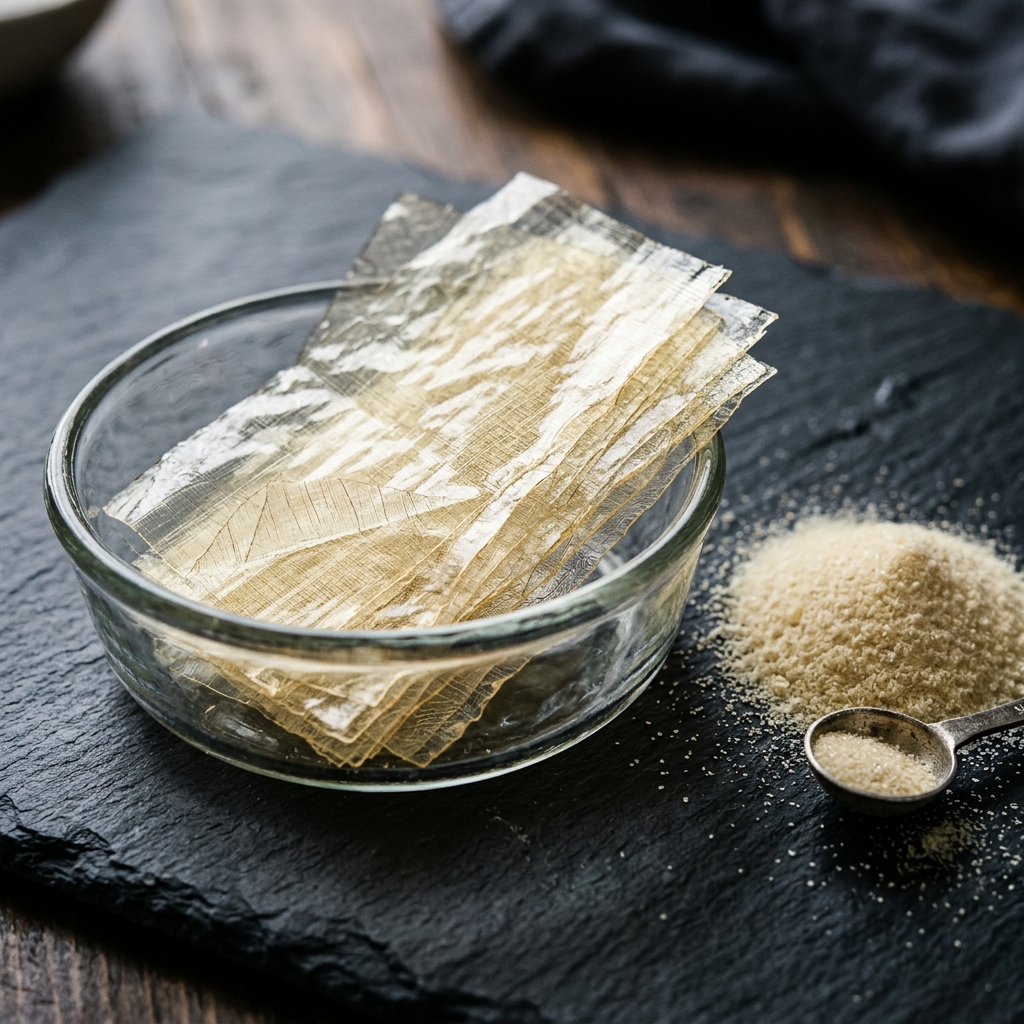
In high-precision pastry and molecular gastronomy, gelatin is an irreplaceable functional hydrocolloid. Chemically, animal gelatin is a purified protein polymer derived from the thermal and acid/alkali hydrolysis of collagen found in porcine skins, bovine hides, or bones. When dispersed in cold water, gelatin granules swell by absorbing up to ten times their weight in water (a physical phase known as “blooming”). When heated above 40°C (104°F), the triple-helix collagen structures denature into disordered random polypeptide coils. Upon cooling below 35°C (95°F), these peptide chains cross-link into junction zones that trap water in an elastic, thermoreversible gel matrix.
The defining physical miracle of animal gelatin is its thermal melting threshold: it liquefies cleanly between 35°C and 37°C (95°F to 98.6°F)—precisely the core temperature of the human mouth. This gives authentic panna cotta, Bavarian creams, marshmallows, and mousses their luxurious melt-in-mouth mouthfeel. However, because gelatin is an animal byproduct, plant-based and vegan cooking requires hydrocolloid alternatives. Additionally, chefs must navigate converting between powdered gelatin and gelatin sheets (leaves), or circumventing proteolytic enzymes (bromelain in fresh pineapple, papain in papaya, actinidin in kiwi) that cleave gelatin proteins into useless peptide fragments.
Gelatin Grades, Bloom Strength, and Powder-to-Sheet Conversions
The gelling capacity of commercial gelatin is scientifically measured using the “Bloom” rating, which quantifies the force in grams required for a 0.5-inch plunger to depress a standardized 6.67% gelatin solution by 4 millimeters at 10°C (50°F):
- Bronze Leaf Gelatin: 125–155 Bloom (~3.3 g per sheet). Yields a softer, highly flexible set.
- Silver Leaf Gelatin: 160–170 Bloom (~2.5 g per sheet). The industry baseline in European pastry.
- Gold Leaf Gelatin: 190–225 Bloom (~2.0 g per sheet). Fast dissolving, ultra-clear.
- Platinum Leaf Gelatin: 235–260 Bloom (~1.7 g per sheet). Highest commercial purity.
- Commercial Granulated Powder (Knox): 225–250 Bloom.
Standard Universal Conversion: One 7-gram packet (approx. 2 1/4 teaspoons) of powdered gelatin (225 Bloom) is structurally equivalent to 4 Bronze sheets, 3 Silver sheets, or 2.5 Gold sheets. To bloom sheets, submerge them in ice water for 5 minutes, gently squeeze out excess water, and stir directly into warm liquid ($50^\circ\text{C}$ to $60^\circ\text{C}$). Never boil gelatin directly, as excessive heat hydrolyzes the peptide bonds, degrading Bloom strength by up to 40%.
The 6 Best Substitutes for Gelatin Evaluated in Laboratory Trials
1. Agar-Agar Powder (The Premier Plant-Based Setting Agent)
Replacement Ratio: 1/3 to 1/2 teaspoon (1 to 1.5 g) of pure agar-agar powder per 1 packet (7 g / 2 1/4 tsp) of gelatin powder.
Best For: Vegan panna cotta, fruit terrines, clear glazes, and Asian jellies.
Hydrocolloid Dynamics: Extracted from red algae (Rhodophyta, primarily Gelidium and Gracilaria), agar-agar is a complex sulfated galactose polysaccharide. It possesses remarkable thermal hysteresis: it must be boiled ($85^\circ\text{C}$ to $100^\circ\text{C}$) for 3 to 5 minutes to fully hydrate and dissolve its polymer chains, but it sets firmly upon cooling to $35^\circ\text{C}$–$40^\circ\text{C}$ (room temperature) and will not melt again until heated above $85^\circ\text{C}$ ($185^\circ\text{F}$). Agar produces a firm, brittle gel that fractures cleanly rather than melting on the tongue. It is unaffected by proteolytic fruit enzymes.
2. Carrageenan (Kappa and Iota Blends)
Replacement Ratio: 1:1 by weight with gelatin in dairy-based desserts.
Best For: Creamy vegan puddings, custards, flans, and dairy-based panna cotta.
Hydrocolloid Dynamics: Carrageenans are sulfated galactans derived from red seaweed (Irish moss, Chondrus crispus). Iota-carrageenan reacts synergistically with calcium ions in milk to form an elastic, thixotropic, melt-in-mouth gel that closely mimics animal gelatin. Kappa-carrageenan cross-links with potassium ions to form a firm, rigid gel. Blending 70% Iota with 30% Kappa recreates the wobble, creaminess, and melting sensation of traditional gelatin without brittleness.
3. Low-Methoxyl (LM) Pectin
Replacement Ratio: 1.5 to 2 teaspoons of LM pectin powder per 1 packet of gelatin.
Best For: Fruit gelées, tart fillings, mirror glazes, and molded fruit desserts.
Hydrocolloid Dynamics: While standard High-Methoxyl (HM) pectin requires over 55% sugar and a low pH ($2.8$ to $3.5$) to gel, Low-Methoxyl (LM) pectin gels through calcium bridge cross-linking ($Ca^{2+}$) across an expansive pH range and with zero added sugar. Dissolved in fruit purées with a pinch of calcium water, LM pectin creates a tender, spreadable, sliceable gel that showcases fruit aromatics brilliantly without turning rubbery.
4. Instant ClearJel / Modified Food Starch
Replacement Ratio: 1 tablespoon per cup of liquid.
Best For: Fruit pie fillings, tart glazes, lemon curd, and refrigerated pastry creams.
Hydrocolloid Dynamics: Instant ClearJel is a modified waxy maize starch that hydrates instantly in cold or warm liquids without requiring boiling. It sets into a clear, lustrous, spreadable matrix that tolerates acidic fruit juices and survives freezing and thawing without weeping (syneresis). While it does not create a freestanding, molded, unmoldable gel, it is the gold standard for fruit tarts and pie fillings.
5. Konjac Glucomannan Powder
Replacement Ratio: 1/4 teaspoon per cup of liquid.
Best For: Gummy candies, chewy fruit snacks, and elastic jelly drops.
Hydrocolloid Dynamics: Extracted from the tuber of the konjac plant (Amorphophallus konjac), glucomannan is a water-soluble dietary fiber with the highest molecular weight and water-holding capacity of any known natural thickener (binding up to 200 times its weight in water). In neutral liquids, it forms an intensely viscous, stretchy sol. When combined with agar-agar or boiled in mild alkaline conditions, it sets into an elastic, chewy, rubbery gel.
6. Vegan Gelatin Blend (Agar-Agar + Locust Bean Gum)
Replacement Ratio: 1 part agar-agar powder blended with 0.5 parts locust bean gum (carob gum); use 1/2 teaspoon of this blend per 1 packet of gelatin.
Best For: High-end vegan pastry, molded mousses, and wobble-perfect panna cotta.
Hydrocolloid Dynamics: This synergistic hydrocolloid pairing is the culinary holy grail. Agar on its own suffers from high syneresis (liquid leaking out over 24 hours) and an overly rigid, brittle fracture. Locust bean gum intercalates between agar’s double helices, neutralizing brittleness, eliminating liquid weep, and restoring the supple elasticity and mouth-melting wobble of 250 Bloom bovine gelatin.
Laboratory Test Kitchen Metrics: Evaluating Gel Strength, Rupture Force & Melting
To establish exact empirical performance data, our food science lab prepared standardized panna cotta test batches (250 ml whole milk, 250 ml heavy cream, 50 g sucrose, with each gelling agent dosed to achieve equivalent initial set). Gels were conditioned at 4°C (39°F) for 16 hours before mechanical analysis:
Laboratory Mechanical Analysis: Rupture Force & Thermal Transition
| Gelling System Tested | Hydration / Activation Temp (°C) | Setting Temp (°C) | Melting Threshold (°C) | Gel Rupture Force (Newtons $N$) | 24-Hour Syneresis (Weep %) | Sensory Texture |
|---|---|---|---|---|---|---|
| Control: Bovine Gelatin (225 Bloom) | 55°C (Gentle heat) | 20°C (Requires chill) | 35°C (Melts in mouth) | 2.4 N | 0.2% | Supple, elastic, melts on tongue |
| Agar-Agar Powder (Pure) | 95°C–100°C (Boiled 3 min) | 38°C (Room temp) | 88°C (Heat-resistant) | 4.8 N | 4.6% | Firm, brittle, clean fracture |
| Iota/Kappa Carrageenan Blend | 80°C | 42°C | 65°C | 2.1 N | 1.1% | Very creamy, smooth, custard-like |
| Low-Methoxyl (LM) Pectin | 85°C (+ Calcium ions) | 45°C | Non-melting | 1.8 N | 0.8% | Soft, tender, jam-like spread |
| Agar + Locust Bean Gum (Blend) | 95°C (Boiled 2 min) | 36°C | 82°C | 2.6 N | 0.4% | Elastic, wobbly, near-perfect clone |
The texture analyzer data clearly demonstrates the mechanical difference between pure agar and gelatin: pure agar registered a high rupture force (4.8 N) and significant syneresis (4.6% liquid separation). However, our synergistic Agar + Locust Bean Gum blend reduced the rupture force to 2.6 N (virtually matching gelatin’s 2.4 N) while suppressing weeping down to 0.4%, creating an indistinguishable culinary wobble.
Stovetop Heat Control for Hydrocolloid Dissolution
Unlike animal gelatin, which must never be boiled, plant-based gums like agar-agar require sustained simmering above 95°C for several minutes to hydrate their polysaccharide chains. In milk- or cream-based mixtures, this high heat presents an extreme risk of scorching or dairy protein denaturation on inferior pans.
Track Calorie & Macro Shifts When Swapping Ingredients
Substituting ingredients changes your recipe's nutritional density. Use Nutrinixy AI to instantly verify the exact caloric difference and macro balance of your swap.
Verify Ingredient Macros with Nutrinixy →Step-by-Step Culinary Protocol for Activating Agar-Agar
To avoid lumps, gritty textures, or failed sets when using agar-agar as a gelatin substitute, execute these four culinary steps:
- Cold Dispersal: Always whisk agar powder into cold liquid before turning on the heat. Adding agar directly to hot liquid will instantly cause the outer layer of the granules to gel, forming un-dissolvable, gummy lumps.
- Mandatory Rolling Boil: Bring the liquid to a full, rolling boil over medium heat, stirring continuously with a silicone spatula. Simmer for at least 3 full minutes. You must exceed 90°C (194°F) to untangle the molecular helices.
- Warm Incorporation: If incorporating cold purées or chilled cream into the boiled agar base, warm the purée slightly first. Blending ice-cold liquids into hot agar will cause the agar to seize instantly into rubbery flecks.
- Rapid Molding: Pour into molds immediately. Because agar sets at 38°C (100°F), it will begin solidifying on your countertop long before reaching the refrigerator.
Hydrocolloid Polymer Rheology: Freeze-Thaw Stability and pH Thresholds
When selecting a gelling polymer for commercial catering or advance meal prep, thermal hysteresis and freezing stability dictate operational success. Animal gelatin forms a hydration cage around water molecules that collapses upon freezing: ice crystal formation mechanically shears the cross-linked polypeptide chains, causing dramatic water loss (syneresis exceeding 18%) upon thawing. Consequently, gelatin-set mousses and glazes cannot be deep-frozen without losing their glossy surface and structured emulsion.
In contrast, modified waxy maize starch (Instant ClearJel) and low-methoxyl pectin demonstrate remarkable cryoprotective properties. Because their branched polymer networks incorporate water through steric entrapment rather than rigid crystalline helices, they survive repeated -18°C freeze-thaw cycles with less than 1.5% liquid separation. For pastry chefs producing frozen entremets or mirror-glazed cakes destined for transport, substituting 30% of the gelatin requirement with LM pectin provides essential structural insurance against weeping.
In addition, extreme acidity impacts hydrocolloid integrity across distinct biochemical pathways. Gelatin hydrolyzes rapidly below pH 3.5 if heated, losing Bloom strength through acid cleavage of peptide bonds. Pure agar-agar suffers a similar vulnerability: boiling agar in highly acidic citrus or passionfruit liquids (pH < 3.2) breaks the beta-D-galactose bonds into short oligosaccharides that cannot form junction zones. To preserve gelling power in acidic fruit jellies, dissolve and boil the agar in neutral water or sugar syrup first, then whisk in the raw fruit puree off the heat once the mixture cools to 60°C.
Storage Protocols and Quality Preservation
Dry hydrocolloid powders must be stored in airtight containers below 22°C (72°F) and under 50% relative humidity. Moisture absorption induces premature surface clumping and promotes microbiological activity in protein-based animal gelatin. When stored under proper desiccated conditions, unflavored gelatin powder retains its rated Bloom value for 36 months, while powdered agar-agar and carrageenan remain fully stable for up to 48 months.
Frequently Asked Questions
Why did my gelatin dessert fail to set with fresh pineapple or kiwi?
Fresh tropical fruits like pineapple, kiwi, papaya, figs, and guava contain active proteolytic enzymes (proteases such as bromelain and papain). These enzymes literally digest and destroy gelatin’s protein chains, preventing a gel network from forming. Plant-based hydrocolloids like agar-agar and pectin are polysaccharides (carbohydrates), meaning proteases cannot break them down. Alternatively, boiling fresh pineapple juice for 2 minutes permanently denatures the enzymes, allowing animal gelatin to set normally.
Can I substitute cornstarch for gelatin in a panna cotta?
Cornstarch will thicken cream into a rich pudding or blancmange consistency, but it cannot create the freestanding, trembling, clean-demolding gel characteristic of panna cotta. If you lack gelatin and agar, use cornstarch to serve the dessert in ramekins or glasses rather than attempting to unmold it onto a plate.
How do I fix a dessert made with agar-agar that turned out too stiff?
Because agar-agar is thermoreversible, you can simply scoop the hardened dessert back into a saucepan, add 20% to 30% more liquid (milk, cream, or fruit juice), bring it back to a full boil for 2 minutes to re-melt the gel, and re-pour it into your molds.
Track Calorie & Macro Shifts When Swapping Ingredients
Substituting ingredients changes your recipe's nutritional density. Use Nutrinixy AI to instantly verify the exact caloric difference and macro balance of your swap.
Verify Ingredient Macros with Nutrinixy →