
Rotisserie Chicken Thanksgiving Shortcut: Portions, Carving Yield & Food Safety
Use 3 lb Costco-style rotisserie chickens (~2 lb edible meat each) as a Thanksgiving shortcut with safe USDA 2-hour cooling, 165 F crisping, and pan gravy tips.

This article includes partner cookware and kitchen scale links marked with rel="sponsored nofollow". Purchases may earn FoxyChef a commission at no extra cost to you. Partners have zero say in our portions, recipes, or safety guidance.
Quick answer: Using store-bought rotisserie chickens is a practical Thanksgiving shortcut for small tables, solo hosts, or turkey-pot-pie hosts: a standard ~3-pound bird (such as Costco’s $4.99 Kirkland Signature rotisserie chicken) yields roughly 2 pounds of actual carved edible meat plus 1 pound of bones and skin for pan gravy stock. Plan one 3-pound bird for 3 to 4 modest holiday plates (or two birds for 6 to 8 guests), follow the 2-hour USDA take-out rule when bringing hot birds home, and reheat chilled meat to 165°F (74°C) in a 325°F+ oven or 350°F air fryer so skin crisps instead of turning rubbery.
Not every holiday gathering calls for wrestling a 16-pound frozen turkey out of the deep freeze four days ahead. Whether your oven is broken, you are hosting two to six people, or you simply want Thanksgiving flavor for dressing, pan gravy, and next-day turkey-style pot pie in 45 minutes total, supermarket rotisserie birds bridge the gap cleanly. The catch is portion arithmetic and food safety: rotisserie weights shrink quickly once skin and carcass come off, and pre-cooked take-out poultry sits closer to the Danger Zone than raw meat.
Whole Turkey vs. Rotisserie Chicken: Portion & Meat Yield Math
People frequently misjudge how many guests one supermarket rotisserie bird actually feeds because grocery labels show gross bone-in weight. USDA FSIS advises planning 1 pound of uncooked whole turkey per person (roughly yielding half that in cooked boneless meat plus bones and shrinkage). By comparison, standard warehouse rotisserie birds—most famously Costco’s flat-$4.99 Kirkland Signature bird guaranteed at a minimum 3 pounds cooked weight (lighter birds under 3 lb are typically priced down around ~$1.66/lb)—strip down at roughly a 2:1 ratio: about 2 pounds of carved edible breast, thigh, wing, and drumstick meat and about 1 pound of carcass, cartilage, and trim.
| Household / Table Size | Rotisserie Birds Needed (~3 lb gross each) | Estimated Edible Meat Yield | Alternate Whole Turkey Baseline (USDA 1 lb/person) |
|---|---|---|---|
| 1 to 2 people (dinner + leftovers) | 1 bird (~$4.99 Costco benchmark) | ~2 lb carved meat (enough for plates + sandwiches) | N/A (4–8 lb turkey breast instead) |
| 3 to 4 guests (single meal) | 1 large bird (or 2 if wanting leftover pot pie) | ~2 lb meat (~0.5 to 0.65 lb cooked meat per guest) | 4 to 6 lb bone-in breast (whole turkeys start ~8 lb) |
| 6 to 8 guests | 2 birds (~$9.98 total) | ~4 lb carved meat + 2 carcasses for stock | 8 lb whole turkey (with fewer leftovers) |
| 10+ guests | 3+ birds (or buy a whole turkey) | ~6+ lb meat; slow to reheat evenly at scale | 10 to 14 lb whole turkey (see 10-guest plan) |
Nutritional comparison note: For meal planners tracking macros, cooked whole turkey meat and skin averages 189 kcal, 28.55 g protein, and 7.39 g fat per 100 g (USDA FoodData Central #171479). Rotisserie chicken carries a comparable high-protein profile while delivering more dark-meat thigh/leg ratio per pound if guests prefer dark meat over lean turkey breast.
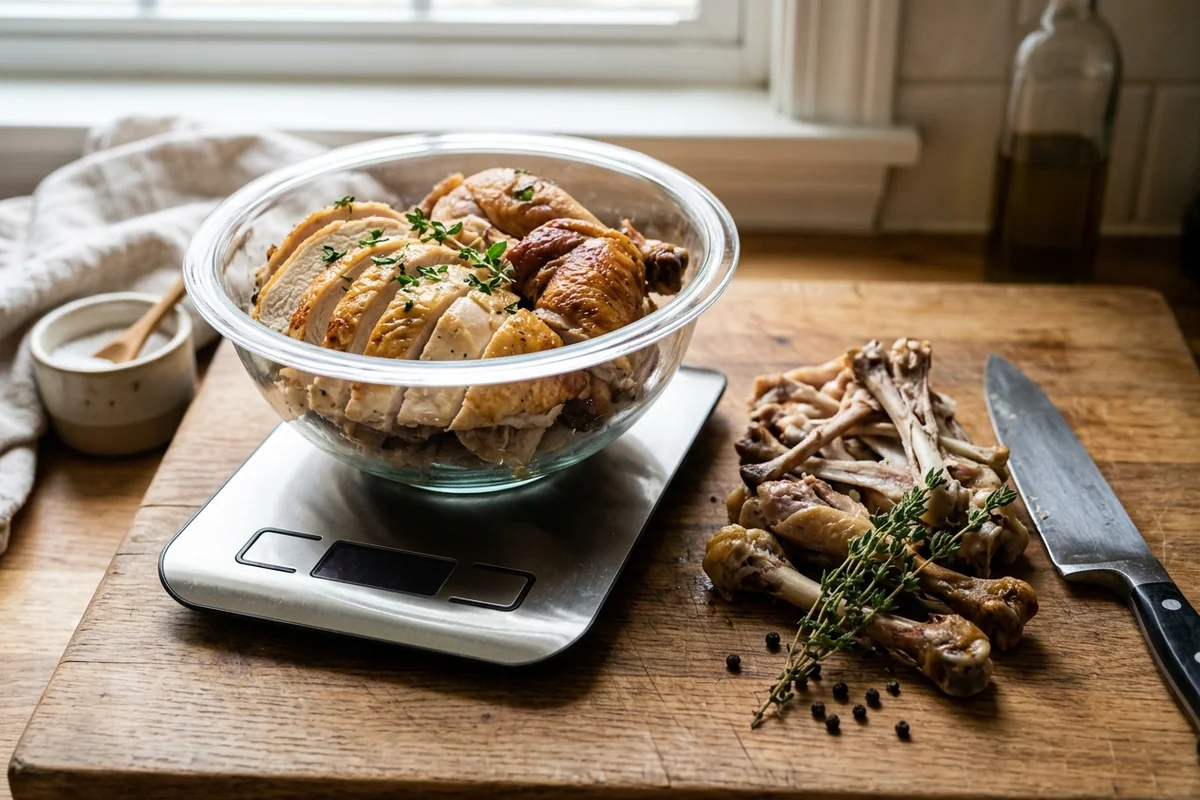
Weigh Stripped Poultry Meat for Exact Pot Pie & Soup Ratios
Knowing whether you stripped 28 ounces or 36 ounces of edible meat keeps rotisserie casseroles, broth ratios, and calorie tracking exact without guessing.
See Digital Kitchen ScalesStep-by-Step: Turning Rotisserie Birds Into Real Thanksgiving Dinner
Fresh supermarket rotisserie chicken tastes best—and looks genuinely festive—when you turn its own trimmings into deep pan gravy while briefly re-crisping the carved quarters with Thanksgiving herbs.
- Carve smart while warm (or right after chilling): Separate legs/thighs at the hip joints, remove the wings, and slice each whole breast lobe clean off the keel bone rather than shredding everything into tiny strands. Keeping whole muscle breast slices and intact leg quarters gives you classic carved Thanksgiving presentation on the platter.
- Build 15-minute stock from the warm carcass: Immediately drop the stripped bones, wing tips, and gelled juices from the container into a wide saucepan with 4 cups of water or low-sodium chicken/turkey stock, smashed garlic, onion quarters, celery trim, and thyme or sage sprigs. Simmer 20 to 30 minutes, strain into a clean pitcher, whisk into a butter-and-flour roux (3 tablespoons butter + 3 tablespoons flour for 2 to 2.5 cups gravy), and bring to a rolling boil for 1 to 2 minutes to cook out raw flour taste.
- Re-crisp the skin cleanly (don’t use the microwave): Brush carved breast halves and leg quarters lightly with melted herb butter (rosemary, thyme, sage, garlic powder). Reheat uncovered at 350°F (175°C) in a 1-layer air fryer basket (roughly 5 to 10 minutes depending on piece thickness) or on a foil-lined oven sheet at 350°F to 375°F until skin blisters and an instant-read thermometer confirms 165°F (74°C) inside the thickest meat without touching bone.
- Use leftover carcass meat for Friday shortcut recipes: Reserve small trimmings pulled off the back and ribs for stuffing-topped rotisserie pot pie, creamy wild rice soup, or warmed cranberry-herb paninis.
USDA Take-Out Chicken Safety Rules You Must Follow
Grocery rotisserie birds fall under USDA FSIS rules for pre-cooked take-out foods—sloppy pickup timing on Wednesday afternoon or keeping birds lukewarm in a car trunk creates real foodborne illness risk.
- Verify hot holding at pickup: Pick birds directly from a hot-holding cabinet that feels hot (≥140°F / 60°C) rather than lukewarm under weak heat lamps. Grab cold sides first and pick up the hot rotisserie chicken at the end of your grocery run so it rides home last.
- Respect the 2-hour clock (1 hour above 90°F): Eat or carve-and-refrigerate hot take-out poultry within 2 hours of picking it up off the warmer (1 hour if outside car/kitchen temperatures exceed 90°F / 32°C).
- Cool in shallow containers for Wednesday prep: Buying chickens on Wednesday to avoid Thanksgiving Day crowds works well as long as you carve the meat off the bone right away and store it in shallow covered containers at 40°F (4°C) or below. Dividing a hot whole bird into shallow packs lets it chill rapidly instead of keeping heat trapped inside the cavity.
- 3 to 4 day fridge limit & 165°F reheat floor: Refrigerated cooked rotisserie chicken stays safe for 3 to 4 days (or freeze plain cooked poultry 2 to 6 months for future meals). On Thursday, reheat chilled chicken thoroughly to 165°F (74°C) in a 325°F+ oven or air fryer—USDA warns never to reheat take-out chicken in slow cookers, chafing dishes, or steam warmers because they stall too long in the 40°F–140°F bacterial growth band.
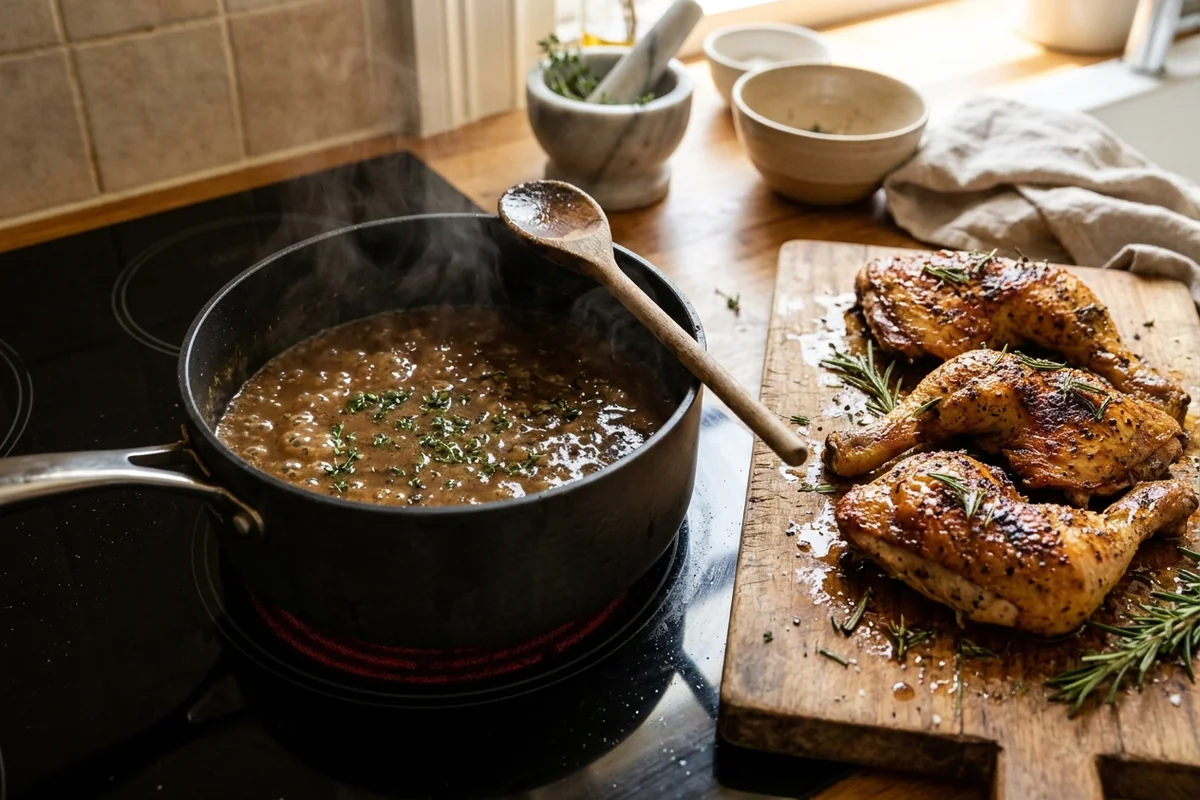
Simmer Carcass Stock & Reheat Chicken Skin Crisp in Dual-Use Cookware
Make rich roasted-bone gravy on the stovetop and crisp carved quarters cleanly in oven-safe heavy-gauge pots and wide sauté pans that go from burner to 400°F oven.
Browse Oven-Safe CookwareFrequently Asked Questions
Is buying a Costco rotisserie chicken the day before Thanksgiving safe?
Yes, provided you get it home into the refrigerator within 2 hours of buying it from the hot case (1 hour in warm weather >90°F), carve the meat off the bones into shallow containers to cool quickly below 40°F (4°C), use it within 3 to 4 days, and reheat it to 165°F (74°C) before serving.
How much edible meat do you actually get from a 3-pound rotisserie chicken?
Expect roughly 2 pounds of carved boneless white and dark meat alongside roughly 1 pound of bones, cartilage, and excess skin—meaning one 3-pound bird typically feeds 3 to 4 people a main holiday meal, or 2 people generously with leftovers.
What if my store only has lemon-pepper or plain rotisserie birds instead of herb-roasted?
Brush carved pieces with melted unsalted butter mixed with minced sage, thyme, rosemary, and black pepper right before crisping in the oven or air fryer, and skip adding extra salt to the meat until you taste your gravy—most commercial rotisserie chickens already contain significant brine sodium.
Food-safety reminder: Store take-out rotisserie poultry at 40°F (4°C) or below within 2 hours of purchase and verify cooked/reheated pieces reach 165°F (74°C) with a food thermometer.
Sources
- USDA FSIS, Safe Handling of Take-Out Foods (Hot-Held Rotisserie Chickens, 2-Hour Rule & 165°F Reheat) — fsis.usda.gov/food-safety/safe-food-handling-and-preparation/food-safety-basics/safe-handling-take-out-foods (checked November 18, 2026)
- USDA FSIS, Leftovers and Food Safety (3–4 Day Fridge Window & Rolling-Boil Gravy) — fsis.usda.gov/food-safety/safe-food-handling-and-preparation/food-safety-basics/leftovers-and-food-safety (checked November 18, 2026)
- USDA FSIS, Let’s Talk Turkey (1 lb per Person Whole-Bird Sizing Baseline) — fsis.usda.gov/food-safety/safe-food-handling-and-preparation/poultry/lets-talk-turkey-roasting (checked November 18, 2026)
- FoodSafety.gov, Safe Minimum Internal Temperatures & Cold Storage Charts — foodsafety.gov/food-safety-charts/safe-minimum-internal-temperatures (checked November 18, 2026)
- USDA FoodData Central, Turkey, whole, meat and skin, cooked, roasted (FDC ID 171479) — fdc.nal.usda.gov/fdc-app.html#/food-details/171479/nutrients (checked November 18, 2026)