
Crispy Grilled Chicken Wings with Carolina Gold BBQ Glaze
Learn the baking powder dry-brine secret for ultra-crispy grilled chicken wings smoked over applewood and coated in tangy, sweet South Carolina Gold mustard barbecue glaze.
Instructions
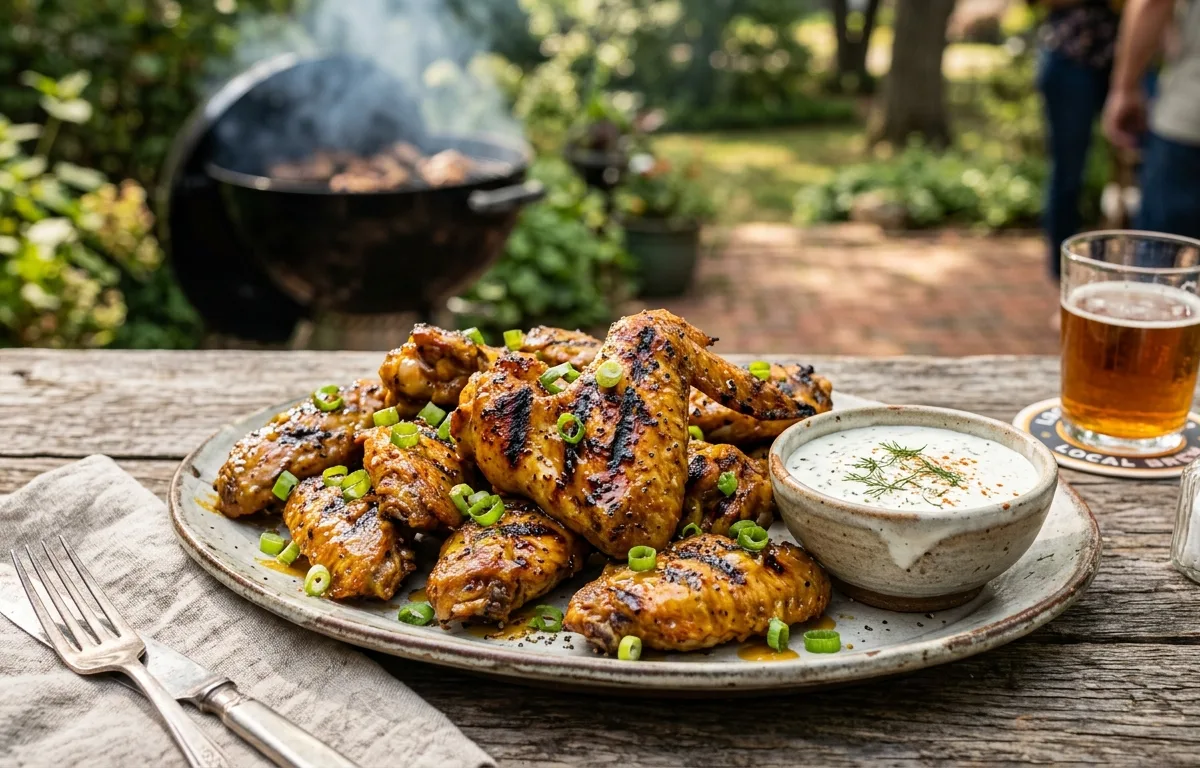
Achieving truly crispy chicken wings on an outdoor grill without deep frying is considered one of the holy grails of backyard barbecue. Standard grilling often leaves wing skin rubbery and tough because fat fails to render efficiently under gentle indirect heat, while direct high flame burns sugary glazes before the meat cooks through. By combining an alkaline dry-brine technique with two-zone convective charcoal heat, these wings develop a blistered, crunchy exterior coated in an authentic South Carolina mustard-based barbecue glaze.
The Culinary Science of Ultra-Crisp Grilled Skin
Poultry skin consists of water, collagen, and subcutaneous fat. To achieve a shattering crisp bite on the grill, you must accomplish two biochemical reactions:
- Accelerated Dehydration & Protein Crosslinking: Dusting raw wings with a small amount of aluminum-free baking powder (sodium bicarbonate) combined with kosher salt elevates the surface pH. An alkaline environment weakens peptide bonds and breaks down surface proteins, allowing moisture to evaporate rapidly during refrigeration and accelerating the Maillard browning reaction at lower cooking temperatures.
- Subcutaneous Fat Rendering: Placing wings in a high-temperature indirect convective vortex (approx. 400°F–425°F / 204°C–218°C) melts the fat deposits beneath the skin without scorching the exterior, effectively oven-frying the wings in their own rendered drippings.
The Anatomy of Authentic Carolina Gold BBQ Sauce
Unlike Kansas City tomato-molasses sauces or vinegar-heavy Eastern Carolina mops, Carolina Gold is built upon a pungent yellow mustard base, dating back to 18th-century German settlers in South Carolina. The mustard provides bright acidity and natural emulsifiers from ground mustard seed. We balance the sharpness with dark brown sugar, raw honey, apple cider vinegar, Worcestershire sauce, cayenne pepper, and a touch of cold butter stirred in off the heat to create a silky, clinging glaze.
Backyard pitmasters looking to experiment with heritage sauces and region-specific spice blends can explore the small-batch provisions delivered through Grill Masters Club. From artisanal South Carolina gold mustards to handcrafted Nashville hot glazes, their monthly boxes feature award-winning pitmaster formulas that make custom wing nights unforgettable.
Charcoal Setup: The Circular Convective Vortex
To cook wings evenly without needing constant flipping, arrange your charcoal kettle using the Vortex or ring-of-fire method. Place a concentrated cone of glowing white-hot lump charcoal in the exact center of the grill (or bank coals tightly in the middle). Position the chicken wings around the perimeter grates in a circular formation over indirect heat. Add a single split of sweet cherry or applewood directly over the center coals. The radiant heat bounces off the domed kettle lid, circulating hot air around every wing like a commercial convection oven.
Step-by-Step Grilling Instructions
- The Overnight Drying Step: Pat 3 pounds of split chicken wings (flats and drumettes) thoroughly dry with paper towels. In a small bowl, whisk together 1 tablespoon of aluminum-free baking powder, 1.5 teaspoons of coarse kosher salt, 1 teaspoon of garlic powder, and 1/2 teaspoon of smoked paprika. Toss the wings until lightly and evenly coated. Place on a wire cooling rack set inside a sheet pan and chill uncovered in the refrigerator for 8 to 24 hours. The skin should look translucent and feel taut.
- Firing the Convective Heat: Light a full chimney of lump charcoal. Once fully ashed over, dump into the center charcoal basket or form a central pile. Stabilize the grill with top and bottom vents wide open, targeting a dome temperature of 425°F (218°C). Drop one chunk of applewood onto the coals.
- Convective Indirect Roasting: Arrange the wings in a circle around the perimeter grates, ensuring none are directly over the coals. Close the lid with the exhaust vent positioned directly over one side of the wings to draw heat and smoke across them. Roast undisturbed for 25 minutes.
- Rotating & Crisp Confirmation: Spin the grill lid 180 degrees to equalize convective flow. Cook for another 15 to 20 minutes until the skin is golden, blistered, and audibly crackles when tapped with tongs. The internal temperature of the meat should register between 190°F–200°F (88°C–93°C). Unlike chicken breast, dark wing meat and collagen-rich joints become exceptionally juicy and tender when cooked well past the standard 165°F mark.
- Saucing & Caramelizing: Transfer the crispy wings to a large stainless steel bowl. Pour half of the warm Carolina Gold sauce over the wings and toss vigorously to coat. Return the sauced wings to the grill for 3 to 5 minutes to allow the sugars in the glaze to bubble and set into a sticky, lacquered crust.
- Serving: Transfer to a platter, drizzle with remaining fresh sauce, and scatter thinly sliced scallions and pickled jalapeños over the top.
Drawbacks, Limitations & Risks (Cons)
- Dedicated hand-washing requirement: To preserve non-stick surface integrity and handle seals, machine dishwasher cycles must be avoided in favor of gentle sponge cleaning.
- Higher upfront equipment investment: Professional multi-clad cookware commands a higher price point than entry-level single-layer aluminum alternatives.
- Substantial piece weight: Tri-ply construction and solid riveted handles bring the average skillet weight to 3.8 to 4.8 lbs, requiring two hands when transferring while full.
Nutritional Information & Beverage Pairings
A generous 6-wing portion delivers 36 grams of satisfying protein and 28 grams of dietary fat, making it an outstanding low-carb meal when served with fresh celery sticks and homemade blue cheese dip. Complement the tangy, smoky profile with a crisp German Pilsner, a dry hard cider, or a bourbon-based highball.