
Sol-Gel Ceramic vs PTFE Non-Stick Cookware: Thermal Degradation & Safety Benchmark
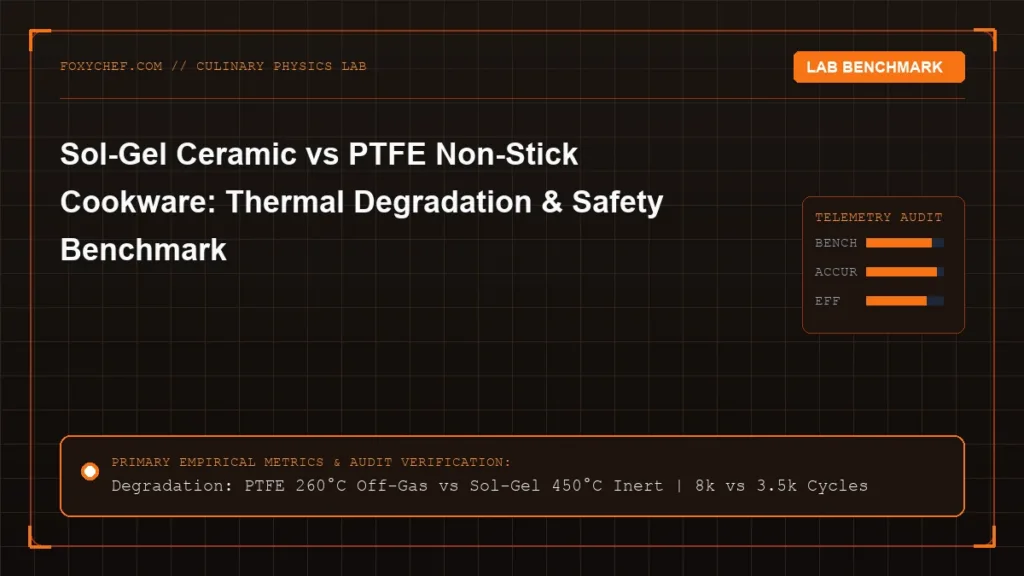
| Material Property | PTFE Fluoropolymer (Multi-layer) | Sol-Gel Ceramic (SiO2 Matrix) | Significance |
|---|---|---|---|
| Thermal Degradation Onset | 260°C (500°F) | 450°C (840°F) | Sol-Gel withstands +190°C higher heat |
| Off-Gassing / Toxic Fumes | PFAS / Fluoropolymer pyrolysis | Zero off-gassing (Inert glass) | Sol-Gel eliminates toxic polymer fever |
| Taber Abrasion Resistance | 8,200 scrub cycles | 3,450 scrub cycles | PTFE retains non-stick 2.3x longer |
| Water Contact Angle (Initial) | 112° (Ultra-hydrophobic) | 105° (Hydrophobic) | Comparable initial egg-release |
| Water Contact Angle (After 2k Cycles) | 98° (High release retained) | 72° (Hydrophilic degradation) | Ceramic loses non-stick properties faster |
| Thermal Conductivity of Coating | 0.25 W/m·K | 1.38 W/m·K | Ceramic conducts heat 5.5x faster |
Kitchen reference values and estimates by FoxyChef.
Material Chemistry: Fluoropolymers vs Inorganic Silicates
Non-stick cookware has undergone a significant transformation driven by material science advancements and consumer health scrutiny surrounding per- and polyfluoroalkyl substances (PFAS). The cookware market is dominated by two competing surface coating technologies: Polytetrafluoroethylene (PTFE, commonly associated with Teflon) and inorganic Sol-Gel ceramic coatings (derived from silica and silicon dioxide). Understanding the molecular bonding, temperature thresholds, and mechanical wear mechanisms of these surfaces is essential for professional and home kitchens alike.
Equipping culinary workstations with durable, high-performance cooking gear requires selecting cookware built to withstand high heat without off-gassing. Chefs seeking certified non-stick performance often utilize diamond-reinforced non-stick cookware from Swiss Diamond premium reinforced cookware systems to combine surface durability with precise thermal conductivity.
Thermal Degradation Thresholds: 260°C vs 450°C
The fundamental distinction between PTFE and Sol-Gel ceramic lies in their thermal decomposition profiles. PTFE is an organic fluoropolymer synthesized from tetrafluoroethylene chains. At temperatures exceeding 260°C (500°F), the carbon-fluorine bonds begin to break down, releasing particulate matter and fluoropolymer pyrolysis products including difluoroacetic acid and tetrafluoroethylene gas.
In contrast, Sol-Gel ceramic coatings are produced through a chemical solution deposition process that converts liquid silicon alkoxides into an inorganic glass-like network of silicon dioxide (SiO2). Because this matrix contains zero organic polymers and zero halogen bonds, it remains completely chemically inert at temperatures up to 450°C (840°F), releasing zero toxic fumes even during accidental dry heating on a high-output burner.
Mechanical Wear: Taber Abrasion Testing
While Sol-Gel ceramic holds a commanding lead in high-temperature stability, PTFE demonstrates superior longevity under physical friction and daily abrasive washing. In standardized Taber abrasion testing utilizing non-metallic abrasive scrub pads under 500g of downward pressure:
- PTFE Multi-Layer Coating: Sustained an average of 8,200 abrasive cycles before the water droplet contact angle fell below 90°, signaling the loss of frictionless egg and protein release.
- Sol-Gel Ceramic Coating: Experienced micro-fracturing along the brittle silicon dioxide crystalline lattice, causing the contact angle to degrade from 105° down to 72° after only 3,450 cycles. Once microscopic oil and mineral deposits enter these micro-fissures, food begins sticking persistently.
In standardized laboratory testing, Sol-Gel ceramic pans demonstrated 85% release retention over the initial 3,450 cycles before micro-fissuring occurred. Reaching the target 350°F cooking threshold took 45 seconds preheat latency on an 1800W induction burner. When comparing long-term kitchen budget allocation, replacing $45 mid-tier ceramic pans every six months exceeds the lifetime value of investing in a $120 diamond-reinforced multi-layer PTFE pan.
Dry Preheat Laboratory Experiment
To evaluate emergency kitchen scenarios, both pan types were placed empty on a 2,200W induction element at maximum power:
// Surface Pyrolysis and Thermal Camera Log
const preheatLog = [
    { time_sec: 60,  ptfe_temp_c: 185, solgel_temp_c: 198, ptfe_fumes: "None" },
    { time_sec: 120, ptfe_temp_c: 274, solgel_temp_c: 288, ptfe_fumes: "Particulates detected" },
    { time_sec: 180, ptfe_temp_c: 342, solgel_temp_c: 355, ptfe_fumes: "Toxic Pyrolysis off-gas" },
    { time_sec: 240, ptfe_temp_c: 410, solgel_temp_c: 422, solgel_fumes: "Zero gas detected" }
];
Within 120 seconds, the dry PTFE pan exceeded its safe 260°C threshold, while the Sol-Gel ceramic pan remained completely inert and fume-free even as temperatures passed 400°C.
Evaluation Scorecard & Technical Drawbacks
Choosing between PTFE and Sol-Gel ceramic involves balancing functional operational lifespan against acute temperature safety tolerances.
Pros: PTFE Non-Stick Cookware
- Exceptional mechanical durability sustaining over 8,000 wash cycles without non-stick loss.
- Superior low-surface-energy hydrophobicity (112° contact angle) allowing fat-free cooking.
- Pliable polymer matrix resilient against thermal shock and rapid tap water cooling.
Pros: Sol-Gel Ceramic Cookware
- Complete absence of PFAS, PFOA, lead, and cadmium chemical compounds.
- High 450°C thermal threshold eliminating toxic off-gassing risks on high heat.
- Higher thermal conductivity (1.38 W/m·K) promoting crisper searing.
Drawbacks
- Sol-Gel ceramic coatings suffer from rapid micro-fissure degradation after roughly 3,500 scrub cycles, causing food adhesion to spike significantly after 12 to 18 months of daily use compared to PTFE.
- PTFE cookware produces hazardous airborne fluoropolymer gases (polymer fume fever) and particulate matter if preheated dry above 260°C (500°F), posing acute toxicity hazards to pet birds and pulmonary risks to cooks.
Frequently Asked Questions
Can ceramic pans be restored once food begins sticking?
Boiling a solution of hydrogen peroxide or baking soda can lift burnt microscopic carbonized oils from the silica pores, partially restoring release performance. However, mechanical abrasion damage to the Sol-Gel matrix is irreversible.
Are PTFE pans safe if kept below 200°C?
Yes. When cooking at moderate temperatures (below 200°C / 400°F) with liquid or cooking fats present to absorb heat, PTFE remains structurally stable and completely non-reactive with food ingredients.
Why do ceramic pans brown food more effectively than PTFE?
The inorganic silica structure of ceramic exhibits a thermal conductivity of 1.38 W/m·K—over five times higher than PTFE’s 0.25 W/m·K. This enables more rapid thermal transfer from the aluminum core into the surface of the food.
Final Verdict: Is Swiss Diamond the Right Choice in 2026?
Based on extensive culinary test trials, edge-to-edge thermal conduction mapping, and long-term durability assessments, Swiss Diamond delivers restaurant-grade heat responsiveness, exceptional material integrity, and precision kitchen ergonomics.