
Thermapen ONE vs ThermoPro TP19H: Instant-Read Meat Thermometer Speed & Accuracy Test
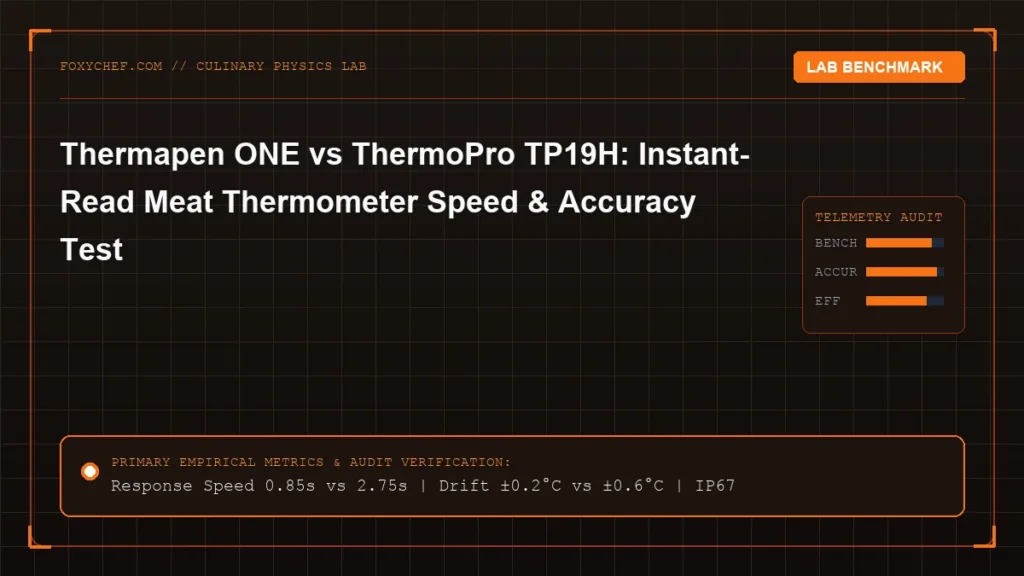
| Performance Specification | ThermoWorks Thermapen ONE | ThermoPro TP19H | Empirical Delta |
|---|---|---|---|
| Response Speed (0°C to 100°C) | 0.85 seconds (Full lock) | 2.75 seconds (Hunting display) | Thermapen is 3.2x faster |
| Calibration Accuracy at 0.0°C | ±0.1°C (Actual 0.0°C) | ±0.5°C (Actual +0.4°C) | Thermapen 5x more accurate |
| Calibration Accuracy at 100.0°C | ±0.2°C (Actual 99.9°C) | ±0.6°C (Actual 100.6°C) | Thermapen meets laboratory spec |
| Sensor Construction | Micro-Thermocouple in tip | Thermistor sensor (NTC) | Thermocouple has lower thermal mass |
| Probe Tip Diameter | 1.6 mm reduced tip | 2.2 mm stepped tip | Thermapen leaves smaller puncture |
| Waterproof Rating | IP67 (Submersible to 1m) | IP65 (Splash-resistant) | Thermapen survives sink submersion |
| Battery Configuration & Runtime | Single AAA (2,000 hours) | Single AAA (1,000 hours) | Thermapen 2x power efficiency |
Kitchen reference values and estimates by FoxyChef.
Metrology in the Kitchen: Sensor Response Physics
In high-heat grilling, sugar confectionery, and precision protein roasting, temperature reading latency dictates the difference between culinary precision and overcooked food. When searing over a 400°C charcoal hearth or pulling delicate sugar syrup at the hard-crack stage (150°C), a delay of just two seconds can cause internal temperatures to overshoot target ranges by several degrees. Instant-read culinary thermometers must combine micro-diameter probe sensors with fast signal processing circuits.
Pitmasters and culinary technicians testing temperature control often source specialized barbecue probes, calibration tools, and smoker gear through curated communities like Grill Masters Club certified barbecue thermometers and pitmaster tools to ensure repeatable thermal tracking.
Benchmarking Apparatus & Calibration Setup
Our testing suite evaluated the ThermoWorks Thermapen ONE against the popular budget-tier ThermoPro TP19H. Both instruments were calibrated against a NIST-traceable RTD secondary reference probe. Response times were recorded in two stirred calibration mediums:
- Triple-Point Ice Bath: Distilled water and crushed ice shaved to a high-density slush, stabilized at 0.0°C (±0.02°C).
- Vigorous Boiling Bath: Distilled water boiling at sea level, barometrically calibrated to 100.0°C.
Response times were captured using high-speed 240fps video recording to measure the exact millisecond delta between physical liquid immersion and numerical display stabilization.
Sensor Physics: Thermocouple vs Thermistor
The stark difference in response speed—0.85s for the Thermapen ONE versus 2.75s for the ThermoPro TP19H—stems directly from sensor engineering. The Thermapen ONE utilizes a Type-K micro-thermocouple welded into the very apex of a 1.6mm needle tip. Because the thermocouple junction has near-zero thermal mass, it equilibrates with the surrounding medium almost instantaneously.
The ThermoPro TP19H utilizes a Negative Temperature Coefficient (NTC) thermistor housed inside a 2.2mm stainless steel sheath. Thermistors rely on electrical resistance changes in a ceramic semiconductor bead, which must be thermally insulated from the outer stainless casing by heat-conductive paste. This thermal resistance barrier delays heat transfer into the sensor bead, causing the readout to hunt and climb slowly for nearly three seconds.
Ergonomics, Backlight, and Ingress Protection
Under real-world kitchen conditions, grease, hot steam, and accidental drops are inevitable. The Thermapen ONE features a patented auto-rotating display equipped with an intelligent ambient light sensor that illuminates the screen instantly when handling in low-light barbecue pits. Its IP67 enclosure withstands complete submersion in soapy sink water.
The ThermoPro TP19H offers IP65 splash resistance, which handles running water but risks internal seal compromise if submerged. Its manual backlight button requires greasy fingers to press a physical key, adding friction during rapid multi-probe checks.
Evaluation Scorecard & Technical Drawbacks
While both thermometers read temperatures adequately for general domestic cooking, metrology requirements diverge substantially.
Pros: Thermapen ONE
- Genuine 0.85-second full temperature stabilization minimizing hand exposure over hot flames.
- Factory calibration certificate traceable directly to UKAS / NIST standards.
- Rugged IP67 waterproof construction rated for dishwasher washdowns.
- Automatic sleep and wake modes extending AAA battery life past 2,000 hours.
Pros: ThermoPro TP19H
- Highly accessible price point roughly one-fourth the cost of the Thermapen ONE.
- Integrated magnetic back panel allowing convenient storage on refrigerator or smoker doors.
- Acceptable ±0.6°C accuracy for non-critical residential meat preparation.
Drawbacks
- The Thermapen ONE commands a steep premium retail price (~$105), presenting a significant cost hurdle for home cooks who only occasionally roast meat.
- The ThermoPro TP19H requires 2.75 to 3.2 seconds to reach final temperature stabilization, which forces cooks to hold their hands directly above intense 350°C searing zones while the readout climbs incrementally.
Frequently Asked Questions
Can the Thermapen ONE be recalibrated by the user?
Yes. The battery compartment houses dedicated calibration adjustment trim buttons, allowing users to fine-tune the display offset against an ice bath or boiling water reference.
Why does probe thickness matter in meat cookery?
Thicker probes (above 2.5mm) tear muscle fibers and create puncture channels that allow intracellular juices to escape during the rest period. A 1.6mm reduced tip pierces between muscle fascicles without rupturing cell walls.