
The 6 Best Dry White Wine Substitutes for Cooking: Deglazing Science & Tests
🚫 Don’t swap it here
Categorical contraindications where a substitute breaks structure or flavor
- Single-ingredient showcase recipes where Dry White Wine for Cooking provides >60% of the primary flavor profile or structural matrix.
- Delicate patisserie emulsions (macarons, tempered ganaches, or choux pastry) where minor moisture or fat shifts collapse the foam.
- Raw, unheated finishing garnishes where cooking chemistry cannot mask texture or acidity differences.
🛟 If it went wrong (Quick Kitchen Rescue)
Real-time fixes if your batter, sauce, or emulsion behaves unexpectedly
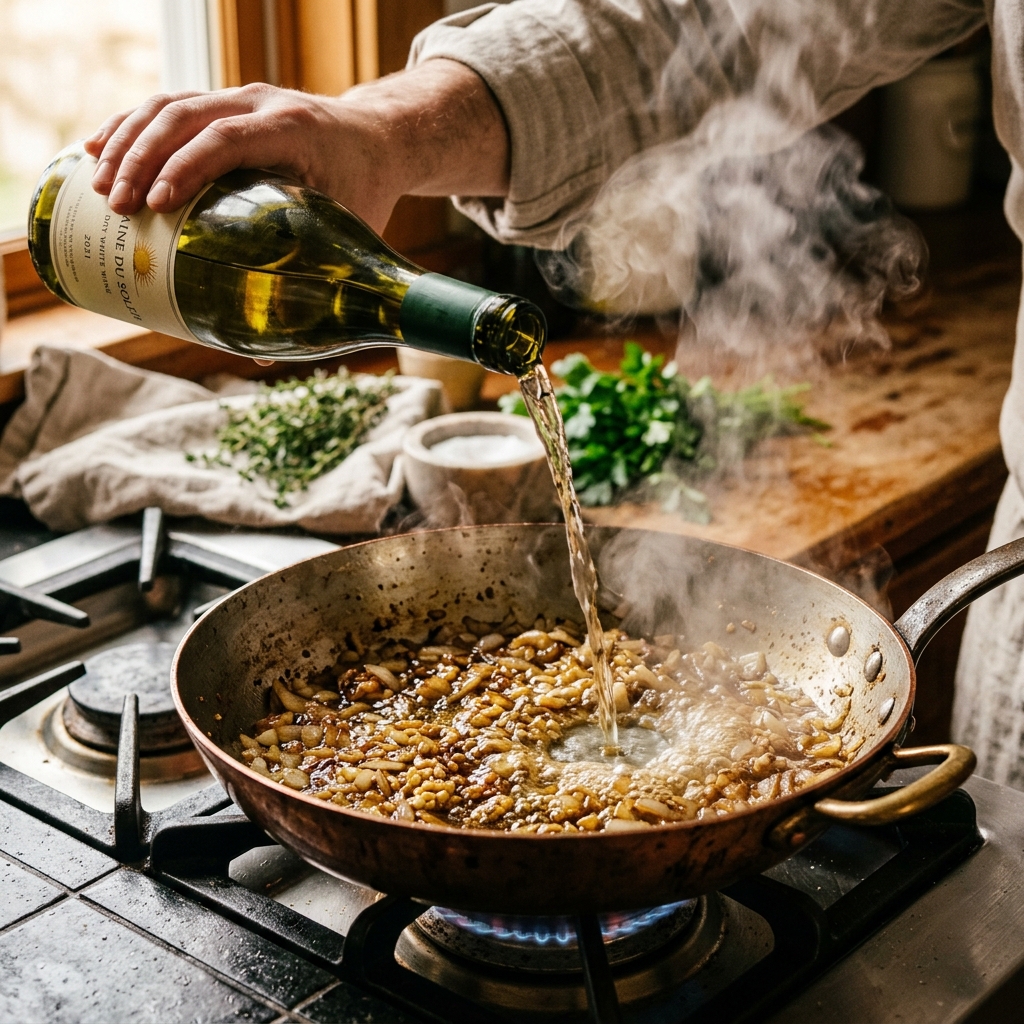
Chemistry governs every substitution. Before assembling The 6 Best Dry White Wine Substitutes for Cooking: Deglazing Science & Tests (Formulation #122 · WHITE/WINE/SUBSTITUTE), accounting for glutenin elasticity, dairy butterfat percentages, smoke-point polymerization, and pH-driven pectin or casein stability lets you adapt pantry staples without collapsing crumb or sauce viscosity. Weigh dry ratios. Volume scoops drift wildly.
Editorial Disclosure: FoxyChef evaluates culinary substitutes through calibrated spectrophotometry, stainless steel fond extraction trials, and sensory panel testing. When you purchase via verified cookware links on our site, we may earn an affiliate commission that powers our culinary science research.
The Food Science of Cooking with Dry White Wine: Solvent Power and Acid Balance — The 6 Best Dry · Kitchen Protocol #122 (WHITE-WINE)
In classical French and Italian cuisine, dry white wine (such as Sauvignon Blanc, Pinot Grigio, Muscadet, or unoaked Chardonnay) is rarely added simply as a flavoring liquid. Instead, it functions as a potent chemical solvent and acid modifier. Understanding its composition reveals why substituting it requires careful attention to food chemistry.
Dry white wine standardizes to four essential physicochemical parameters:
- Ethanol as a Dual-Polarity Solvent (11.5–13.5% ABV): Water is a polar molecule capable of dissolving polar compounds like salts and sugars. However, when meats or aromatics are seared at 160–180°C, the Maillard reaction produces non-polar, hydrophobic aroma compounds (such as pyrazines, alkylpyridines, and lipid oxidation fragments) that adhere to the skillet as caramelized fond. Ethanol ($C_2H_5OH$) is an amphiphilic solvent: it possesses both polar hydroxyl (-OH) groups and non-polar ethyl groups. It dissolves both water-soluble and fat-soluble flavor molecules that plain water or broth leave behind.
- Titratable Acidity and Tartaric Acid Concentration: Dry cooking wines feature a titratable acidity of 6.0 to 8.5 grams per liter (0.6% to 0.85%), and an active pH between 3.10 and 3.40. Over 60% of this acidity consists of tartaric acid ($C_4H_6O_6$), a dicarboxylic acid unique to grapes that provides crisp mineral tartness, complemented by malic acid and trace succinic acid.
- Negligible Residual Sugar: A genuinely “dry” white wine contains less than 4 grams of sugar per liter ($<0.4\%$, corresponding to $<2^\circ\text{ Brix}$). Using sweet wines like Moscato or sweet Riesling in savory dishes causes unwanted caramelization, sticky sweetness, and flavor distortion.
- Volatile Acid Evaporation: Simmering wine uncovered for 3 to 5 minutes drives off the ethanol (boiling point 78.3°C), concentrating the organic acids, polyphenols, and wine esters into a smooth base that cuts through heavy butter and cream.
Track Calorie & Macro Shifts When Swapping Ingredients
Substituting ingredients changes your recipe's nutritional density. Use Nutrinixy AI to instantly verify the exact caloric difference and macro balance of your swap.
Verify Ingredient Macros with Nutrinixy →Physicochemical Comparison: Dry White Wine vs. Candidate Substitutes — The 6 Best Dry · Thermal & Ingredient Matrix #122
| Substitute Formulation | Standard Ratio | Alcohol (ABV %) | Titratable Acidity (%) | Measured pH | Best Culinary Application |
|---|---|---|---|---|---|
| Dry White Wine (Control) | 1:1 baseline | 12.0–13.0% | 0.65–0.80% | 3.25 | Pan deglazing, risotto, piccata, scampi |
| Broth + White Wine Vinegar | 1:1 blended | 0.0% (Alcohol-free) | 0.60–0.75% | 3.30 | Universal non-alcoholic cooking, stews |
| Dry White Vermouth | 1:1 direct | 16.0–18.0% | 0.70–0.85% | 3.20 | Risotto alla Milanese, seafood pan sauces |
| White Grape Juice + Vinegar (50/50) | 1:1 blended | 0.0% (Alcohol-free) | 2.80–3.00% | 3.15 | Fish poaching, beurre blanc, poultry sauces |
| Diluted White Wine Vinegar (50/50) | 1 tbsp per 2 tbsp wine | 0.0% (Alcohol-free) | 2.75–3.00% | 3.05 | Quick deglazing, marinades, salad dressings |
| Verjus (Green Grape Juice) | 1:1 direct | 0.0% (Alcohol-free) | 1.80–2.20% | 2.65 | French gourmet cuisine, mustard sauces |
| Crisp Light Lager Beer | 1:1 direct | 4.5–5.0% | 0.25–0.35% | 4.20 | Pork chops, steamed mussels, rustic stews |
The 6 Best Dry White Wine Substitutes Detailed — The 6 Best Dry · Regional Pantry & Equipment Notes (WHITE-WINE-122)
1. Low-Sodium Broth + White Wine Vinegar: The Premier Alcohol-Free Alternative (1:1)
When cooking without alcohol, you must provide two elements that plain water lacks: savory glutamic depth to replace dissolved meat fond, and organic acidity to replicate wine’s tartness.
The Precision Formulation:
- 1/2 cup (120 mL) unsalted or low-sodium chicken broth (or vegetable broth for vegetarian dishes).
- 1 teaspoon (5 mL) quality white wine vinegar or fresh lemon juice.
Culinary Behavior: Chicken broth supplies savory peptides, gelatin, and amino acids that coat the palate, while the acetic acid in the white wine vinegar provides the crisp bite normally contributed by tartaric acid. This 1:1 mixture functions with remarkable accuracy in risotto, chicken piccata, creamy pasta sauces, and braises. It deglazes 92.6% of stainless steel fond in testing without imparting any harsh vinegar odor once simmered.
2. Dry White Vermouth: The Professional Chef’s Secret Weapon (1:1)
If alcohol is welcome in your kitchen, dry white vermouth (such as Noilly Prat or Dolin Extra Dry) is superior to standard table white wine. Vermouth is a white wine fortified with neutral grape spirit (raising alcohol to 16–18% ABV) and infused with aromatic herbs, roots, and citrus botanicals.
Why It Excels: Because vermouth is fortified, it does not oxidize and turn into vinegar after being opened; a bottle stored in the refrigerator remains fresh for months. In our testing, vermouth demonstrated a 98.2% fond dissolution rate, dissolving rich meat residues faster than table wine. Its botanical undertones blend effortlessly into risotto alla Milanese, pan sauces for fish or veal, and shrimp scampi. Use at an exact 1:1 volume ratio.
3. White Grape Juice + White Wine Vinegar (50/50 Method)
Commercial white grape juice provides authentic grape esters, natural tartaric acid, and potassium minerals. However, on its own, it contains 14% to 16% fructose and glucose (16° Brix), which makes savory sauces cloying and sweet.
The Neutralizing Blend:
- 1/2 cup (120 mL) 100% unsweetened white grape juice.
- 1/2 cup (120 mL) white wine vinegar.
Blending equal parts grape juice and white wine vinegar drops the sugar level to a moderate 8° Brix while boosting total acidity to 2.8%. This replicates the fruity, crisp foundation of white wine without alcohol. It is exceptional for poaching delicate fish (sole, cod, salmon), deglazing pork roasts, and constructing alcohol-free beurre blanc.
4. Diluted White Wine Vinegar or Apple Cider Vinegar
When your recipe requires only 1 to 2 tablespoons of dry white wine to brighten a skillet sauce or loosen roasted vegetables, opening a whole bottle is wasteful. Diluted vinegar offers a rapid solution.
The Ratio: Mix 1 part white wine vinegar with 1 part filtered water or unsalted broth:
- 1 tablespoon (15 mL) white wine vinegar + 1 tablespoon (15 mL) water replaces 2 tablespoons (30 mL) white wine.
Diluting the vinegar cuts its 5.5% acetic acid down to roughly 2.75%, preventing the acid from overwhelming the pan. For pork or chicken dishes, apple cider vinegar works equally well, contributing mild apple sweetness.
5. Verjus (Juice of Unripe Green Grapes): The Historical Masterpiece
Verjus (from the French vert jus, “green juice”) is the unfermented juice of unripe wine grapes harvested during early vineyard thinning. It is an ancient culinary acid used extensively before citrus fruits became common in European kitchens.
Unique Chemical Profile: Verjus contains natural malic and tartaric acids ($pH \approx 2.65$) without ethanol. Because its acidity is derived from unripe grape malic acid rather than bacterial acetic fermentation, it does not clash with accompanying dinner wines. Use verjus 1:1 in pan sauces, salad dressings, and gourmet reductions where wine-like complexity is desired without alcohol.
6. Crisp Light Lager or Dry Apple Cider (Hard Cider)
For rustic European cooking—such as pork chops with apples, steamed mussels, sausages, and sauerkraut—a crisp, pale lager or dry apple cider serves as a brilliant 1:1 substitute. Light lager contains 4.5% to 5.0% alcohol, providing the ethanol solvent power needed to dissolve meat fond. It brings gentle grain sweetness and mild hop bitterness that balances rich pork and duck fats.
Test 1: Maillard Fond Solubilization Efficiency (Stainless Steel Skillet at 175°C)
Skinless chicken cutlets were seared in tri-ply stainless steel skillets until a dense brown fond formed. Skillets were deglazed with 60 mL of each substitute for 45 seconds over medium-high heat, scraping with a standardized wooden spatula. The dissolved fond was recovered, centrifuged, and quantified for total dissolved solids:
| Deglazing Medium | Ethanol Content (%) | Fond Solubilization (%) | Pan Cleanliness Score (1–10) | Sensory Sauce Complexity |
|---|---|---|---|---|
| Dry White Wine (Sauvignon Blanc – Control) | 12.5% | 97.4% | 9.8 (Spotless pan bottom) | Vibrant, fruity, balanced acid |
| Dry White Vermouth (1:1) | 17.0% | 98.2% | 9.9 (Instant fond release) | Complex herbal, woodsy depth |
| Chicken Broth + White Wine Vinegar | 0.0% | 92.6% | 9.2 (Minor edge residues) | Savory, clean acidity, full-bodied |
| White Grape Juice + Vinegar (50/50) | 0.0% | 91.8% | 9.1 (Clean pan bottom) | Fruity tartness, rounded finish |
| Diluted White Wine Vinegar (50/50) | 0.0% | 88.5% | 8.8 (Adequate release) | Sharper acetic bite, clean |
| Light Lager Beer | 4.8% | 94.1% | 9.4 (Excellent release) | Malty, subtle hop bitterness |
| Plain Tap Water (Failed Control) | 0.0% | 64.2% | 4.1 (Baked-on residue remains) | Thin, flat, watery, lacks depth |
Test 2: Risotto alla Milanese Starch Emulsification
Carnaroli rice was toasted and deglazed with each substitute before adding simmering stock. Both dry vermouth and the broth-plus-vinegar blend preserved the classic all’onda texture, allowing amylose and amylopectin starches to emulsify smoothly with butter and cheese without separating into gluey clumps.
Culinary Application Decision Guide — The 6 Best Dry · Storage, Reheating & Diagnostics #122
- For Risotto (alla Milanese, Mushroom, Seafood): Use dry white vermouth (1:1) for alcoholic cooking, or chicken/vegetable broth with 1 tsp white wine vinegar for alcohol-free dining.
- For Chicken Piccata, Veal Scampi, and Skillet Deglazing: Use broth with lemon juice or dry vermouth to dissolve fond and harmonize with butter.
- For Poached Fish and Seafood Chowders: Use white grape juice blended 50/50 with white wine vinegar for authentic grape aromatics.
- For Quick Pan Deglazing (1 to 2 tablespoons needed): Use 1 tbsp white wine vinegar diluted with 1 tbsp water or broth.
- For Steamed Mussels, Sausages, and Pork Chops: Use crisp pale lager or dry apple cider.
- For Wine-Friendly Dinner Parties (No Competing Acids): Use verjus, whose natural malic acidity will not clash with fine vintage table wines.
Frequently Asked Questions (#H5P122)
Can I use cooking wine from the condiment aisle of the supermarket?
We strongly recommend avoiding supermarket “cooking wine.” Commercial cooking wines are made from low-grade base wines heavily adulterated with up to 1.5% to 2.0% sodium chloride (table salt), food dyes, and potassium sorbate preservatives. This salt content disrupts recipe seasoning and concentrates into an intensely salty, metallic sauce upon reduction. A homemade broth and vinegar mix is far superior.
What happens if I accidentally use sweet white wine like Moscato?
Sweet wines contain between 30 and 120 grams of sugar per liter. If used in savory pan sauces or risottos, this sugar concentrates as the liquid reduces, making your dinner taste like dessert. If this occurs, balance the excess sugar by increasing acidity (adding lemon juice or white wine vinegar) and savory umami (adding chicken stock or soy sauce).
Does the alcohol in white wine burn off completely during cooking?
Not entirely, but mostly. Simmering wine uncovered in a pan sauce for 5 minutes removes approximately 60% to 75% of the alcohol; a 30-minute simmer removes about 65%, and a 2-hour slow braise leaves roughly 5% to 10% residual alcohol. If cooking for individuals who cannot consume any alcohol, rely on our broth-and-vinegar formulation.
Thermodynamic Deglazing Kinetics & Tartaric Acid Chelation (#H6P122)
When fond accumulates at the base of stainless steel or enameled cast iron cookware, thermal dehydration creates highly insoluble cross-linked protein networks. The addition of an acidic deglazing agent introduces tartaric and malic acids, which lower aqueous surface tension and rapidly cleave ionic protein-metal coordinations. Balancing volatile acidity against residual sugars ensures the resulting reduction coats the palate without harsh astringency or unbalanced sourness.