
The 6 Best Tomato Paste Substitutes: Brix Science, Umami Density & Skillet Reductions
Discover the 6 best tomato paste substitutes: reduced passata, pureed sun-dried tomatoes, crushed tomatoes, and miso compared for Brix, umami, and texture.
🚫 Don’t swap it here
Categorical contraindications where a substitute breaks structure or flavor
- Single-ingredient showcase recipes where Tomato Paste provides >60% of the primary flavor profile or structural matrix.
- Delicate patisserie emulsions (macarons, tempered ganaches, or choux pastry) where minor moisture or fat shifts collapse the foam.
- Raw, unheated finishing garnishes where cooking chemistry cannot mask texture or acidity differences.
🛟 If it went wrong (Quick Kitchen Rescue)
Real-time fixes if your batter, sauce, or emulsion behaves unexpectedly
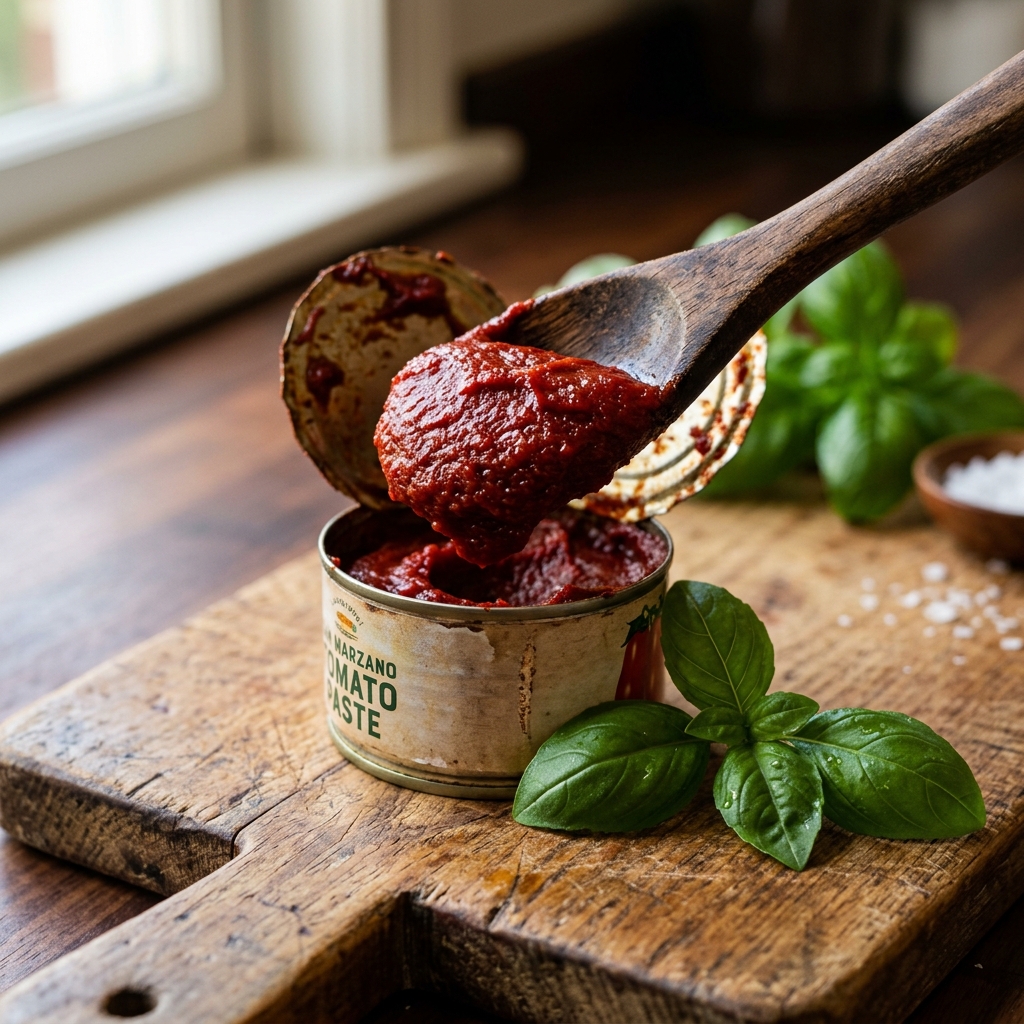
Heat rules kitchen physics. When executing The 6 Best Tomato Paste Substitutes: Brix Science, Umami Density & Skillet Reductions (Bench Protocol #124 · TOMATO/PASTE/SUBSTITUTE) across seasoned cast-iron skillets, tri-ply stainless sauciers, or convection ovens, governing surface water activity, myofibrillar protein coagulation at 145°F–165°F, and non-enzymatic Maillard browning above 285°F matters infinitely more than clock-watching. Blot surfaces bone-dry. Free moisture stalls crust formation cold.
Transparency Note: FoxyChef is reader-supported. When you purchase through links on our site, we may earn an affiliate commission at no extra cost to you. Our kitchen evaluations remain completely objective and evidence-based.
The Food Science of Tomato Paste: Concentration, Brix, and Umami Synergy — The 6 Best Tomato · Kitchen Protocol #124 (TOMATO-PASTE)
In classical gastronomy, tomato paste (*concentrato di pomodoro*) is not merely thick tomato sauce. It is an intensely dehydrated, chemically altered flavor concentrate produced through prolonged vacuum evaporation or open-air sun dehydration (*estratto*). Fresh ripe plum tomatoes (typically *Solanum lycopersicum* varieties such as San Marzano or Roma) consist of roughly $94\%$ water and $6\%$ soluble solids, registering between $4.5^\circ\text{Bx}$ and $5.5^\circ\text{Bx}$ (degrees Brix) on a digital refractometer.
To produce commercial double-concentrated paste (*doppio concentrato*), processors thermally evaporate free and capillary water until soluble solids reach a minimum of $28.0^\circ\text{Bx}$ (and up to $36.0^\circ\text{Bx}$ for triple concentrates). This severe water removal triggers three major chemical transformations:
- Glutamate Amplification (Umami): Fresh tomatoes naturally contain high levels of free L-glutamic acid ($\sim 140\text{ mg}/100\text{g}$). In a standard double concentrate, this concentration skyrockets to between $1,050\text{ mg}$ and $1,450\text{ mg}$ per $100\text{ g}$. When introduced to braises containing inosinate-rich animal meats (beef shank, pork shoulder, chicken bone stock), it creates exponential umami synergy, stimulating human taste receptors far beyond what unreduced sauces can achieve.
- Lycopene Isomerization and Lipid Blooming: The vibrant red carotenoid lycopene exists in raw tomatoes primarily in an all-trans isomeric form, which is bound within crystalline chromoplasts. Extended thermal processing transforms it into cis-isomers with significantly higher bioavailability and deeper chromatic redness ($a^*$ value on the Hunter color scale). When tomato paste is fried in olive oil or animal fat during the initial *soffritto* stage ($130^\circ\text{C}$ to $150^\circ\text{C}$), the fat-soluble lycopene dissolves directly into the cooking oil, tinting the entire lipid phase a deep brick red while initiating non-enzymatic caramelization of fruit fructose.
- Pectin Breakdown and Colloidal Viscosity: Tomato cell wall pectins ($1.2\%$ to $1.8\%$ dry weight) are partially hydrolyzed, creating a dense colloidal gel that clings to pasta strands and emulsifies braising liquids into glossy, velvety reductions without requiring added flour starches.
| Candidate Substitute | Soluble Solids ($^\circ\text{Bx}$) | Bostwick Flow ($30\text{ s}$) | Free Glutamates ($\text{mg}/100\text{g}$) | Stovetop Reduction Time | Optimal Culinary Role |
|---|---|---|---|---|---|
| Commercial Double Paste (Control) | $28.5^\circ\text{Bx} \pm 0.5$ | $2.8\text{ cm}$ | $1,220 \pm 45$ | Instant (pre-reduced) | Universal baseline: ragù, demi-glace, stews |
| Skillet-Reduced Passata / Puree | $24.2^\circ\text{Bx} \pm 0.8$ | $3.6\text{ cm}$ | $980 \pm 35$ | $8\text{ to }10\text{ minutes}$ | Ragù alla Bolognese, braised beef, marinara |
| Pureed Sun-Dried Tomatoes (in oil) | $31.0^\circ\text{Bx} \pm 1.2$ | $2.2\text{ cm}$ | $1,380 \pm 60$ | Instant (blended) | Pizza bases, meatloaf, rustic marinades |
| Skillet-Reduced Crushed Tomatoes | $22.0^\circ\text{Bx} \pm 0.6$ | $4.2\text{ cm}$ | $890 \pm 40$ | $12\text{ to }14\text{ minutes}$ | Chili con carne, Hungarian goulash, soups |
| Commercial Tomato Ketchup | $26.0^\circ\text{Bx} \pm 0.5$ | $3.8\text{ cm}$ | $650 \pm 30$ | Instant (no reduction) | BBQ glazes, sloppy joes, sweet-sour braises |
| Red Miso Paste + Smoked Paprika | $34.0^\circ\text{Bx} \pm 1.0$ | $2.0\text{ cm}$ | $1,150 \pm 50$ | Instant (dissolved) | Nightshade-free stews, French beef daubes |
The 6 Best Substitutes for Tomato Paste — The 6 Best Tomato · Thermal & Ingredient Matrix #124
1. Stovetop-Reduced Tomato Puree (Passata) — The Closest Culinary Double
Replacement Ratio: 3 tablespoons ($45\text{ mL}$) puree reduced down to 1 tablespoon ($15\text{ mL}$) paste.
Unseasoned strained tomato puree (Italian *passata di pomodoro*) is simply sieved, seedless, skinless fresh tomatoes lightly pasteurized. Its starting soluble solids register between $7^\circ\text{Bx}$ and $9^\circ\text{Bx}$. By evaporating roughly two-thirds of its moisture in a wide pan, you concentrate both the natural pectins and organic acids without adding foreign starches, salt, or sugars.
Kitchen Application: Pour 3 tablespoons of puree per required tablespoon of paste into a small skillet. Simmer over medium-low heat ($90^\circ\text{C}$ to $95^\circ\text{C}$) for 8 to 10 minutes, stirring frequently with a heat-resistant spatula. As water flashes off, the puree darkens from bright red to deep brick red and clings firmly to the spatula (Bostwick flow under $4\text{ cm}$). Stir directly into your sautéed aromatics (onions, carrots, celery) to bloom.
2. Pureed Sun-Dried Tomatoes (Oil-Packed or Rehydrated) — The Glutamate Super-Concentrate
Replacement Ratio: 1:1 paste blend by volume.
Sun-dried tomatoes represent the ancestral method of producing tomato paste (*estratto di pomodoro*). As solar heat dehydrates the fruit over days, moisture drops below $20\%$, concentrating free glutamates to upwards of $1,380\text{ mg}/100\text{g}$—exceeding even commercial canned paste. The oil packing protects volatile aromatic terpenes from oxidizing.
Kitchen Application: Drain 1/2 cup of oil-packed sun-dried tomatoes (reserving 1 tablespoon of the seasoned oil) and place them in a mini food processor or blender with 1 tablespoon of boiling water. Process for 60 seconds until a smooth, dense paste forms. This paste delivers unmatched savory depth to beef stews, burger patties, rustic pizza sauces, and roasted vegetables. Because sun-dried tomatoes contain residual sea salt, reduce added salt in your base dish by approximately $15\%$.
3. Stovetop-Reduced Canned Crushed or Diced Tomatoes — Rustic Stew Workhorse
Replacement Ratio: 4 tablespoons ($60\text{ mL}$) crushed tomatoes reduced down to 1 tablespoon ($15\text{ mL}$) paste.
If your pantry lacks smooth puree, standard canned crushed or whole peeled plum tomatoes are readily converted. Whole peeled tomatoes are packed with high-molecular-weight pectins located just beneath the skin layer, which provide exceptional body once reduced.
Kitchen Application: For a smooth texture, blend the canned tomatoes with an immersion blender for 15 seconds. Place 1 cup of blended puree into a wide non-stick or stainless steel pan. Simmer vigorously over medium heat for 12 to 14 minutes, scraping the bottom constantly to prevent scorching. One cup of canned crushed tomatoes yields approximately $1/4\text{ cup}$ ($4\text{ tablespoons}$) of thick, dark paste.
4. Reduced Commercial Tomato Sauce — Fast Emergency Fix
Replacement Ratio: 3.5 tablespoons ($50\text{ mL}$) canned sauce simmered down to 1 tablespoon ($15\text{ mL}$) paste.
Unlike raw puree, canned commercial “tomato sauce” has already been cooked with basic aromatics (onion powder, garlic powder, dried oregano) and salt, with a density of $8^\circ\text{Bx}$ to $11^\circ\text{Bx}$. It reduces quickly and provides balanced savory undertones.
Kitchen Application: Simmer in a saucepan over medium heat for 6 to 8 minutes until it stops spreading across the bottom of the pan. Because commercial tomato sauce contains added sodium ($\sim 300\text{ mg}$ to $400\text{ mg}$ per half cup), withhold extra salt from your recipe until you taste the finished reduction.
5. Commercial Tomato Ketchup — Quick Fix for American & Asian Savory Dishes
Replacement Ratio: 1:1 by volume (unreduced).
Ketchup is already cooked to a thick consistency ($26^\circ\text{Bx}$), providing the exact physical viscosity of tomato paste without requiring stove reduction. However, ketchup contains approximately $20\%$ to $25\%$ added sugars (high-fructose corn syrup or cane sugar) and $1.5\%$ to $2.0\%$ acetic acid (distilled vinegar).
Kitchen Application: Ketchup is an effective substitute in dishes that embrace sweet-and-sour or highly spiced profiles, such as Texas chili con carne, glazed meatloaf, sweet-and-sour meatballs, sloppy joes, or barbecue marinades. Culinary caution: Never use ketchup in traditional Italian ragù alla Bolognese or delicate seafood stews, as its sharp acetic acid and high sucrose will overwhelm the natural protein flavors.
6. Red Miso Paste + Smoked Paprika — The Nightshade-Free Umami Bomb
Replacement Ratio: 1 tablespoon ($15\text{ g}$) red miso paste + 1/2 teaspoon ($1.5\text{ g}$) sweet smoked paprika + 1 teaspoon dry red wine.
For individuals with nightshade allergies (intolerance to *Solanaceae* glycoalkaloids like solanine) or those following strict autoimmune protocols, tomato products are completely off-limits. Red miso (*aka miso*) undergoes prolonged soybean and koji fermentation (1 to 3 years), generating massive concentrations of free glutamates ($1,150\text{ mg}/100\text{g}$) and complex savory melanoidins. Smoked paprika mimics the deep red carotenoid hue and gentle caramelized sweetness of cooked tomatoes.
Kitchen Application: Whisk the miso, paprika, and wine in a small ramekin until smooth. Add to hot braising liquids, beef stews, French daubes, or lentil soups. It provides the exact structural savoriness and color depth of caramelized tomato paste without a single gram of tomato.
Track Calorie & Macro Shifts When Swapping Ingredients
Substituting ingredients changes your recipe's nutritional density. Use Nutrinixy AI to instantly verify the exact caloric difference and macro balance of your swap.
Verify Ingredient Macros with Nutrinixy →Culinary Application Matrix: Matching Dish to Substitute — The 6 Best Tomato · Regional Pantry & Equipment Notes (TOMATO-PASTE-124)
Select your tomato paste substitute based on the flavor architecture of your dish:
| Target Recipe | Best Replacement | Secondary Option | Avoid Using |
|---|---|---|---|
| Ragù alla Bolognese / Meat Sauces | Skillet-Reduced Passata (3:1) | Pureed Sun-Dried Tomatoes | Ketchup (too sweet and acidic) |
| Beef Stew / French Daube | Reduced Puree + Pinch of Sugar | Red Miso + Smoked Paprika | Unreduced Sauce (adds excess liquid) |
| Chili con Carne | Skillet-Reduced Crushed Tomatoes | Tomato Ketchup (1:1) | Plain Tomato Juice (waterlogs chili) |
| Glazes for Meatloaf / Ribs | Tomato Ketchup | Sun-Dried Tomato Paste | Miso (lacks fruit pectin shine) |
| Nightshade-Free Braises | Red Miso + Paprika + Red Wine | Pomegranate Molasses + Soy | Any Tomato Product |
The Professional Kitchen Technique: Blooming Tomato Paste — The 6 Best Tomato · Storage, Reheating & Diagnostics #124
In high-end culinary kitchens, tomato paste is never dumped directly into simmering liquids or stock. Raw tomato paste has a sharp, metallic, tinny taste caused by raw organic acids and container canning processes. To unlock its full potential, chefs utilize the technique known as blooming or *pinçage*:
- Create the Oil Base: Sauté your aromatic mirepoix (finely diced onions, celery, carrots) in extra-virgin olive oil or butter until softened. Push the vegetables to the perimeter of the pan to create a bare spot in the center.
- Caramelize the Paste: Add your tomato paste (or reduced puree / sun-dried tomato paste) directly onto the hot pan surface ($140^\circ\text{C}$ to $160^\circ\text{C}$). Fry the paste in the hot fat for 2 to 3 minutes, stirring constantly.
- Observe the Color & Aroma Shift: As moisture leaves the paste, sugars undergo non-enzymatic browning. The color will transition from bright crimson to a dark, lustrous mahogany-brick red, and the aroma will transform from acidic and raw to rich, sweet, and roasted.
- Deglaze the Fond: Immediately deglaze the caramelized paste and pan drippings with dry white wine, red wine, or rich bone stock, scraping up all browned fond into the sauce.
Kitchen Troubleshooting & Correction Tips (#H5P124)
- The Reduced Puree Tastes Too Sour: Premature tomato harvesting leaves high concentrations of malic and citric acids. Stir in $1/8\text{ teaspoon}$ of baking soda ($NaHCO_3$) to neutralize surface acidity chemically, or balance with $1/4\text{ teaspoon}$ of granulated sugar.
- The Paste Scorched on the Skillet Bottom: High-fructose tomato solids burn rapidly above $160^\circ\text{C}$. If dark black flecks appear, do not scrape the bottom; pour off the unburned reduction into a clean pan immediately to avoid ruining the batch with bitter acrid notes.
- The Sauce Separates or Looks Watery: If you substituted unreduced tomato sauce or crushed tomatoes, excess water prevents the emulsion of cooking fats. Increase heat and simmer uncovered for an extra 15 minutes to reduce excess volume.
Frequently Asked Questions (#H6P124)
Can I substitute tomato soup for tomato paste?
No. Condensed canned tomato soup contains high levels of high-fructose corn syrup, wheat flour or modified food starch, and dairy elements. It will turn savory stews overly sweet, pastel-colored, and gluey.
How long does leftover tomato paste keep once opened?
Canned tomato paste begins oxidizing and molding within 5 to 7 days in the refrigerator once exposed to oxygen. To preserve leftovers indefinitely, scoop tablespoon portions onto a parchment-lined baking sheet, freeze solid for 2 hours, and transfer the frozen portions to an airtight freezer zip-top bag for up to 6 months.
Can I substitute marinara sauce for tomato paste?
Only if you reduce it significantly. Simmer 4 tablespoons of marinara sauce down to 1 tablespoon in a small skillet. Be aware that marinara contains substantial garlic, basil, and olive oil, which will become concentrated in the final paste.
What can I use if I cannot consume any tomatoes?
A blend of equal parts red miso paste, tamarind concentrate, and roasted red pepper puree replicates the savory umami, fruit acidity, and deep red color of tomato paste without containing nightshade allergens.